1. Theme - P2 Rubric Crit. A
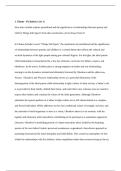
How does Achebe explore parenthood and the significance of relationships between parent and
child in Things Fall Apart? And what conclusions can be drawn from it?
In Chinua Achebe's novel "Things Fall Apart," the exploration of parenthood and the significance
of relationships between parents and children is a central theme that reflects the cultural and
societal dynamics of the Igbo people during pre-colonial Nigeria. For the Igbo, the ideal parent-
child relationship is characterized by a few key elements: reverence for fathers, respect, and
obedience. In the novel, Achebe places a strong emphasis on father and son relationships,
zeroing in on the dynamics strained and ultimately fractured by Okonkwo and his eldest son,
Nwoye. Okonkwo and Nwoye's relationship serves as a powerful illustration of the
disintegration of the ideal parent-child relationship in Igbo culture. In their society, a father's role
is to provide for their family, defend their honor, and teach their sons, whereas sons are raised to
respect their fathers and continue the values of the older generation. Although Okonkwo
embodies the typical qualities of a father in Igbo culture, he is still characterized as a complex
and flawed individual. While adherence to the clan's traditional values of strength, stoicism, and
the assertion of male hegemony is seen as a virtue, Okonkwo takes it to an extreme, with his
rigidity and obsession with masculinity contributing to his portrayal as a sometimes oppressive
character. Okonkwo's unyielding pursuit of a hyper-masculine ideal, fueled by the haunting
specter of his own father Unoka's perceived weaknesses, engendered a fear-driven approach to
parenting characterized by harsh discipline and inflexibility. This created an atmosphere of fear
within his relationships with his children, where trepidation rather than reverence hung in the air.
, Nwoye, in turn, does not view his father with admiration or respect but rather with perturbation.
In the novel, Nwoye emerges as a sensitive individual whose values deviate from societal norms.
However, this dichotomy between each character's values renders Okonkwo unable to accept the
truth, reflecting the difficulty in navigating change within a cultural framework that values
conformity. The resulting lack of understanding and empathy between father and son leads to a
breakdown in communication, propelling Nwoye toward alternative sources of guidance and
acceptance, highlighting the impact of parental insensitivity on an individual's search for identity
and belonging in a rapidly changing cultural landscape. Through exploring this symbolic
relationship between father and son in the novel, Achebe underscores the consequences that may
arise when families and societies struggle to navigate divergent belief systems, underlining the
importance of adaptability and understanding in the face of evolving cultural landscapes.
2. Analysis - P2 Rubric Crit. B
How does Achebe explore parenthood and the significance of relationships between parent and
child in Things Fall Apart? And what conclusions can be drawn from it?
In Chinua Achebe's novel "Things Fall Apart," the exploration of parenthood and the significance
of relationships between parents and children is a central theme that reflects the cultural and
societal dynamics of the Igbo people during pre-colonial Nigeria. For the Igbo, the ideal parent-
child relationship is characterized by a few key elements: reverence for fathers, respect, and
obedience. In the novel, Achebe places a strong emphasis on father and son relationships,
zeroing in on the dynamics strained and ultimately fractured by Okonkwo and his eldest son,
Nwoye. Okonkwo and Nwoye's relationship serves as a powerful illustration of the
disintegration of the ideal parent-child relationship in Igbo culture. In their society, a father's role
is to provide for their family, defend their honor, and teach their sons, whereas sons are raised to
respect their fathers and continue the values of the older generation. Although Okonkwo
embodies the typical qualities of a father in Igbo culture, he is still characterized as a complex
and flawed individual. While adherence to the clan's traditional values of strength, stoicism, and
the assertion of male hegemony is seen as a virtue, Okonkwo takes it to an extreme, with his
rigidity and obsession with masculinity contributing to his portrayal as a sometimes oppressive
character. Okonkwo's unyielding pursuit of a hyper-masculine ideal, fueled by the haunting
specter of his own father Unoka's perceived weaknesses, engendered a fear-driven approach to
parenting characterized by harsh discipline and inflexibility. This created an atmosphere of fear
within his relationships with his children, where trepidation rather than reverence hung in the air.
, Nwoye, in turn, does not view his father with admiration or respect but rather with perturbation.
In the novel, Nwoye emerges as a sensitive individual whose values deviate from societal norms.
However, this dichotomy between each character's values renders Okonkwo unable to accept the
truth, reflecting the difficulty in navigating change within a cultural framework that values
conformity. The resulting lack of understanding and empathy between father and son leads to a
breakdown in communication, propelling Nwoye toward alternative sources of guidance and
acceptance, highlighting the impact of parental insensitivity on an individual's search for identity
and belonging in a rapidly changing cultural landscape. Through exploring this symbolic
relationship between father and son in the novel, Achebe underscores the consequences that may
arise when families and societies struggle to navigate divergent belief systems, underlining the
importance of adaptability and understanding in the face of evolving cultural landscapes.
2. Analysis - P2 Rubric Crit. B