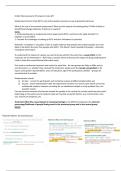
EC2A5: Microeconomic Principles II notes MT
Randomised Control Trials (RCT): visit all the parallel universes to see all potential outcomes
What is the use of an economic experiment? What are the impacts of enacting policy X? Who is likely to
benefit/lose/change behaviour if policy X is enacted?
Goals:
1. Understanding why a randomised control experiment (RCT) is said to be the “gold standard” to
establish a causal effect.
2. Consider the challenges of setting up RCTs and their limitations (in practice)
Reminder: correlation ≠ causation. There is ample evidence that people who visited hospitals are more
likely to die within the year than people who didn’t. This doesn’t mean hospitals kill people – obviously
missing key information.
To understand the impact of a policy, we need to know whether the policy has a causal effect on the
outcomes we are interested in – RCTs help us answer where to find out the impact of doing anything we’d
need to know the counterfactual (alternative case).
First need to randomise treatment and control to avoid bias - the two groups are likely to differ only in
one dimension, i.e. whether they received the treatment. Ideally want the sample composition to be
equal: same gender representation, years of education, age of the participants, abilities – groups are
counterfactual to another.
Randomisation checks
1) Ex ante - screen the participants and randomise using a stratified sample before exp
2) Ex post - check randomisation after the experiment has been run and to some extent correct for
unbalanced samples, however correcting for an unbalanced sample is rarely problem free, can
question results.
Can we convince someone that had we treated the people in the control the results would stay the same?
Depending on the policy we are trying to study we may look at specific factors, e.g. income levels, class
size, severity of symptoms, etc.
Treatment effect (the causal impact of receiving training) as the difference between the amount/
percentage/likelihood of people finding work in the treatment group and in the control group.
Model
,BUT experiments don’t always lead to causal effects as they may fall short of the golden standard:
1. Failure to follow experimental protocol
2. Attrition: reduction in numbers
3. Experimental effects
4. External validity
1) Failure to follow protocol: Some people may be disappointed when allocated to a given group and
might persuade other people involved in the experiment to take the treatment on the side, common w/
medical treatments: many of the people not selected for experimental treatments try to find alternative
ways to receive the drugs
2) Attrition: people may simply drop out of the experiment This is not an issue per se: if people randomly
drop out in both the treatment and control groups
But it might induce sample selection: distortion in a measure of association due to a sample selection
that does not accurately reflect the target population e.g. what if the people dropping out of your training
programme are the ones who already found a job? This makes comparing the treatment and control
groups much harder.
3) Experimental effects: The mere fact that a person knows that they are taking part in an experiment
might change their behaviour, good practice to give a placebo in clinical trials
4)External validity: people react to the context they live in - The impact of a policy can change when the
policy is scaled up (“general equilibrium effects”) and is unlikely to be uniform across geography and time
RCTs don’t tell the whole story - specifically, they don’t tell us how we should modify them to take other
events into account. Repeated extrapolation might suggest that a policy work...until it doesn’t! The
pandemic has taught us a lot about this, even experiments have limits not just feasibility.
Consumer Theory: what are we trying to achieve?
(Neoclassical) consumer theory gives us a framework to understand people’s decisions:
-what to consume with a limited budget -> uncompensated demands;
-how to minimise the cost of obtaining a given level of utility -> compensated demands;
-how much labour to provide to the market; how much to save/borrow...
This naturally leads to questions about what happens when the prices/ incomes/ wages/ taxes/ interest
rates change -> people’s welfare
We assume that individuals are rational decision-makers who attempt to maximise their utility,
downward sloping demand and which consumption bundle each consumer chooses will depend on their
preferences which can be represented by indifference curves:
But of course, we don’t always act “rationally”. Daniel Kahneman in his seminal work
“Thinking Fast and Slow” proposes 2 systems of thought:
,1. System 1: decisions we make quickly, emotionally, lack of info (and where we are likely to go wrong)
2. System 2: the homo economicus system, we make some slow and deliberate decisions
Utilising maximising agents
To understand critiques to the neoclassical model of consumer theory we need to understand its building
blocks.
Utility function: Consumers’ utility in these models depends on their individual consumption of goods and
services U(x1,...,xn) = f(x1,...,xn) and this is a number
Critique #1: we observe many people who don’t seem to care only about themselves, should we expand this
framework – eg spending money on other people consumption? Possibly, but adding preferences for other
people’s consumption doesn’t break the model
A natural question is then which assumptions are needed for these models to be meaningful and whether
critiques to those assumptions create more fundamental issues
Modern consumer theory assumes that preferences are:
1. Complete: people know how to rank any two bundles
2. Transitive: people are consistent in their ranking
3. Continuous: people know how to value even marginal amount of a good
4. Non-satiated: more is always better (or at least never bad)
5. Convex: people prefer averages to extremes
1. Completeness
We assume that people know how to rank any two bundles and tell us: A ⪰ B or B ⪰ A
Or equivalently:
u(x1A,...,xnA) ⪰ u(x1B,...,xnB) utility is higher Critique #2: can people really rank any two bundles – people do
not have perfect information and may not know these goods or how they impact their utility.
2. Transitivity
We assume that people are consistent in their ranking: if bundle A is preferred to bundle B and bundle B is
preferred to bundle C bundle A is preferred to bundle C
if A ⪰ B and B ⪰ C then A ⪰ C which means u(A) ≥ u(B) ≥ u(C)
Critique #3: people’s preferences might be context- dependent and/or intransitive eg knowing that Arsenal
beat ManU and ManU beat Wolves doesn’t mean that Arsenal will beat Wolves, if it rains we may pay more for
a cab even if we prefer walking (can separate these goods eg x1=walking dry, x2=walking in rain)
3. Continuity
If prefer the indifference curve with highest utlity eg A over B – bundle with more of both
goods, then should prefer A to C (largest to tiniest)
Critique #4: it’s hard to imagine even discerning tiny differences, people typically round
numbers to the nearest integer – people make time saving quick decisions without always
evaluating all options
Assumptions 1-3: implications
Start consumer theory by assuming that people can tell us if they prefer one bundle over another
If completeness, transitivity and continuity hold, we can write utility function that represents those
preferences
For any utility function, e.g. u(x1, x2) = x1x2 we can find (infinitely many) indifference curves, one for each
level of utility and show where the consumer is better off.
But we’re still not saying how much people prefer a bundle to another, that is utility is
ordinal/rankable
4.Non-Satiation
More of what gives us utility is better (or in any case never worse)
Critique #5: for at least some goods non-satiation is a very bad assumption
Non-satiation is an important assumption!
Non-satiation tells us that people derive utility from higher consumption. Note we don’t
care about people’s incomes, we only care about their utility. So non-satiation is really
, telling us that people will want to spend any extra money they make, because spending it makes them
consume more of the goods they like and raises their utility
If we assume that people’s preferences are non-satiated we can move from a budget constraint (all the
combinations of goods people can afford) to a budget line (all the combinations of goods such that all income
is spent)
5.Convexity
We assume that the preferred set is convex - means that people prefer average
bundles to extreme ones.
Consider an average of bundles A and B, no matter which weight we pick, any
intermediate bundle lies in the preferred set and would lead to a higher utility.
Many times people do prefer extremes to averages. In many countries in the world
people like to consume tea and coffee but not both at the same time -> A cup filled
with coffee and tea (an average bundle) isn’t appealing for many.
Critique #5: convexity is not always a good assumption
Diminishing marginal utility
consuming more of the same good continues
to increase our utility, but at a decreasing
rate.
Applies to convexity assumption - If we like
both goods mixing between them is a good
idea to obtain the highest possible utility
Consumer theory: what happens if the income/prices change?
Consumers will maximise utility by setting the marginal rate of substitution (the slope of their indifference
curve) equal to the price ratio
Optimally MRS = (∂u/∂x1) / (∂u/∂x2) = p1 / p2 where p1 is the price of good 1 and p2 the price of good 2.
The left-hand side of the equation depends on the preferences so it’s relatively fixed at a point in time, but the
right-hand side can change!
This means that consumers will adjust how much of each good they demand based on: 1) the (marginal) utility
they receive from each good and 2) the prices of goods 1 and 2
Substitution effect
We can see the MRS= price ratio condition as MU1/p1 = MU2/p2 (optimal bundle)
1. when p1 increases or p2 decreases good 2 is relatively cheaper than good 1 and consumers
will substitute away from x1 to consume more x2
2. when p1 decreases or p2 increases good 2 is relatively more expensive than good 1 and
consumers will substitute away from x2 to consume more x1
The substitution effect tells us that (whenever possible) we should consume less of the relatively more
expensive good and more of the relatively cheaper good.
Income effect
Randomised Control Trials (RCT): visit all the parallel universes to see all potential outcomes
What is the use of an economic experiment? What are the impacts of enacting policy X? Who is likely to
benefit/lose/change behaviour if policy X is enacted?
Goals:
1. Understanding why a randomised control experiment (RCT) is said to be the “gold standard” to
establish a causal effect.
2. Consider the challenges of setting up RCTs and their limitations (in practice)
Reminder: correlation ≠ causation. There is ample evidence that people who visited hospitals are more
likely to die within the year than people who didn’t. This doesn’t mean hospitals kill people – obviously
missing key information.
To understand the impact of a policy, we need to know whether the policy has a causal effect on the
outcomes we are interested in – RCTs help us answer where to find out the impact of doing anything we’d
need to know the counterfactual (alternative case).
First need to randomise treatment and control to avoid bias - the two groups are likely to differ only in
one dimension, i.e. whether they received the treatment. Ideally want the sample composition to be
equal: same gender representation, years of education, age of the participants, abilities – groups are
counterfactual to another.
Randomisation checks
1) Ex ante - screen the participants and randomise using a stratified sample before exp
2) Ex post - check randomisation after the experiment has been run and to some extent correct for
unbalanced samples, however correcting for an unbalanced sample is rarely problem free, can
question results.
Can we convince someone that had we treated the people in the control the results would stay the same?
Depending on the policy we are trying to study we may look at specific factors, e.g. income levels, class
size, severity of symptoms, etc.
Treatment effect (the causal impact of receiving training) as the difference between the amount/
percentage/likelihood of people finding work in the treatment group and in the control group.
Model
,BUT experiments don’t always lead to causal effects as they may fall short of the golden standard:
1. Failure to follow experimental protocol
2. Attrition: reduction in numbers
3. Experimental effects
4. External validity
1) Failure to follow protocol: Some people may be disappointed when allocated to a given group and
might persuade other people involved in the experiment to take the treatment on the side, common w/
medical treatments: many of the people not selected for experimental treatments try to find alternative
ways to receive the drugs
2) Attrition: people may simply drop out of the experiment This is not an issue per se: if people randomly
drop out in both the treatment and control groups
But it might induce sample selection: distortion in a measure of association due to a sample selection
that does not accurately reflect the target population e.g. what if the people dropping out of your training
programme are the ones who already found a job? This makes comparing the treatment and control
groups much harder.
3) Experimental effects: The mere fact that a person knows that they are taking part in an experiment
might change their behaviour, good practice to give a placebo in clinical trials
4)External validity: people react to the context they live in - The impact of a policy can change when the
policy is scaled up (“general equilibrium effects”) and is unlikely to be uniform across geography and time
RCTs don’t tell the whole story - specifically, they don’t tell us how we should modify them to take other
events into account. Repeated extrapolation might suggest that a policy work...until it doesn’t! The
pandemic has taught us a lot about this, even experiments have limits not just feasibility.
Consumer Theory: what are we trying to achieve?
(Neoclassical) consumer theory gives us a framework to understand people’s decisions:
-what to consume with a limited budget -> uncompensated demands;
-how to minimise the cost of obtaining a given level of utility -> compensated demands;
-how much labour to provide to the market; how much to save/borrow...
This naturally leads to questions about what happens when the prices/ incomes/ wages/ taxes/ interest
rates change -> people’s welfare
We assume that individuals are rational decision-makers who attempt to maximise their utility,
downward sloping demand and which consumption bundle each consumer chooses will depend on their
preferences which can be represented by indifference curves:
But of course, we don’t always act “rationally”. Daniel Kahneman in his seminal work
“Thinking Fast and Slow” proposes 2 systems of thought:
,1. System 1: decisions we make quickly, emotionally, lack of info (and where we are likely to go wrong)
2. System 2: the homo economicus system, we make some slow and deliberate decisions
Utilising maximising agents
To understand critiques to the neoclassical model of consumer theory we need to understand its building
blocks.
Utility function: Consumers’ utility in these models depends on their individual consumption of goods and
services U(x1,...,xn) = f(x1,...,xn) and this is a number
Critique #1: we observe many people who don’t seem to care only about themselves, should we expand this
framework – eg spending money on other people consumption? Possibly, but adding preferences for other
people’s consumption doesn’t break the model
A natural question is then which assumptions are needed for these models to be meaningful and whether
critiques to those assumptions create more fundamental issues
Modern consumer theory assumes that preferences are:
1. Complete: people know how to rank any two bundles
2. Transitive: people are consistent in their ranking
3. Continuous: people know how to value even marginal amount of a good
4. Non-satiated: more is always better (or at least never bad)
5. Convex: people prefer averages to extremes
1. Completeness
We assume that people know how to rank any two bundles and tell us: A ⪰ B or B ⪰ A
Or equivalently:
u(x1A,...,xnA) ⪰ u(x1B,...,xnB) utility is higher Critique #2: can people really rank any two bundles – people do
not have perfect information and may not know these goods or how they impact their utility.
2. Transitivity
We assume that people are consistent in their ranking: if bundle A is preferred to bundle B and bundle B is
preferred to bundle C bundle A is preferred to bundle C
if A ⪰ B and B ⪰ C then A ⪰ C which means u(A) ≥ u(B) ≥ u(C)
Critique #3: people’s preferences might be context- dependent and/or intransitive eg knowing that Arsenal
beat ManU and ManU beat Wolves doesn’t mean that Arsenal will beat Wolves, if it rains we may pay more for
a cab even if we prefer walking (can separate these goods eg x1=walking dry, x2=walking in rain)
3. Continuity
If prefer the indifference curve with highest utlity eg A over B – bundle with more of both
goods, then should prefer A to C (largest to tiniest)
Critique #4: it’s hard to imagine even discerning tiny differences, people typically round
numbers to the nearest integer – people make time saving quick decisions without always
evaluating all options
Assumptions 1-3: implications
Start consumer theory by assuming that people can tell us if they prefer one bundle over another
If completeness, transitivity and continuity hold, we can write utility function that represents those
preferences
For any utility function, e.g. u(x1, x2) = x1x2 we can find (infinitely many) indifference curves, one for each
level of utility and show where the consumer is better off.
But we’re still not saying how much people prefer a bundle to another, that is utility is
ordinal/rankable
4.Non-Satiation
More of what gives us utility is better (or in any case never worse)
Critique #5: for at least some goods non-satiation is a very bad assumption
Non-satiation is an important assumption!
Non-satiation tells us that people derive utility from higher consumption. Note we don’t
care about people’s incomes, we only care about their utility. So non-satiation is really
, telling us that people will want to spend any extra money they make, because spending it makes them
consume more of the goods they like and raises their utility
If we assume that people’s preferences are non-satiated we can move from a budget constraint (all the
combinations of goods people can afford) to a budget line (all the combinations of goods such that all income
is spent)
5.Convexity
We assume that the preferred set is convex - means that people prefer average
bundles to extreme ones.
Consider an average of bundles A and B, no matter which weight we pick, any
intermediate bundle lies in the preferred set and would lead to a higher utility.
Many times people do prefer extremes to averages. In many countries in the world
people like to consume tea and coffee but not both at the same time -> A cup filled
with coffee and tea (an average bundle) isn’t appealing for many.
Critique #5: convexity is not always a good assumption
Diminishing marginal utility
consuming more of the same good continues
to increase our utility, but at a decreasing
rate.
Applies to convexity assumption - If we like
both goods mixing between them is a good
idea to obtain the highest possible utility
Consumer theory: what happens if the income/prices change?
Consumers will maximise utility by setting the marginal rate of substitution (the slope of their indifference
curve) equal to the price ratio
Optimally MRS = (∂u/∂x1) / (∂u/∂x2) = p1 / p2 where p1 is the price of good 1 and p2 the price of good 2.
The left-hand side of the equation depends on the preferences so it’s relatively fixed at a point in time, but the
right-hand side can change!
This means that consumers will adjust how much of each good they demand based on: 1) the (marginal) utility
they receive from each good and 2) the prices of goods 1 and 2
Substitution effect
We can see the MRS= price ratio condition as MU1/p1 = MU2/p2 (optimal bundle)
1. when p1 increases or p2 decreases good 2 is relatively cheaper than good 1 and consumers
will substitute away from x1 to consume more x2
2. when p1 decreases or p2 increases good 2 is relatively more expensive than good 1 and
consumers will substitute away from x2 to consume more x1
The substitution effect tells us that (whenever possible) we should consume less of the relatively more
expensive good and more of the relatively cheaper good.
Income effect