Thermodynamics
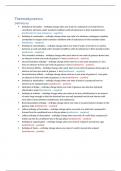
Definitions
Enthalpy of formation – enthalpy change when one mole of a substance is formed from its
constituent elements under standard conditions with all substances in their standard states
(exothermic for most substances – negative)
Enthalpy of combustion – enthalpy change when one mole of a substance undergoes complete
combustion in oxygen under standard conditions with all substances in their standard states
(exothermic – negative)
Enthalpy of neutralisation – enthalpy change when one mole of water is formed in a reaction
between an acid and alkali under standard conditions with all substances in their standard states
(exothermic – negative)
First ionisation enthalpy – enthalpy change when each atom in one mole of gaseous atoms loses
an electron to form one mole of gaseous 1+ ions (endothermic – positive)
Second ionisation enthalpy – enthalpy change when each ion in one mole of gaseous 1+ ions
loses an electron to form one mole of gaseous 2+ ions (endothermic – positive)
First electron affinity – enthalpy change when each atom in one mole of gaseous atoms gains an
electron to form one mole of gaseous 1- ions (exothermic – negative)
Second electron affinity – enthalpy change when each ion in one mole of gaseous 1- ions gains
an electron to form one mole of gaseous 2- ions (endothermic – positive)
Enthalpy of atomisation – enthalpy change when one mole of atoms is produced from an
element in its standard state (endothermic – positive)
Hydration enthalpy – enthalpy change when one mole of gaseous ions become hydrated
(dissolved in water) (exothermic – negative)
Enthalpy of solution – enthalpy change when one mole of an ionic solid dissolves in an amount
of water large enough so that the dissolved ions are well separated and do not interact with
each other (varies between endothermic and exothermic)
Bond dissociation enthalpy – enthalpy change when one mole of covalent bonds is broken in the
gaseous state (endothermic – positive)
Lattice enthalpy of formation – enthalpy change when one mole of a solid ionic compound is
formed from its constituent ions in the gas phase (exothermic – negative)
Lattice enthalpy of dissociation – enthalpy change when one mole of a solid ionic compound is
broken up into its constituent ions in the gas phase (endothermic – positive)
Enthalpy of vapourisation – enthalpy change when one mole of a liquid is turned into a gas
(endothermic – positive)
Enthalpy of fusion – enthalpy change when one mole of a solid is turned into a liquid
(endothermic – positive)
Definitions
Enthalpy of formation – enthalpy change when one mole of a substance is formed from its
constituent elements under standard conditions with all substances in their standard states
(exothermic for most substances – negative)
Enthalpy of combustion – enthalpy change when one mole of a substance undergoes complete
combustion in oxygen under standard conditions with all substances in their standard states
(exothermic – negative)
Enthalpy of neutralisation – enthalpy change when one mole of water is formed in a reaction
between an acid and alkali under standard conditions with all substances in their standard states
(exothermic – negative)
First ionisation enthalpy – enthalpy change when each atom in one mole of gaseous atoms loses
an electron to form one mole of gaseous 1+ ions (endothermic – positive)
Second ionisation enthalpy – enthalpy change when each ion in one mole of gaseous 1+ ions
loses an electron to form one mole of gaseous 2+ ions (endothermic – positive)
First electron affinity – enthalpy change when each atom in one mole of gaseous atoms gains an
electron to form one mole of gaseous 1- ions (exothermic – negative)
Second electron affinity – enthalpy change when each ion in one mole of gaseous 1- ions gains
an electron to form one mole of gaseous 2- ions (endothermic – positive)
Enthalpy of atomisation – enthalpy change when one mole of atoms is produced from an
element in its standard state (endothermic – positive)
Hydration enthalpy – enthalpy change when one mole of gaseous ions become hydrated
(dissolved in water) (exothermic – negative)
Enthalpy of solution – enthalpy change when one mole of an ionic solid dissolves in an amount
of water large enough so that the dissolved ions are well separated and do not interact with
each other (varies between endothermic and exothermic)
Bond dissociation enthalpy – enthalpy change when one mole of covalent bonds is broken in the
gaseous state (endothermic – positive)
Lattice enthalpy of formation – enthalpy change when one mole of a solid ionic compound is
formed from its constituent ions in the gas phase (exothermic – negative)
Lattice enthalpy of dissociation – enthalpy change when one mole of a solid ionic compound is
broken up into its constituent ions in the gas phase (endothermic – positive)
Enthalpy of vapourisation – enthalpy change when one mole of a liquid is turned into a gas
(endothermic – positive)
Enthalpy of fusion – enthalpy change when one mole of a solid is turned into a liquid
(endothermic – positive)