Unit 14C
STRUCTURAL ISOMERISM
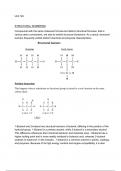
Compounds with the same molecular formula but distinct structural formulas, that is
various atom connections, are said to exhibit structural isomerism. As a result, structural
isomers frequently exhibit distinct chemical and physical characteristics.
Position Isomerism
This happens when a substituent or functional group is joined to a new location on the same
carbon chain.
1-Butanol and 2-butanol are structural isomers of butanol, differing in the position of the
hydroxyl group. 1-Butanol is a primary alcohol, while 2-butanol is a secondary alcohol.
This difference influences their chemical behavior and industrial uses. 1-Butanol has a
higher boiling point and is more readily oxidized to butanoic acid, whereas 2-butanol
oxidizes to butanone. In the industry , 1-butanol is a common solvent in paints, coatings,
and polymers. Because of its high energy content and engine compatibility, it is also
,receiving interest as a possible biofuel. As a carrier solvent, it is also used in cosmetics
and medications. The main commercial usage of 2-butanol, on the other hand, is as a
precursor to the significant solvent methyl ethyl ketone. While it is also utilised in
antifreeze, coatings, and occasionally cosmetics, its function is more specialised.
Because of its flexibility and promise for renewable energy, 1-butanol generally has
more industrial uses and more economic relevance.
Chain Isomerism
Molecules with the same chemical formula but distinct carbon chain architectures are
said to exhibit chain isomerism, often referred to as skeletal isomerism. This indicates
that while their atom counts and kinds are the same their primary chain configurations,
especially those of the carbon atoms, differ.
Butane and isobutane are structural isomers with the same molecular formula but
different arrangements of atoms, leading to distinct physical properties and industrial
uses. Butane, or n-butane, is a straight-chain alkane, while isobutane has a branched
structure.
This structural difference gives butane a slightly higher boiling point compared to
isobutane, making it more suitable for certain applications involving liquefied gas
storage. In industry, both are commonly used as fuels and propellants.Lighters, portable
stoves, and petrochemical production—particularly the synthesis of butadiene, a
necessary monomer for synthetic rubber—all frequently employ butane as a feedstock.
However, in the refining sector, isobutane is especially valuable as a feedstock for the
alkylation process, which creates high-octane petrol components. Because of its
advantageous vapour pressure properties and lower boiling point, it is also frequently
utilised as an aerosol propellant and refrigerant. Although both are significant, butane's
strength is in its wider application as a general-purpose fuel and chemical feedstock,
while isobutane has greater strategic importance in fuel refining and consumer goods.
, Functional Group isomerism
This is a type of structural isomerism that describes compounds with the same
molecular formula but has different functional groups.
This indicates that the molecules are members of distinct homologous series and
families of chemicals. Propanol and propanone, for example, both have the formula
C3H6O, but they differ in the carbonyl group C=O that they contain as a functional
group.
Propanal and propanone are both three-carbon compounds containing a carbonyl
group, however they have different structures and chemical classifications. Propanal is
an aldehyde, with the carbonyl group located at the end of the carbon chain, while
propanone (commonly known as acetone) is a ketone, with the carbonyl group bonded
to two carbon atoms in the middle of the chain. Their responsiveness and applicability
are greatly impacted by this variation. Because of its aldehyde group, propanal is more
reactive, which makes it a valuable intermediary in the production of plastics, perfumes,
and medications. Compared to ketones, it is less stable and more likely to oxidise.
Conversely, propanone is a very stable and adaptable solvent that finds extensive
usage in sectors including polymers, medicines, and cosmetics. It is also a crucial
component of nail polish remover and a crucial step in the creation of organic
compounds. Propanone is significantly more common in industry because of its stability,
low toxicity, and wide range of solvent uses, whereas propanal is mostly utilised in more
specialised chemical synthesis. Despite this, both molecules are useful.
Stereoisomerism
STRUCTURAL ISOMERISM
Compounds with the same molecular formula but distinct structural formulas, that is
various atom connections, are said to exhibit structural isomerism. As a result, structural
isomers frequently exhibit distinct chemical and physical characteristics.
Position Isomerism
This happens when a substituent or functional group is joined to a new location on the same
carbon chain.
1-Butanol and 2-butanol are structural isomers of butanol, differing in the position of the
hydroxyl group. 1-Butanol is a primary alcohol, while 2-butanol is a secondary alcohol.
This difference influences their chemical behavior and industrial uses. 1-Butanol has a
higher boiling point and is more readily oxidized to butanoic acid, whereas 2-butanol
oxidizes to butanone. In the industry , 1-butanol is a common solvent in paints, coatings,
and polymers. Because of its high energy content and engine compatibility, it is also
,receiving interest as a possible biofuel. As a carrier solvent, it is also used in cosmetics
and medications. The main commercial usage of 2-butanol, on the other hand, is as a
precursor to the significant solvent methyl ethyl ketone. While it is also utilised in
antifreeze, coatings, and occasionally cosmetics, its function is more specialised.
Because of its flexibility and promise for renewable energy, 1-butanol generally has
more industrial uses and more economic relevance.
Chain Isomerism
Molecules with the same chemical formula but distinct carbon chain architectures are
said to exhibit chain isomerism, often referred to as skeletal isomerism. This indicates
that while their atom counts and kinds are the same their primary chain configurations,
especially those of the carbon atoms, differ.
Butane and isobutane are structural isomers with the same molecular formula but
different arrangements of atoms, leading to distinct physical properties and industrial
uses. Butane, or n-butane, is a straight-chain alkane, while isobutane has a branched
structure.
This structural difference gives butane a slightly higher boiling point compared to
isobutane, making it more suitable for certain applications involving liquefied gas
storage. In industry, both are commonly used as fuels and propellants.Lighters, portable
stoves, and petrochemical production—particularly the synthesis of butadiene, a
necessary monomer for synthetic rubber—all frequently employ butane as a feedstock.
However, in the refining sector, isobutane is especially valuable as a feedstock for the
alkylation process, which creates high-octane petrol components. Because of its
advantageous vapour pressure properties and lower boiling point, it is also frequently
utilised as an aerosol propellant and refrigerant. Although both are significant, butane's
strength is in its wider application as a general-purpose fuel and chemical feedstock,
while isobutane has greater strategic importance in fuel refining and consumer goods.
, Functional Group isomerism
This is a type of structural isomerism that describes compounds with the same
molecular formula but has different functional groups.
This indicates that the molecules are members of distinct homologous series and
families of chemicals. Propanol and propanone, for example, both have the formula
C3H6O, but they differ in the carbonyl group C=O that they contain as a functional
group.
Propanal and propanone are both three-carbon compounds containing a carbonyl
group, however they have different structures and chemical classifications. Propanal is
an aldehyde, with the carbonyl group located at the end of the carbon chain, while
propanone (commonly known as acetone) is a ketone, with the carbonyl group bonded
to two carbon atoms in the middle of the chain. Their responsiveness and applicability
are greatly impacted by this variation. Because of its aldehyde group, propanal is more
reactive, which makes it a valuable intermediary in the production of plastics, perfumes,
and medications. Compared to ketones, it is less stable and more likely to oxidise.
Conversely, propanone is a very stable and adaptable solvent that finds extensive
usage in sectors including polymers, medicines, and cosmetics. It is also a crucial
component of nail polish remover and a crucial step in the creation of organic
compounds. Propanone is significantly more common in industry because of its stability,
low toxicity, and wide range of solvent uses, whereas propanal is mostly utilised in more
specialised chemical synthesis. Despite this, both molecules are useful.
Stereoisomerism