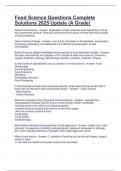
Food Science Questions Complete
Solutions 2025 Update (A Grade)
Define Food Science - Answer- Application of basic sciences and engineering to study
the fundamental physical, chemical, and biochemical nature of foods and the principles
of food processing
Define Food technology - Answer- Use of that information in the selection, preservation,
processing, packaging, and distribution as if affects the consumption of safe
commodities
Basic all around subject knowledge that is required by food scientists includes - Answer-
the basic requirements for a degree in FST include at least one course of: Chemistry,
Organic Chemistry, Biology, Microbiology, Nutrition, Calculus, Statistics, Physics
In what areas of specialization can you branch in to food science - Answer- Food
Microbiology
Food Engineering
Food Chemistry
Marketing
Psychology (Sensory)
Food Processing
In the times before food science became popular, what areas of study would most of
those with an interest in food commodities study? - Answer- - Dairy Science
- Meat Science
- Cereal Chemists
What are examples of the things that food scientist do - Answer- -Develop low
cost/palatable/nutritious food for those in need (nearly 2 billion worldwide)
-Develop food for the military and space programs
-Industrial work to process and improve current food supply
-Alter the nutrition content of food
-Food safety
-Food quality
-Biotechnology
What factors influence the perceptions of food apperance - Answer- shape, size, color,
structure, transparency (turbidity), dullness (gloss), degree of wholeness or damage.
(Ex: Color indicates ripeness or strength) (Size: large eggs over small)
What is food texture - Answer- 1. qualities of food that can be felt with fingers, tongue,
palate or teeth
2. can also be indicative of quality (mushy fruit, dry bread)
, 3. RHEOLOGY: science of deformation and flow of matter (how food reacts when
pressure is applied )
Define Rheology and examples - Answer- science of deformation and flow of matter
Elastic: property of a solid (like a coiled spring), will it return when smushed?
Viscosity: property of a liquid (resistance to flow) water is less viscous that ketchup
Plastic: substance that can be molded (warm chocolate, shortening)
What are some aspects of food flavor - Answer- 1. mostly subjective (taste and aroma)
2. Index of quality (old food looks and smells bad)
3. salt, sweet, sour, bitter, umami (MSG and other savory flavor enhancers)
What factors can affect taste sensitivity - Answer- -depends on the length of time to
taste a substance, and how concentrated it is
-THRESHOLD concentration is required for identification of a substance (can vary)
-temperature can affect it, hot foods generally taste stronger
-Psychology can affect as well, preconceived ideas based on appearance or previous
experience
what is sensory tasting? - Answer- Using one or more of the senses to evaluate food
-uses taste panels to sample food under controlled conditions (color, sound, temp, etc)
-does not substitute for tasting by consumers
explain the different tests use in sensory testing - Answer- -Triangle (identify the sample
that is different)
-Duo-Trio (Give a reference and identify match among two other samples)
-Acceptance/Preference (general public, large numbers)
-Descriptive (highly trained, small group)
what is the objective food testing - Answer- -Use of physical and chemical techniques to
evaluate food quality (use of equipment)
-Provide routine testing of products
Ex. Color difference meter, spectrophotometer, viscometers, chromatography
-Tests are repeatable, not subject to human error
Why is water important in food science - Answer- -Present in almost all living things,
including food.
-Essential for life, but no calories
-Involved in most food processing techniques (freezing, drying, emulsion, gels, bread)
-Important solvent and dispersing medium
What is the chemical formula for water? Draw a water molecule - Answer- H2O
what makes water a polar molecule? - Answer- slight positive charge on one side and a
slight negative charge on the other
Solutions 2025 Update (A Grade)
Define Food Science - Answer- Application of basic sciences and engineering to study
the fundamental physical, chemical, and biochemical nature of foods and the principles
of food processing
Define Food technology - Answer- Use of that information in the selection, preservation,
processing, packaging, and distribution as if affects the consumption of safe
commodities
Basic all around subject knowledge that is required by food scientists includes - Answer-
the basic requirements for a degree in FST include at least one course of: Chemistry,
Organic Chemistry, Biology, Microbiology, Nutrition, Calculus, Statistics, Physics
In what areas of specialization can you branch in to food science - Answer- Food
Microbiology
Food Engineering
Food Chemistry
Marketing
Psychology (Sensory)
Food Processing
In the times before food science became popular, what areas of study would most of
those with an interest in food commodities study? - Answer- - Dairy Science
- Meat Science
- Cereal Chemists
What are examples of the things that food scientist do - Answer- -Develop low
cost/palatable/nutritious food for those in need (nearly 2 billion worldwide)
-Develop food for the military and space programs
-Industrial work to process and improve current food supply
-Alter the nutrition content of food
-Food safety
-Food quality
-Biotechnology
What factors influence the perceptions of food apperance - Answer- shape, size, color,
structure, transparency (turbidity), dullness (gloss), degree of wholeness or damage.
(Ex: Color indicates ripeness or strength) (Size: large eggs over small)
What is food texture - Answer- 1. qualities of food that can be felt with fingers, tongue,
palate or teeth
2. can also be indicative of quality (mushy fruit, dry bread)
, 3. RHEOLOGY: science of deformation and flow of matter (how food reacts when
pressure is applied )
Define Rheology and examples - Answer- science of deformation and flow of matter
Elastic: property of a solid (like a coiled spring), will it return when smushed?
Viscosity: property of a liquid (resistance to flow) water is less viscous that ketchup
Plastic: substance that can be molded (warm chocolate, shortening)
What are some aspects of food flavor - Answer- 1. mostly subjective (taste and aroma)
2. Index of quality (old food looks and smells bad)
3. salt, sweet, sour, bitter, umami (MSG and other savory flavor enhancers)
What factors can affect taste sensitivity - Answer- -depends on the length of time to
taste a substance, and how concentrated it is
-THRESHOLD concentration is required for identification of a substance (can vary)
-temperature can affect it, hot foods generally taste stronger
-Psychology can affect as well, preconceived ideas based on appearance or previous
experience
what is sensory tasting? - Answer- Using one or more of the senses to evaluate food
-uses taste panels to sample food under controlled conditions (color, sound, temp, etc)
-does not substitute for tasting by consumers
explain the different tests use in sensory testing - Answer- -Triangle (identify the sample
that is different)
-Duo-Trio (Give a reference and identify match among two other samples)
-Acceptance/Preference (general public, large numbers)
-Descriptive (highly trained, small group)
what is the objective food testing - Answer- -Use of physical and chemical techniques to
evaluate food quality (use of equipment)
-Provide routine testing of products
Ex. Color difference meter, spectrophotometer, viscometers, chromatography
-Tests are repeatable, not subject to human error
Why is water important in food science - Answer- -Present in almost all living things,
including food.
-Essential for life, but no calories
-Involved in most food processing techniques (freezing, drying, emulsion, gels, bread)
-Important solvent and dispersing medium
What is the chemical formula for water? Draw a water molecule - Answer- H2O
what makes water a polar molecule? - Answer- slight positive charge on one side and a
slight negative charge on the other