

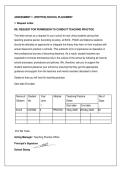
ASSESSMENT 1: (WRITTEN) SCHOOL PLACEMENT
1. Request Letter
RE: REQUEST FOR PERMISSION TO CONDUCT TEACHING PRACTICE
This letter serves as a request for your school to host Unisa students during their
teaching practice period. According to policy, all B.Ed., PGCE and Diploma students
should be afforded an opportunity to integrate the theory they learn in their modules with
actual classroom practice in schools. This authentic form of experience is imperative in
their professional journey of becoming teachers. As a result, student teachers are
expected to immerse themselves fully in the culture of the school by following all internal
school processes, procedures and policies. We, therefore, ask you to support the
student teachers placed at your school by ensuring that they get the appropriate
guidance and support from the teachers and mentor teachers allocated to them.
Student/s that you will host for teaching practice:
Start date End date
Name of Student Yea/ Module Teaching Practice No of
Student No Leve Dates Days
l Start date End date
Xondi 1247834 2 TPN3703 1 May 2026 29 May 2026 30
Prof MJ Taole
Acting Manager: Teaching Practice Office
Principal’s Signature
School Stamp
,School Name: _Joubertina Primary School_____
E-mail Address:
,SCHOOL INFORMATION
MY LEARNING CONTRACT WITH THE SCHOOL
I Xondi 1247834, understand and agree to adhere to the policies, guidelines and
expectations set forth by Joubertina Primary School.
I am committed to upholding the professional standards and ethical considerations
associated with teaching. This includes, but is not limited to:
I will always conduct myself in a professional manner, respecting the school’s code of
conduct and dress code.
I will diligently prepare and plan for each lesson, adhering to the curriculum and any
guidelines provided by the school.
I will actively participate in collaborative activities and meetings with school staff,
sharing insights and contributing positively to the school community.
I will employ effective classroom management techniques to create a positive and
inclusive learning environment.
I am open to feedback from mentor teachers and school administrators and will actively
seek opportunities for professional growth.
I will respect the confidentiality of learner information and other sensitive matters
related to the school community.
I will adhere to the school’s schedule, arriving punctually and maintaining regular
attendance throughout the teaching practice period.
I shall inform the school of any reason for absence as soon as possible.
I understand that I must be at the school for FIVE weeks.
I shall not leave the school during school hours, without permission.
I understand that corporal punishment of learners is prohibited by the school’s act
SASACT 84 OF 1996. NO PERSON MAY ADMINISTER CORPORAL PUNISHMENT
TO A SCHOOL LEARNER AND ANY PERSON WHO ADMINISTERS CORPORAL
PUNISHMENT IS GUILTY OF OFFENCE. CHILDREN HAVE A RIGHT TO BE FREE
FROM ALL FORMS OF VIOLENCE, TO ENJOY THEIR EDUCATION AND NOT TO BE
THREATENED OR PUNISHED IN A CRUEL AND DEGRADING WAY.
, 4. Technology activity
To help learners become familiar with technology at Joubertina Primary School, I would
slowly introduce technology in daily lessons. I would start with simple tools such as
Kahoot! quizzes and QR codes linked to reading activities. This helps learners feel
comfortable using technology.
One advantage of technology is that it helps different learners learn in different ways.
For example, videos can make science lessons easier to understand. One
disadvantage is that not all learners have access to devices or internet at home, which
can create challenges. To solve this problem, I would use the school computer lab for
group activities and make use of offline resources that do not need internet access. I
would also teach learners about online safety and how to use technology responsibly.
Another way to use technology is by using my smartphone to show pictures, diagrams,
and learning materials. I would work together with the IT teacher to plan lessons that
improve learners’ digital skills. I would also provide printed worksheets, with extra online
activities for learners who have internet access at home. This approach helps learners
develop technology skills while making sure that all learners have a fair chance to learn.
5. Collaborating as a Professional Teacher
Case scenario: You are a grade 5 teacher and a learner in your class is struggling with
reading comprehension.
5.1. Collaboration with parents or caregivers
5.1.1. Identify how you can collaborate with the learner's parents or caregivers to
support reading comprehension.
1. Request Letter
RE: REQUEST FOR PERMISSION TO CONDUCT TEACHING PRACTICE
This letter serves as a request for your school to host Unisa students during their
teaching practice period. According to policy, all B.Ed., PGCE and Diploma students
should be afforded an opportunity to integrate the theory they learn in their modules with
actual classroom practice in schools. This authentic form of experience is imperative in
their professional journey of becoming teachers. As a result, student teachers are
expected to immerse themselves fully in the culture of the school by following all internal
school processes, procedures and policies. We, therefore, ask you to support the
student teachers placed at your school by ensuring that they get the appropriate
guidance and support from the teachers and mentor teachers allocated to them.
Student/s that you will host for teaching practice:
Start date End date
Name of Student Yea/ Module Teaching Practice No of
Student No Leve Dates Days
l Start date End date
Xondi 1247834 2 TPN3703 1 May 2026 29 May 2026 30
Prof MJ Taole
Acting Manager: Teaching Practice Office
Principal’s Signature
School Stamp
,School Name: _Joubertina Primary School_____
E-mail Address:
,SCHOOL INFORMATION
MY LEARNING CONTRACT WITH THE SCHOOL
I Xondi 1247834, understand and agree to adhere to the policies, guidelines and
expectations set forth by Joubertina Primary School.
I am committed to upholding the professional standards and ethical considerations
associated with teaching. This includes, but is not limited to:
I will always conduct myself in a professional manner, respecting the school’s code of
conduct and dress code.
I will diligently prepare and plan for each lesson, adhering to the curriculum and any
guidelines provided by the school.
I will actively participate in collaborative activities and meetings with school staff,
sharing insights and contributing positively to the school community.
I will employ effective classroom management techniques to create a positive and
inclusive learning environment.
I am open to feedback from mentor teachers and school administrators and will actively
seek opportunities for professional growth.
I will respect the confidentiality of learner information and other sensitive matters
related to the school community.
I will adhere to the school’s schedule, arriving punctually and maintaining regular
attendance throughout the teaching practice period.
I shall inform the school of any reason for absence as soon as possible.
I understand that I must be at the school for FIVE weeks.
I shall not leave the school during school hours, without permission.
I understand that corporal punishment of learners is prohibited by the school’s act
SASACT 84 OF 1996. NO PERSON MAY ADMINISTER CORPORAL PUNISHMENT
TO A SCHOOL LEARNER AND ANY PERSON WHO ADMINISTERS CORPORAL
PUNISHMENT IS GUILTY OF OFFENCE. CHILDREN HAVE A RIGHT TO BE FREE
FROM ALL FORMS OF VIOLENCE, TO ENJOY THEIR EDUCATION AND NOT TO BE
THREATENED OR PUNISHED IN A CRUEL AND DEGRADING WAY.
, 4. Technology activity
To help learners become familiar with technology at Joubertina Primary School, I would
slowly introduce technology in daily lessons. I would start with simple tools such as
Kahoot! quizzes and QR codes linked to reading activities. This helps learners feel
comfortable using technology.
One advantage of technology is that it helps different learners learn in different ways.
For example, videos can make science lessons easier to understand. One
disadvantage is that not all learners have access to devices or internet at home, which
can create challenges. To solve this problem, I would use the school computer lab for
group activities and make use of offline resources that do not need internet access. I
would also teach learners about online safety and how to use technology responsibly.
Another way to use technology is by using my smartphone to show pictures, diagrams,
and learning materials. I would work together with the IT teacher to plan lessons that
improve learners’ digital skills. I would also provide printed worksheets, with extra online
activities for learners who have internet access at home. This approach helps learners
develop technology skills while making sure that all learners have a fair chance to learn.
5. Collaborating as a Professional Teacher
Case scenario: You are a grade 5 teacher and a learner in your class is struggling with
reading comprehension.
5.1. Collaboration with parents or caregivers
5.1.1. Identify how you can collaborate with the learner's parents or caregivers to
support reading comprehension.


