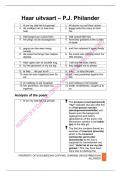
Haar uitvaart – P.J. Philander
1. Al oor my dak het hul gemaal … 1. All above my roof they circled …
2. dié voëltjies het vir haar kom 2. these birds that came to fetch
haal. her.
3. Half-toegevoue vuisies klein 3. Half closed little fists
4. het ylings na die doodsgordyn 4. feverishly grabbed at the curtain
of death
5. gegryp en dan weer moeg 5. and then released it again tiredly
verslap … …
6. die sweet het langs haar slapies 6. the sweat was dripping down her
afgetap. little temples.
7. Haar ogies sien ek duidelik nog, 7. I still see her eyes clearly,
8. hul het gesmeek vir my om tog 8. they begged me to please
9. te help … die pyn te stil 9. help … to stop the pain
10. maar ek was magteloos teen Sy 10. but I was powerless against His
wil, will,
11. en halfweg na die hospitaal 11. and halfway to the hospital
12. het, asemloos, die dood ons 12. death, breathlessly, caught up to
ingehaal. us.
Analysis of the poem
1. Al oor my dak het hul gemaal … The pronoun (voornaamwoord)
“my” indicates (dui aan) that this
is a first-person narrator
(eerstepersoonsverteller) and
based upon the background
(agtergrond) and history
(geskiedenis) of the poem, this
first-person narrator is the father
(pa) of the little girl.
The first line contains (bevat) an
example of inversion (inversie)
which is the incorrect
(verkeerde) word order
(woordorde) as the line is
supposed to (veronderstel om)
read: “Hulle het al oor my dak
gemaal.” This may have been
done due to (danksy) the
PROPERTY OF M SOUNES NO COPYING, SHARING OR DISTRIBUTION
1
ALLOWED
, consistent (vaste) rhyme
scheme (rymskema) where
“gemaal” rhymes with “haal”.
One normally assumes that when
vultures (aasvoëls) circle above
(bo), something dead is nearby.
The girl is still very little and
perhaps this is why the speaker
chose to use the euphemism
(eufemisme) of “voëltjies”
instead of vultures as she was
on her deathbed (doodsbed).
The ellipsis (ellips) serves
(dien) to heighten (verhoog) the
tension (spanning) as the
reader does not yet know who
these “hul” is and why they are
circling above the speaker’s roof
(dak). It might also be because
the speaker finds it difficult
(moeilik) to talk about this event
(gebeurtenis).
2. dié voëltjies het vir haar kom The akuutaksent on the “dié”
haal. indicates (dui aan) that these are
specific birds who came to fetch
the “haar” which shows that it
was a female (meisie) whom the
birds came for.
The diminutive (verkleining) of
the word “voëltjies” further
emphasizes (beklemtoon) the
fact that the girl was still very
young when this tragedy
(tragedie) occurred
(plaasgevind/gebeur het).
This line is an example of a
euphemism
(eufemisme/versagting) as the
young girl passed away (gesterf).
3. Half-toegevoue vuisies klein Another example of inversion
(inversie) as the line was
supposed to read: “Klein half-
toegevoue vuisies” and it again
may have been done to serve the
PROPERTY OF M SOUNES NO COPYING, SHARING OR DISTRIBUTION
2
ALLOWED
1. Al oor my dak het hul gemaal … 1. All above my roof they circled …
2. dié voëltjies het vir haar kom 2. these birds that came to fetch
haal. her.
3. Half-toegevoue vuisies klein 3. Half closed little fists
4. het ylings na die doodsgordyn 4. feverishly grabbed at the curtain
of death
5. gegryp en dan weer moeg 5. and then released it again tiredly
verslap … …
6. die sweet het langs haar slapies 6. the sweat was dripping down her
afgetap. little temples.
7. Haar ogies sien ek duidelik nog, 7. I still see her eyes clearly,
8. hul het gesmeek vir my om tog 8. they begged me to please
9. te help … die pyn te stil 9. help … to stop the pain
10. maar ek was magteloos teen Sy 10. but I was powerless against His
wil, will,
11. en halfweg na die hospitaal 11. and halfway to the hospital
12. het, asemloos, die dood ons 12. death, breathlessly, caught up to
ingehaal. us.
Analysis of the poem
1. Al oor my dak het hul gemaal … The pronoun (voornaamwoord)
“my” indicates (dui aan) that this
is a first-person narrator
(eerstepersoonsverteller) and
based upon the background
(agtergrond) and history
(geskiedenis) of the poem, this
first-person narrator is the father
(pa) of the little girl.
The first line contains (bevat) an
example of inversion (inversie)
which is the incorrect
(verkeerde) word order
(woordorde) as the line is
supposed to (veronderstel om)
read: “Hulle het al oor my dak
gemaal.” This may have been
done due to (danksy) the
PROPERTY OF M SOUNES NO COPYING, SHARING OR DISTRIBUTION
1
ALLOWED
, consistent (vaste) rhyme
scheme (rymskema) where
“gemaal” rhymes with “haal”.
One normally assumes that when
vultures (aasvoëls) circle above
(bo), something dead is nearby.
The girl is still very little and
perhaps this is why the speaker
chose to use the euphemism
(eufemisme) of “voëltjies”
instead of vultures as she was
on her deathbed (doodsbed).
The ellipsis (ellips) serves
(dien) to heighten (verhoog) the
tension (spanning) as the
reader does not yet know who
these “hul” is and why they are
circling above the speaker’s roof
(dak). It might also be because
the speaker finds it difficult
(moeilik) to talk about this event
(gebeurtenis).
2. dié voëltjies het vir haar kom The akuutaksent on the “dié”
haal. indicates (dui aan) that these are
specific birds who came to fetch
the “haar” which shows that it
was a female (meisie) whom the
birds came for.
The diminutive (verkleining) of
the word “voëltjies” further
emphasizes (beklemtoon) the
fact that the girl was still very
young when this tragedy
(tragedie) occurred
(plaasgevind/gebeur het).
This line is an example of a
euphemism
(eufemisme/versagting) as the
young girl passed away (gesterf).
3. Half-toegevoue vuisies klein Another example of inversion
(inversie) as the line was
supposed to read: “Klein half-
toegevoue vuisies” and it again
may have been done to serve the
PROPERTY OF M SOUNES NO COPYING, SHARING OR DISTRIBUTION
2
ALLOWED