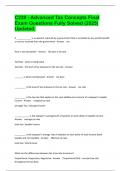
C239 - Advanced Tax Concepts Final
Exam Questions Fully Solved (2025)
Updated.
A ____________ is a payment required by a government that is unrelated to any specific benefit
or service received from the government - Answer tax
How is tax calculated? - Answer Tax base x Tax rate
Tax Base - what is being taxed
Tax Rate - the level of tax imposed on the tax rate - Answer
_______ is what is being taxed - Answer tax base
_________ is the level of tax imposed on the tax rate - Answer tax rate
_________ is the tax rate that applies to the next additional increment of a taxpayer's taxable
income - Answer marginal tax rate
(change) Tax / (change) income
____________ is the taxpayer's average level of taxation on each dollar of taxable income -
Answer average tax rate
total tax / taxable income
_________ is the taxpayer's average rate of taxation on each dollar of total income (both
taxable and non-taxable) - Answer effective tax rate
total tax / total income
What are the differences between the 3 tax rate structures?
Proportional, Progressive, Regressive - Answer Proportional (flat) - constant tax rate
throughout the tax base
,What type of tax rate structure is the following?
a. sales
b. individual income
c. unemployment
d. corporate income - Answer a. proportional
b. progressive
c. regressive
d. proportional
What are the types of taxes? - Answer 1. Federal Taxes
a. income
b. employment (soc sec and medicare taxes)
c. unemployment
d. excise - quantity tax
e. transfer (gift and estate)
2. State and Local Taxes
a. income
b. property - ad valorem tax
c. sales and use
d. excise
__________ are indirect taxes that result from a tax advantage the government grants to certain
transactions - Answer implicit taxes
How are implicit taxes defined? - Answer - the reduced before tax return that a tax favored
asset produces because of its tax advantaged status
Know the *Tax System Qualities* Definitions:
Sufficiency, Equity, Certainty, Convenience, Economy - Answer
,static forecasting - ignores how the taxpayer may change their behavior to the proposed change
in law
dynamic forecasting - takes in to account tax payer response - provides better info to law makers
to make decisions regarding tax law changes - Answer
How is sufficiency assessment performed? - Answer - by static or dynamic forecasting
static forecasting - ignores how the taxpayer may change their behavior to the proposed change
in law
dynamic forecasting - takes in to account tax payer response - provides better info to law makers
to make decisions regarding tax law changes
What tax system quality is the following:
Assessing the aggregate size of the tax revenues that must be generated and making sure that
the tax system provides these revenues. - Answer sufficiency
__________ is how the tax burden should be distributed across taxpayers. - Answer Equity
How is equity evaluated in a tax system? - Answer - horizontal or vertical equity
What is the difference between horizontal and vertical tax equity? - Answer - horizontal:
means 2 taxpayers in the same situation will pay the same tax
- vertical: when taxpayers have a greater ability to pay more tax, the will
___________ means that taxpayers should be able to determine when to pay the tax, where to
pay the tax, and how to determine the tax. - Answer certainty
___________ means that a tax system should be designed to be collected without any undue
hardship to the taxpayer - Answer convenience
, - Internal Revenue Code (IRC)
- Congressional Committee Reports
What are the tax law Administrative sources? - Answer (in order of authority):
- Treasury Regulations (can be interpretative or legislative)
- Revenue Rulings
- Revenue Procedures
- Private Letter Rulings (PLRs)
- Technical Advice Memorandum (TAMs)
What are the 4 tax law sources? - Answer (in order of greatest authority)
1. statutory
2. administrative
3. judicial decisions
4. secondary sources (from tax research services - journals, BNA, etc) (do not have authority for
tax positions or arguments with IRS)
What are the primary sources of tax law? - Answer - statutory sources
Who is the ultimate authority that interprets the IRS? - Answer - the court system
Who settles disputes between tax payers and the IRS? - Answer - the court system
Where do tax related dispute court cases start? - Answer - the lower trial level courts
What are the 3 lower trial level courts? - Answer 1. US court of federal claims
2. US tax court
3. US district court
Exam Questions Fully Solved (2025)
Updated.
A ____________ is a payment required by a government that is unrelated to any specific benefit
or service received from the government - Answer tax
How is tax calculated? - Answer Tax base x Tax rate
Tax Base - what is being taxed
Tax Rate - the level of tax imposed on the tax rate - Answer
_______ is what is being taxed - Answer tax base
_________ is the level of tax imposed on the tax rate - Answer tax rate
_________ is the tax rate that applies to the next additional increment of a taxpayer's taxable
income - Answer marginal tax rate
(change) Tax / (change) income
____________ is the taxpayer's average level of taxation on each dollar of taxable income -
Answer average tax rate
total tax / taxable income
_________ is the taxpayer's average rate of taxation on each dollar of total income (both
taxable and non-taxable) - Answer effective tax rate
total tax / total income
What are the differences between the 3 tax rate structures?
Proportional, Progressive, Regressive - Answer Proportional (flat) - constant tax rate
throughout the tax base
,What type of tax rate structure is the following?
a. sales
b. individual income
c. unemployment
d. corporate income - Answer a. proportional
b. progressive
c. regressive
d. proportional
What are the types of taxes? - Answer 1. Federal Taxes
a. income
b. employment (soc sec and medicare taxes)
c. unemployment
d. excise - quantity tax
e. transfer (gift and estate)
2. State and Local Taxes
a. income
b. property - ad valorem tax
c. sales and use
d. excise
__________ are indirect taxes that result from a tax advantage the government grants to certain
transactions - Answer implicit taxes
How are implicit taxes defined? - Answer - the reduced before tax return that a tax favored
asset produces because of its tax advantaged status
Know the *Tax System Qualities* Definitions:
Sufficiency, Equity, Certainty, Convenience, Economy - Answer
,static forecasting - ignores how the taxpayer may change their behavior to the proposed change
in law
dynamic forecasting - takes in to account tax payer response - provides better info to law makers
to make decisions regarding tax law changes - Answer
How is sufficiency assessment performed? - Answer - by static or dynamic forecasting
static forecasting - ignores how the taxpayer may change their behavior to the proposed change
in law
dynamic forecasting - takes in to account tax payer response - provides better info to law makers
to make decisions regarding tax law changes
What tax system quality is the following:
Assessing the aggregate size of the tax revenues that must be generated and making sure that
the tax system provides these revenues. - Answer sufficiency
__________ is how the tax burden should be distributed across taxpayers. - Answer Equity
How is equity evaluated in a tax system? - Answer - horizontal or vertical equity
What is the difference between horizontal and vertical tax equity? - Answer - horizontal:
means 2 taxpayers in the same situation will pay the same tax
- vertical: when taxpayers have a greater ability to pay more tax, the will
___________ means that taxpayers should be able to determine when to pay the tax, where to
pay the tax, and how to determine the tax. - Answer certainty
___________ means that a tax system should be designed to be collected without any undue
hardship to the taxpayer - Answer convenience
, - Internal Revenue Code (IRC)
- Congressional Committee Reports
What are the tax law Administrative sources? - Answer (in order of authority):
- Treasury Regulations (can be interpretative or legislative)
- Revenue Rulings
- Revenue Procedures
- Private Letter Rulings (PLRs)
- Technical Advice Memorandum (TAMs)
What are the 4 tax law sources? - Answer (in order of greatest authority)
1. statutory
2. administrative
3. judicial decisions
4. secondary sources (from tax research services - journals, BNA, etc) (do not have authority for
tax positions or arguments with IRS)
What are the primary sources of tax law? - Answer - statutory sources
Who is the ultimate authority that interprets the IRS? - Answer - the court system
Who settles disputes between tax payers and the IRS? - Answer - the court system
Where do tax related dispute court cases start? - Answer - the lower trial level courts
What are the 3 lower trial level courts? - Answer 1. US court of federal claims
2. US tax court
3. US district court