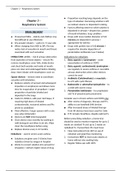
Chapter 3 – Respiratory System
Proportion reaching lungs depends on the
Chapter 3 – type of nebuliser. Remaining solution is left
Respiratory System as residual volume or deposited in tubing
Factors affecting extent to which solution is
deposited in airways = droplet size, pattern
DRUG DELIVERY
of breath inhalation, lung condition
Pressurised MDIs – elderly and children may Drops with mass median diameter of 1-5
find difficult to use effectively microns are deposited in airways =
Dry powder inhalers – useful in >5 year olds appropriate for asthma
When changing from MDI to DPI, Pts may Drops with particle size of 1-2 microns =
notice lack of sensation in mouth and throat required for alveolar deposition of
associated with each actuation pentamidine isethionate (see 5 below)
MHRA/CHM: pMDIs – risk of airway obstruction Indications for nebulisers
from aspiration of loose objects – ensure Pts 1. Beta2-agonist or ipratropium – acute
remove mouthpiece cover fully, shake device exacerbation of asthma or COPD
and check both outside and inside of mouth- 2. Beta2-agonist, corticosteroid, ipratropium –
piece are clear and undamaged before inhaling use regularly in severe asthma or reversible
dose. Store inhaler with mouthpiece cover on. airways obstruction when other devices
cannot be used
Spacer devices – remove need to coordinate
3. Antibiotic (Colistimethate) or mucolytic –
actuation with inhalation.
to a Pt with cystic fibrosis
Reduces velocity of aerosol and subsequent
4. Budesonide or adrenaline/epinephrine – to
impaction on oropharynx and allows more
a child with severe croup
time for evaporation of propellant = larger
5. Pentamidine isethionate – for prophylaxis
proportion of particles inhaled and
and Tx of pneumocystis pneumonia
deposited in the lungs
Useful in children, with poor technique, if Consider use in chronic asthma and COPD only:
requiring high doses of inhaled After review of diagnosis, therapy and Pt’s
corticosteroids, nocturnal asthma and Pts ability to use handheld (HH) devices
prone to candidiasis After increased doses of inhaled therapy
Most effective = larger spacers with a one- from HH devices have been used for 2wks
way valve (Volumatic) If Pt remains breathless, despite optimal Tx
Devices are NOT interchangeable
Before prescribing nebuliser, a home trial
Clean device once monthly by washing in
should be used to monitor response for up to 2
mild detergent and allow to air-dry. Wipe
weeks on standard Tx and up to 2 weeks on
clean the mouthpiece before using
nebulised Tx. If prescribed, Pts must have:
Replace devices every 6-12 months
1. Clear instructions from HCP on use of
Nebulisers – used in severe acute asthma nebuliser and peak-flow monitoring
2. Instructions NOT to treat acute attacks at
Solutions are given over 5-10mins from
home without also seeking help
nebuliser driven by oxygen in hospital
3. Regular follow-ups with HCPs
Works to convert solution into aerosol for
inhalation = delivers higher doses of drug
, Chapter 3 – Respiratory System
Jet nebulisers – require optimum gas flow rate NICE Guidelines (2019) for over 17s
of 6-8L/min and can be driven by piped air or
1. Offer SABA as reliever therapy in newly
oxygen. As domiciliary oxygen cylinders don’t
diagnosed asthma.
provide adequate flow rate, an electrical
2. If infrequent, short-lived wheeze and
compressor is needed. In COPD Pts, nebuliser
normal lung function, consider SABA
must be driven by air as oxygen can be
reliever alone.
dangerous (risk of hypercapnia).
3. Offer low dose ICS as the 1st line
Tubing – use correct grade of tubing when maintenance therapy if:
connecting a nebuliser to a medical gas supply Symptoms indicate need for
or compressor maintenance therapy (e.g. asthma
related symptoms 3 times a week or
Ultrasonic nebulisers – produce aerosol by
more, or causing waking at night) or
ultrasonic vibration of drug solution hence do
Asthma is uncontrolled with SABA
NOT require a gas flow. They’re unsuitable for
4. If (3) fails, offer LTRA in addition to the ICS
the nebulisation of dornase alfa
and review response in 4 to 8 weeks
Nebuliser diluent – usual diluent is sterile NaCl 5. If (4) fails, offer LABA with ICS, and review
0.9% (physiological saline). LTRA treatment as follows:
Discuss with Pt whether or not to
Peak flow meters – useful in Pts with severe
continue LTRA treatment
asthma and those who are ‘poor perceivers’,
Consider response to LTRA Tx.
hence slow to detect worsening asthma
6. If (5) fails, offer to change ICS and LABA
CHRONIC ASTHMA maintenance therapy to a MART regimen
with a low maintenance ICS dose.
Chronic inflammatory condition associated 7. If (6) fails, consider increasing ICS to a
with airway hyperresponsiveness and moderate maintenance dose (either
variable airflow obstruction continuing on a MART regimen or changing
Symptoms = cough, wheeze, tight chest, to a fixed-dose of an ICS and a LABA, with a
breathlessness SABA as a reliever therapy).
Complete control = no daytime symptoms, 8. If (7) fails, consider:
no night-time awakening due to asthma, no Increasing ICS to a high maintenance
asthma attacks, no need for rescue meds, dose (this should only be offered as part
no limitation on activity (incl. exercise), of a fixed-dose regimen, with a SABA
normal lung function (FEV1) and/or peak used as a reliever therapy) or
expiratory flow (PEF) >80% predicted/best Trial an additional drug (e.g. LAMA or
and minimal SEs from Tx theophylline)
Lifestyle changes = weight loss, smoking BTS Guidelines (2019) for adults
cessation, breathing exercise programmes
Non-drug Tx
Reduce exposure to allergens e.g. mites
Encourage breast feeding
Consider weight loss in obese/overweight
Smoking cessation
Breathing exercise programmes
Drug Tx
Proportion reaching lungs depends on the
Chapter 3 – type of nebuliser. Remaining solution is left
Respiratory System as residual volume or deposited in tubing
Factors affecting extent to which solution is
deposited in airways = droplet size, pattern
DRUG DELIVERY
of breath inhalation, lung condition
Pressurised MDIs – elderly and children may Drops with mass median diameter of 1-5
find difficult to use effectively microns are deposited in airways =
Dry powder inhalers – useful in >5 year olds appropriate for asthma
When changing from MDI to DPI, Pts may Drops with particle size of 1-2 microns =
notice lack of sensation in mouth and throat required for alveolar deposition of
associated with each actuation pentamidine isethionate (see 5 below)
MHRA/CHM: pMDIs – risk of airway obstruction Indications for nebulisers
from aspiration of loose objects – ensure Pts 1. Beta2-agonist or ipratropium – acute
remove mouthpiece cover fully, shake device exacerbation of asthma or COPD
and check both outside and inside of mouth- 2. Beta2-agonist, corticosteroid, ipratropium –
piece are clear and undamaged before inhaling use regularly in severe asthma or reversible
dose. Store inhaler with mouthpiece cover on. airways obstruction when other devices
cannot be used
Spacer devices – remove need to coordinate
3. Antibiotic (Colistimethate) or mucolytic –
actuation with inhalation.
to a Pt with cystic fibrosis
Reduces velocity of aerosol and subsequent
4. Budesonide or adrenaline/epinephrine – to
impaction on oropharynx and allows more
a child with severe croup
time for evaporation of propellant = larger
5. Pentamidine isethionate – for prophylaxis
proportion of particles inhaled and
and Tx of pneumocystis pneumonia
deposited in the lungs
Useful in children, with poor technique, if Consider use in chronic asthma and COPD only:
requiring high doses of inhaled After review of diagnosis, therapy and Pt’s
corticosteroids, nocturnal asthma and Pts ability to use handheld (HH) devices
prone to candidiasis After increased doses of inhaled therapy
Most effective = larger spacers with a one- from HH devices have been used for 2wks
way valve (Volumatic) If Pt remains breathless, despite optimal Tx
Devices are NOT interchangeable
Before prescribing nebuliser, a home trial
Clean device once monthly by washing in
should be used to monitor response for up to 2
mild detergent and allow to air-dry. Wipe
weeks on standard Tx and up to 2 weeks on
clean the mouthpiece before using
nebulised Tx. If prescribed, Pts must have:
Replace devices every 6-12 months
1. Clear instructions from HCP on use of
Nebulisers – used in severe acute asthma nebuliser and peak-flow monitoring
2. Instructions NOT to treat acute attacks at
Solutions are given over 5-10mins from
home without also seeking help
nebuliser driven by oxygen in hospital
3. Regular follow-ups with HCPs
Works to convert solution into aerosol for
inhalation = delivers higher doses of drug
, Chapter 3 – Respiratory System
Jet nebulisers – require optimum gas flow rate NICE Guidelines (2019) for over 17s
of 6-8L/min and can be driven by piped air or
1. Offer SABA as reliever therapy in newly
oxygen. As domiciliary oxygen cylinders don’t
diagnosed asthma.
provide adequate flow rate, an electrical
2. If infrequent, short-lived wheeze and
compressor is needed. In COPD Pts, nebuliser
normal lung function, consider SABA
must be driven by air as oxygen can be
reliever alone.
dangerous (risk of hypercapnia).
3. Offer low dose ICS as the 1st line
Tubing – use correct grade of tubing when maintenance therapy if:
connecting a nebuliser to a medical gas supply Symptoms indicate need for
or compressor maintenance therapy (e.g. asthma
related symptoms 3 times a week or
Ultrasonic nebulisers – produce aerosol by
more, or causing waking at night) or
ultrasonic vibration of drug solution hence do
Asthma is uncontrolled with SABA
NOT require a gas flow. They’re unsuitable for
4. If (3) fails, offer LTRA in addition to the ICS
the nebulisation of dornase alfa
and review response in 4 to 8 weeks
Nebuliser diluent – usual diluent is sterile NaCl 5. If (4) fails, offer LABA with ICS, and review
0.9% (physiological saline). LTRA treatment as follows:
Discuss with Pt whether or not to
Peak flow meters – useful in Pts with severe
continue LTRA treatment
asthma and those who are ‘poor perceivers’,
Consider response to LTRA Tx.
hence slow to detect worsening asthma
6. If (5) fails, offer to change ICS and LABA
CHRONIC ASTHMA maintenance therapy to a MART regimen
with a low maintenance ICS dose.
Chronic inflammatory condition associated 7. If (6) fails, consider increasing ICS to a
with airway hyperresponsiveness and moderate maintenance dose (either
variable airflow obstruction continuing on a MART regimen or changing
Symptoms = cough, wheeze, tight chest, to a fixed-dose of an ICS and a LABA, with a
breathlessness SABA as a reliever therapy).
Complete control = no daytime symptoms, 8. If (7) fails, consider:
no night-time awakening due to asthma, no Increasing ICS to a high maintenance
asthma attacks, no need for rescue meds, dose (this should only be offered as part
no limitation on activity (incl. exercise), of a fixed-dose regimen, with a SABA
normal lung function (FEV1) and/or peak used as a reliever therapy) or
expiratory flow (PEF) >80% predicted/best Trial an additional drug (e.g. LAMA or
and minimal SEs from Tx theophylline)
Lifestyle changes = weight loss, smoking BTS Guidelines (2019) for adults
cessation, breathing exercise programmes
Non-drug Tx
Reduce exposure to allergens e.g. mites
Encourage breast feeding
Consider weight loss in obese/overweight
Smoking cessation
Breathing exercise programmes
Drug Tx