ATI TEAS 7 EXAM 2024
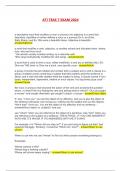
a descriptive word that modifies a noun or pronoun.An adjective is a word that
describes, identifies or further defines a noun or a pronoun.Ex A, an & the.
Salty,Sharp, loud Ex: She wore a beautiful dress. Adjective is beautiful -
answerAdjective
a word that modifies a verb, adjective, or another adverb and indicated when, where,
how, why and how much
* the adverb usually includes ending -ly to describe verb
*She sang loudly(loudly modifies the verb sang) - answerAdverb
a word that is used to limit a noun, either indefinite ( a and an) or definite (the). EX:
Give me THE book vs Give me a book. very specific noun - answerArticle
a group of words that are related and contain both a subject and a verb.A clause is a
group of related words containing a subject that tells readers what the sentence is
about, and a verb that tells readers what the subject is doing. A clause comes in four
types; independent, dependent, relative or noun clause."my dog loves pizza crust" -
answerClause
the noun or pronoun that receives the action of the verb and answers the question
whom, or what.Find it by finding the verb and asking what or whom? "Our cat caught
a mouse" verb-caught direct(who got caught?) object- a mouse - answerDirect object
If I say, "I love you," you are the object of my affection, and you is also the object of
the sentence (because I am loving you, making me the subject and you the object).
How's that? I love you. You are the object of my affection and my sentence. -
answer(Direct object vs. subject) I love you
use "whom" when you are referring to the object of a sentence. Use "who" when you
are referring to the subject of a sentence. THE M TRICK...IF YOU CAN ANSWER IT
WITH HIM, ITS WHOM. IF ITS ANSWERED WITH HE IT'S WHO
For example, it is "Whom did you step on?" if you are trying to figure out that I had
squished Squiggly. Similarly, it would be "Whom do I love?" - answerWhen to use
whom?
When to use who we use "whose" to find out which person something belongs to.
Examples:
Whose camera is this?
Whose dog is barking outside?
Whose cell phone keeps ringing? - answerWhen to use whose?
, So when is it OK to use "who"? If you were asking about the subject of these
sentences, then you would use "who." For example, "Who loves you?" and "Who
stepped on Squiggly?" In both these cases the one you are asking about is the
subject—the one taking action, not the one being acted upon. - answerWhen to use
who?
*Good is an adjective while well is an adverb answering the question how.USED TO
DESCRIBE AN ACTION, PLACE,PERSON OR THING
EX. You did the job well.
*Well is usually an adverb (runs well, a well-written essay).
EX. She jogged very well for her age - answerGood vs. well
a word for a person, place or thing - answerNoun
a word such as that tells the position of the noun.Usually found before the noun.; by,
at, to, or from that gives additional info, usually in relationship to something else in
the sentence. "When a snake slides through the ground" Preposition is through -
answerPreposition
the noun, pronoun, phase, or clause to which the preposition refers.Example
Morgan's house is across the street. (Across "the" what?) street - answerObject of
preposition
a group of words that are related but do not contain a verb and a subject together.
Incomplete sentence ...EX:after the devastation - answerPhrase
a pronoun used to indicate ownership - answerPossessive pronoun
a word that replaces and refers to a noun - answerPronoun
a noun or pronoun that performs the action of the verb. If the sentence contains a
verb of being or a linking verb such as be, feel, become, or look, the subject of the
sentence is the noun or the pronoun being described.EX: Sonia like to run...subject
Sonia - answerSubject
a word that shows an action or a state of being - answerVerb
In a plural verb drop the s
The churches inspire us
(plural subject) (plural Verb)
TIP: Both the subject and verb can't have an s - answerPlural verb
In a singular verb add a s
The church inspires us - answersingular verbs
a descriptive word that modifies a noun or pronoun.An adjective is a word that
describes, identifies or further defines a noun or a pronoun.Ex A, an & the.
Salty,Sharp, loud Ex: She wore a beautiful dress. Adjective is beautiful -
answerAdjective
a word that modifies a verb, adjective, or another adverb and indicated when, where,
how, why and how much
* the adverb usually includes ending -ly to describe verb
*She sang loudly(loudly modifies the verb sang) - answerAdverb
a word that is used to limit a noun, either indefinite ( a and an) or definite (the). EX:
Give me THE book vs Give me a book. very specific noun - answerArticle
a group of words that are related and contain both a subject and a verb.A clause is a
group of related words containing a subject that tells readers what the sentence is
about, and a verb that tells readers what the subject is doing. A clause comes in four
types; independent, dependent, relative or noun clause."my dog loves pizza crust" -
answerClause
the noun or pronoun that receives the action of the verb and answers the question
whom, or what.Find it by finding the verb and asking what or whom? "Our cat caught
a mouse" verb-caught direct(who got caught?) object- a mouse - answerDirect object
If I say, "I love you," you are the object of my affection, and you is also the object of
the sentence (because I am loving you, making me the subject and you the object).
How's that? I love you. You are the object of my affection and my sentence. -
answer(Direct object vs. subject) I love you
use "whom" when you are referring to the object of a sentence. Use "who" when you
are referring to the subject of a sentence. THE M TRICK...IF YOU CAN ANSWER IT
WITH HIM, ITS WHOM. IF ITS ANSWERED WITH HE IT'S WHO
For example, it is "Whom did you step on?" if you are trying to figure out that I had
squished Squiggly. Similarly, it would be "Whom do I love?" - answerWhen to use
whom?
When to use who we use "whose" to find out which person something belongs to.
Examples:
Whose camera is this?
Whose dog is barking outside?
Whose cell phone keeps ringing? - answerWhen to use whose?
, So when is it OK to use "who"? If you were asking about the subject of these
sentences, then you would use "who." For example, "Who loves you?" and "Who
stepped on Squiggly?" In both these cases the one you are asking about is the
subject—the one taking action, not the one being acted upon. - answerWhen to use
who?
*Good is an adjective while well is an adverb answering the question how.USED TO
DESCRIBE AN ACTION, PLACE,PERSON OR THING
EX. You did the job well.
*Well is usually an adverb (runs well, a well-written essay).
EX. She jogged very well for her age - answerGood vs. well
a word for a person, place or thing - answerNoun
a word such as that tells the position of the noun.Usually found before the noun.; by,
at, to, or from that gives additional info, usually in relationship to something else in
the sentence. "When a snake slides through the ground" Preposition is through -
answerPreposition
the noun, pronoun, phase, or clause to which the preposition refers.Example
Morgan's house is across the street. (Across "the" what?) street - answerObject of
preposition
a group of words that are related but do not contain a verb and a subject together.
Incomplete sentence ...EX:after the devastation - answerPhrase
a pronoun used to indicate ownership - answerPossessive pronoun
a word that replaces and refers to a noun - answerPronoun
a noun or pronoun that performs the action of the verb. If the sentence contains a
verb of being or a linking verb such as be, feel, become, or look, the subject of the
sentence is the noun or the pronoun being described.EX: Sonia like to run...subject
Sonia - answerSubject
a word that shows an action or a state of being - answerVerb
In a plural verb drop the s
The churches inspire us
(plural subject) (plural Verb)
TIP: Both the subject and verb can't have an s - answerPlural verb
In a singular verb add a s
The church inspires us - answersingular verbs