KRM 310 Chapter 4
Erin Polyblank
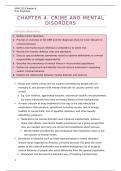
CHAPTER 4- CRIME AND MENTAL
DISORDERS
Learning Objectives:
1. Define mental disorders.
2. Provide an overview of the DSM and the diagnoses that are most relevant to
criminal behavior.
3. Define and review issues relating to competency to stand trial.
4. Review the insanity defense rules and standards.
5. Discuss special defenses sometimes raised to absolve defendants of criminal
responsibility or mitigate responsibility.
6. Describe the prevalence of mental illness in incarcerated populations.
7. Define risk assessment and identify the risk factors employed in assessing
violent criminal behavior.
8. Explore the relationship between mental disorder and violence.
Brutal and violent crimes are not usually committed by people who are
mentally ill, and persons with mental illness do not usually commit such
crimes.
o Eg. Gun violence, aggravated assaults, and sexual assaults are perpetrated
by many individuals who have no mental illness in their backgrounds.
A major criticism of drug treatment to this day is the side-effects the
medications often produce, sometimes including nausea, loss of energy,
inability to concentrate, loss of appetite, dizziness, and other equally
disturbing symptoms.
o Medications for mental disorder have improved substantially, produce
fewer side effects, and mental health practitioners as a group accept that
they are needed, but many are concerned nonetheless about overuse.
Mental health practitioners also emphasize that medication alone is not
the solution to mental illness.
Deviations in behavior such as those demonstrated in mental disorders
should not be regarded as illnesses, primarily because this gave too much
power to the medical profession and enabled widespread use of drugs to
control behavior of people who acted differently from the general population.
o Medication has become the dominant way of treating mental illness.
1
,KRM 310 Chapter 4
Erin Polyblank
Many researchers distinguish between mental illness in general and serious
mental illness (SMI) in particular.
o Serious mental illness: A mental, behavioral, or emotional disorder
resulting in serious functional impairment, which substantially interferes
with or limits one or more major life activities.
o People with SMI typically commit minor offenses rather than serious and
violent crime.
They are more likely to trespass, shoplift, or commit simple assault than
to murder someone.
Recent research indicates that serious mental illness is not a direct
cause of crime and that risk factors for offending are similar in both
mentally ill and non–mentally ill of-fenders.
DEFINING MENTAL ILLNESS
Mental illness: A disorder (some say a disease) of the mind that is judged
by experts to interfere substantially with a person’s ability to cope with life on
a daily basis.
o It is a term used for a variety of psychiatric diagnoses that indicate that the
individual has problems in living.
Mental illness is manifested in behavior that deviates notably from what is
considered normal conduct in any given society.
o Serious mental illness not only deviates from normal conduct, it also
severely impedes, or has potential to impede, a person’s functioning.
An alternative term, mental disorder, need not imply that a person is sick,
to be pitied, or even necessarily less responsible for his or her actions.
Intellectual disability: Limitations in cognitive capacity, determined by IQ
tests and a variety of performance measures.
o This cannot be cured although, people who are intellectually disabled can
be provided training and support services to lead productive and
independent lives.
o Intellectually disabled people are sometimes charged with primarily minor
offenses that result in arrests, being detained in jail, and serving time.
o They also may be charged and convicted of serious felonies, including
murder.
2
, KRM 310 Chapter 4
Erin Polyblank
Mental disorders are manifested in a variety of behaviors, ranging in severity
from dangerous, harmful acts to conduct that is essentially innocuous.
THE DSM
The concept of mental illness connotes a wide range of bizarre, dramatic,
harmful, or mildly unusual behaviors whose classifications are published in
the Diagnostic and Statistical Manual of Mental Disorders (DSM).
o Diagnostic and Statistical Manual of Mental Disorders (DSM): The
official guidebook or manual, published by the American Psychiatric
Association, used to define and diagnose specific mental disorders.
Some prefer to use an alternative classification system, the International
Classification of Disease (ICD)—published by the World Health Organization
(WHO).
Diagnoses often appear in official records, such as court documents and
prison files, and they are commonly seen in noncriminal matters such as
disability determinations and child custody proceedings.
o Psychologists are generally advised not to include clinical diagnoses in
their psychological reports unless specifically asked by the courts to
provide them.
Diagnoses are often misconstrued and misunderstood by persons who
are not mental health professionals.
When looking at individuals that have mental illness and commit crime, it is
important to understand that:
1. Persons with these disorders are not “crime prone,”
2. Even if an individual is diagnosed with these disorders, that person still
can be held responsible for criminal conduct.
The categories of mental disorders most relevant in criminal behaviour are:
1. The schizophrenia spectrum and other psychotic disorders.
2. Bipolar disorder.
3. Major depression.
4. The personality disorder called “antisocial personality disorder.”
3
Erin Polyblank
CHAPTER 4- CRIME AND MENTAL
DISORDERS
Learning Objectives:
1. Define mental disorders.
2. Provide an overview of the DSM and the diagnoses that are most relevant to
criminal behavior.
3. Define and review issues relating to competency to stand trial.
4. Review the insanity defense rules and standards.
5. Discuss special defenses sometimes raised to absolve defendants of criminal
responsibility or mitigate responsibility.
6. Describe the prevalence of mental illness in incarcerated populations.
7. Define risk assessment and identify the risk factors employed in assessing
violent criminal behavior.
8. Explore the relationship between mental disorder and violence.
Brutal and violent crimes are not usually committed by people who are
mentally ill, and persons with mental illness do not usually commit such
crimes.
o Eg. Gun violence, aggravated assaults, and sexual assaults are perpetrated
by many individuals who have no mental illness in their backgrounds.
A major criticism of drug treatment to this day is the side-effects the
medications often produce, sometimes including nausea, loss of energy,
inability to concentrate, loss of appetite, dizziness, and other equally
disturbing symptoms.
o Medications for mental disorder have improved substantially, produce
fewer side effects, and mental health practitioners as a group accept that
they are needed, but many are concerned nonetheless about overuse.
Mental health practitioners also emphasize that medication alone is not
the solution to mental illness.
Deviations in behavior such as those demonstrated in mental disorders
should not be regarded as illnesses, primarily because this gave too much
power to the medical profession and enabled widespread use of drugs to
control behavior of people who acted differently from the general population.
o Medication has become the dominant way of treating mental illness.
1
,KRM 310 Chapter 4
Erin Polyblank
Many researchers distinguish between mental illness in general and serious
mental illness (SMI) in particular.
o Serious mental illness: A mental, behavioral, or emotional disorder
resulting in serious functional impairment, which substantially interferes
with or limits one or more major life activities.
o People with SMI typically commit minor offenses rather than serious and
violent crime.
They are more likely to trespass, shoplift, or commit simple assault than
to murder someone.
Recent research indicates that serious mental illness is not a direct
cause of crime and that risk factors for offending are similar in both
mentally ill and non–mentally ill of-fenders.
DEFINING MENTAL ILLNESS
Mental illness: A disorder (some say a disease) of the mind that is judged
by experts to interfere substantially with a person’s ability to cope with life on
a daily basis.
o It is a term used for a variety of psychiatric diagnoses that indicate that the
individual has problems in living.
Mental illness is manifested in behavior that deviates notably from what is
considered normal conduct in any given society.
o Serious mental illness not only deviates from normal conduct, it also
severely impedes, or has potential to impede, a person’s functioning.
An alternative term, mental disorder, need not imply that a person is sick,
to be pitied, or even necessarily less responsible for his or her actions.
Intellectual disability: Limitations in cognitive capacity, determined by IQ
tests and a variety of performance measures.
o This cannot be cured although, people who are intellectually disabled can
be provided training and support services to lead productive and
independent lives.
o Intellectually disabled people are sometimes charged with primarily minor
offenses that result in arrests, being detained in jail, and serving time.
o They also may be charged and convicted of serious felonies, including
murder.
2
, KRM 310 Chapter 4
Erin Polyblank
Mental disorders are manifested in a variety of behaviors, ranging in severity
from dangerous, harmful acts to conduct that is essentially innocuous.
THE DSM
The concept of mental illness connotes a wide range of bizarre, dramatic,
harmful, or mildly unusual behaviors whose classifications are published in
the Diagnostic and Statistical Manual of Mental Disorders (DSM).
o Diagnostic and Statistical Manual of Mental Disorders (DSM): The
official guidebook or manual, published by the American Psychiatric
Association, used to define and diagnose specific mental disorders.
Some prefer to use an alternative classification system, the International
Classification of Disease (ICD)—published by the World Health Organization
(WHO).
Diagnoses often appear in official records, such as court documents and
prison files, and they are commonly seen in noncriminal matters such as
disability determinations and child custody proceedings.
o Psychologists are generally advised not to include clinical diagnoses in
their psychological reports unless specifically asked by the courts to
provide them.
Diagnoses are often misconstrued and misunderstood by persons who
are not mental health professionals.
When looking at individuals that have mental illness and commit crime, it is
important to understand that:
1. Persons with these disorders are not “crime prone,”
2. Even if an individual is diagnosed with these disorders, that person still
can be held responsible for criminal conduct.
The categories of mental disorders most relevant in criminal behaviour are:
1. The schizophrenia spectrum and other psychotic disorders.
2. Bipolar disorder.
3. Major depression.
4. The personality disorder called “antisocial personality disorder.”
3