KRM 310 Chapter 1
Erin Polyblank
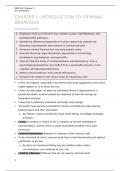
CHAPTER 1: INTRODUCTION TO CRIMINAL
BEHAVIOUR
Learning objective:
1. Emphasize that such behavior has multiple causes, manifestations, and
developmental pathways.
2. Identify the different perspectives of human nature that underlie the
theoretical development and research of criminal behavior.
3. Introduce various theories that may help explain crime.
4. Describe the three major disciplinary approaches in criminology:
sociological, psychological, and psychiatric.
5. Point out that the study of criminal behavior and delinquency, from a
psychological perspective, has shifted from a personality toward a more
cognitive and developmental focus.
6. Define criminal behavior and juvenile delinquency.
7. Introduce the reader to the various ways of measuring crime
Crime can frighten, especially if we believe that what happened to one victim
might happen to us or those we love.
Crime can also anger, as when an inebriated driver is responsible for a
pedestrian death, or when people are deprived of their life savings by
fraudulent schemes.
Crime that is politically motivated can terrify and outrage.
The public have become sensitized to crimes committed by high-ranking
political figure and their associates:
o Eg. Perjury, money laundering, fraud, bribe-taking, and illegal campaign
activities.
Crime: A conduct or failure to act in violation of the law forbidding or
commanding it, and for which a range of possible penalties exist upon
conviction.
Criminal behaviour: Behavior in violation of the criminal code.
To be convicted of crime, a person must have acted intentionally and without
justification or excuse.
o Eg. Even an intentional killing may be justified under certain
circumstances, as in defense of one’s life.
Liability offenses: Offenses that do not require criminal intent.
1
,KRM 310 Chapter 1
Erin Polyblank
People like politicians and public officials, offer simple and incomplete
solution of the obliterating crime, particularly violent and street crime.
o Eg. More police officers, video cameras and state-of-the-art surveillance
equipment, armed teachers and more guns.
Solutions that attack what are believed to be root causes of crime—such as
reducing economic inequality, improving educational opportunities, or
offering substance abuse treatment—have considerable merit, but they
require public commitment, energy, and financial resources.
The inability to prevent crime is also partly because we have trouble
understanding criminal behaviour and identifying and agreeing upon its
multiple cases.
o Because crime is complex, explanations of crime require complicated,
involved answers.
o Psychological research indicates that most people have limited tolerance
for complexity and ambiguity.
There is no all-encompassing psychological explanation for crime.
Criminology: The scientific study of crime.
o Needs all the interdisciplinary help it can get to explain and control
criminal behaviour.
o Only science that studies crime in its relativity (In its full spectrum).
Sociology:
Psychology: Focuses on the individual factors that results in one becoming a
criminal.
The primary goal is to review and integrate recent scholarship and research
in the psychology of crime, compare it with traditional approaches, and
discuss strategies that have been offered to prevent and modify criminal
behaviour.
THEORIES OF CRIME
Theory: May refer to personal experiences, observations, traditional beliefs,
a set of opinions, or a collection of abstract thoughts.
“Just worlders” have a personal theory that the world is a just place, where
one gets what one deserves.
o They believe that things do not happen to people without reason that is
closely related to their own actions.
2
, KRM 310 Chapter 1
Erin Polyblank
o They may believe both that a burglar deserved a severe penalty, and that
the victim did not protect their property sufficiently.
Research on the just world theory has identified 2 tracks:
1. Belief in a general just-world.
- Belief in a general just-world, seems to be far more problematic, as it is
associated with less compassion for others and even a derogation of
victims of crime.
2. Belief in a personal just-world
- Belief in a personal just-world (“I usually get what I deserve”) is
considered adaptive and helpful in coping with dire circumstances in
one’s life.
o Eg. Research found that prisoners with a high personal just-world
orientation evaluated their prison experiences more positively and
reported better overall well-being than those without such an
orientation.
Scientific Theory: A set of interrelated constructs, definitions, and
propositions that present a systematic view of phenomena by specifying
relations among variables, with the purpose of explaining and predicting the
phenomena.
o It should provide a general explanation that encompasses and
systematically connects many different social, economic, and
psychological variable to criminal behaviour, and it should be supported
by well-executed, methodologically sound research.
o The terms in any scientific theory must be as precise as possible, and
their meaning and usage clear and unambiguous, so that it can be
meaningfully tested by observation and analysis.
The process of theory testing is called theory verification.
o Theory Verification: A process whereby a scientific theory is tested
through observation and analysis. If the process falsifies the theory, the
theory must be revised to account for the observed events.
If a theory is not verified it is known as falsification.
3
Erin Polyblank
CHAPTER 1: INTRODUCTION TO CRIMINAL
BEHAVIOUR
Learning objective:
1. Emphasize that such behavior has multiple causes, manifestations, and
developmental pathways.
2. Identify the different perspectives of human nature that underlie the
theoretical development and research of criminal behavior.
3. Introduce various theories that may help explain crime.
4. Describe the three major disciplinary approaches in criminology:
sociological, psychological, and psychiatric.
5. Point out that the study of criminal behavior and delinquency, from a
psychological perspective, has shifted from a personality toward a more
cognitive and developmental focus.
6. Define criminal behavior and juvenile delinquency.
7. Introduce the reader to the various ways of measuring crime
Crime can frighten, especially if we believe that what happened to one victim
might happen to us or those we love.
Crime can also anger, as when an inebriated driver is responsible for a
pedestrian death, or when people are deprived of their life savings by
fraudulent schemes.
Crime that is politically motivated can terrify and outrage.
The public have become sensitized to crimes committed by high-ranking
political figure and their associates:
o Eg. Perjury, money laundering, fraud, bribe-taking, and illegal campaign
activities.
Crime: A conduct or failure to act in violation of the law forbidding or
commanding it, and for which a range of possible penalties exist upon
conviction.
Criminal behaviour: Behavior in violation of the criminal code.
To be convicted of crime, a person must have acted intentionally and without
justification or excuse.
o Eg. Even an intentional killing may be justified under certain
circumstances, as in defense of one’s life.
Liability offenses: Offenses that do not require criminal intent.
1
,KRM 310 Chapter 1
Erin Polyblank
People like politicians and public officials, offer simple and incomplete
solution of the obliterating crime, particularly violent and street crime.
o Eg. More police officers, video cameras and state-of-the-art surveillance
equipment, armed teachers and more guns.
Solutions that attack what are believed to be root causes of crime—such as
reducing economic inequality, improving educational opportunities, or
offering substance abuse treatment—have considerable merit, but they
require public commitment, energy, and financial resources.
The inability to prevent crime is also partly because we have trouble
understanding criminal behaviour and identifying and agreeing upon its
multiple cases.
o Because crime is complex, explanations of crime require complicated,
involved answers.
o Psychological research indicates that most people have limited tolerance
for complexity and ambiguity.
There is no all-encompassing psychological explanation for crime.
Criminology: The scientific study of crime.
o Needs all the interdisciplinary help it can get to explain and control
criminal behaviour.
o Only science that studies crime in its relativity (In its full spectrum).
Sociology:
Psychology: Focuses on the individual factors that results in one becoming a
criminal.
The primary goal is to review and integrate recent scholarship and research
in the psychology of crime, compare it with traditional approaches, and
discuss strategies that have been offered to prevent and modify criminal
behaviour.
THEORIES OF CRIME
Theory: May refer to personal experiences, observations, traditional beliefs,
a set of opinions, or a collection of abstract thoughts.
“Just worlders” have a personal theory that the world is a just place, where
one gets what one deserves.
o They believe that things do not happen to people without reason that is
closely related to their own actions.
2
, KRM 310 Chapter 1
Erin Polyblank
o They may believe both that a burglar deserved a severe penalty, and that
the victim did not protect their property sufficiently.
Research on the just world theory has identified 2 tracks:
1. Belief in a general just-world.
- Belief in a general just-world, seems to be far more problematic, as it is
associated with less compassion for others and even a derogation of
victims of crime.
2. Belief in a personal just-world
- Belief in a personal just-world (“I usually get what I deserve”) is
considered adaptive and helpful in coping with dire circumstances in
one’s life.
o Eg. Research found that prisoners with a high personal just-world
orientation evaluated their prison experiences more positively and
reported better overall well-being than those without such an
orientation.
Scientific Theory: A set of interrelated constructs, definitions, and
propositions that present a systematic view of phenomena by specifying
relations among variables, with the purpose of explaining and predicting the
phenomena.
o It should provide a general explanation that encompasses and
systematically connects many different social, economic, and
psychological variable to criminal behaviour, and it should be supported
by well-executed, methodologically sound research.
o The terms in any scientific theory must be as precise as possible, and
their meaning and usage clear and unambiguous, so that it can be
meaningfully tested by observation and analysis.
The process of theory testing is called theory verification.
o Theory Verification: A process whereby a scientific theory is tested
through observation and analysis. If the process falsifies the theory, the
theory must be revised to account for the observed events.
If a theory is not verified it is known as falsification.
3