

ANATOMY AND PHYSIOLOGY – HUB1019F
Organisation levels of the body
Atom → molecule → macromolecule → organelle → cell → tissue → organ → organ
system → organism
Levels of development in an organisms
1. Chemical level – atoms combine to form molecules
2. Cell level – molecules from organelles
3. Tissue level – similar cells and surrounding material make up tissue
4. Organ level – different tissues combine to form organs
5. Organ system level – organs that combine to form a system
6. Organism level – a combination of organ systems
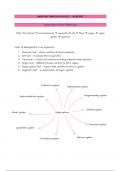
Endocrine system
Reproductive system
Gastrointestinal system Integumentary system
Skeletal system
Renal system Body systems
x̅
Muscular system
Lymphatic system
Nervous system
Circulatory system
, System Description Function
Integumentary Largest organ of the body – skin Provides a protective barrier
Includes epidermis, dermis, against mechanical, thermal &
hypodermis, glands, hair & nails physical injury
Prevents loss of moisture
Reduces harmful effects of UV
radiation
Acts as sensory organ
Regulates temperature
Immune organ
Skeletal Consists of axial and Locomotion – gives attachment
appendicular skeleton to the different body muscles
Protection – of the vital organs
Metabolic function – calcium
reservoir
Produces blood cells
Supports the body
Muscular Contains skeletal, smooth & Permits movement of the body
cardiac muscle Maintains posture
Controlled through the nervous Circulates blood
system Major source of heat production
Nervous Contains a central nervous Controls the body’s functions
system and a peripheral nervous Detects changes in the body’s
system internal and external
environments
Circulatory Made up of blood, the heart and Pump blood throughout the
blood vessels body
Carries oxygen and nutrients to
cells
Defends against disease
Lymphatic Network of delicate tubes Managing fluid levels in the
body
Renal Consists of kidneys, ureters, Eliminates waste from the body
bladder and the urethra Regulates blood volume and
pressure
Controls blood pH
Maintains mineral balance
Gastrointestinal Passageway of the digestive Physical and chemical
system that leads from the breakdown of food
mouth to the anus Absorbs nutrients
Endocrine Glands and organs messenger Regulates body activities through
system hormones
Reproductive Men: prostate, testes & penis Produce egg & sperm cells
Women: ovaries, fallopian tubes, Nurture developing offspring
uterus, cervix & vagina Produce hormones
Organisation levels of the body
Atom → molecule → macromolecule → organelle → cell → tissue → organ → organ
system → organism
Levels of development in an organisms
1. Chemical level – atoms combine to form molecules
2. Cell level – molecules from organelles
3. Tissue level – similar cells and surrounding material make up tissue
4. Organ level – different tissues combine to form organs
5. Organ system level – organs that combine to form a system
6. Organism level – a combination of organ systems
Endocrine system
Reproductive system
Gastrointestinal system Integumentary system
Skeletal system
Renal system Body systems
x̅
Muscular system
Lymphatic system
Nervous system
Circulatory system
, System Description Function
Integumentary Largest organ of the body – skin Provides a protective barrier
Includes epidermis, dermis, against mechanical, thermal &
hypodermis, glands, hair & nails physical injury
Prevents loss of moisture
Reduces harmful effects of UV
radiation
Acts as sensory organ
Regulates temperature
Immune organ
Skeletal Consists of axial and Locomotion – gives attachment
appendicular skeleton to the different body muscles
Protection – of the vital organs
Metabolic function – calcium
reservoir
Produces blood cells
Supports the body
Muscular Contains skeletal, smooth & Permits movement of the body
cardiac muscle Maintains posture
Controlled through the nervous Circulates blood
system Major source of heat production
Nervous Contains a central nervous Controls the body’s functions
system and a peripheral nervous Detects changes in the body’s
system internal and external
environments
Circulatory Made up of blood, the heart and Pump blood throughout the
blood vessels body
Carries oxygen and nutrients to
cells
Defends against disease
Lymphatic Network of delicate tubes Managing fluid levels in the
body
Renal Consists of kidneys, ureters, Eliminates waste from the body
bladder and the urethra Regulates blood volume and
pressure
Controls blood pH
Maintains mineral balance
Gastrointestinal Passageway of the digestive Physical and chemical
system that leads from the breakdown of food
mouth to the anus Absorbs nutrients
Endocrine Glands and organs messenger Regulates body activities through
system hormones
Reproductive Men: prostate, testes & penis Produce egg & sperm cells
Women: ovaries, fallopian tubes, Nurture developing offspring
uterus, cervix & vagina Produce hormones


