18/10/2019
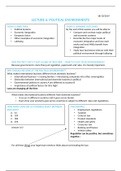
LECTURE 6: POLITICAL ENVIRONMENTS
TODAY’S OBJECTIVES: TODAY’S LEARNING OUTCOMES
• Political Systems By the end of this session you will be able to:
• Economic integration • Compare and contrast major political
• European Union and economic systems
• Other examples of economic integration • Describe the five major levels of
• Lobbying economic integration and how each
works and how MNEs benefit from
integration
• Study how businesses interact with their
political environment through lobbying
WHY POLITICS? ISN’T IT JUST A LOAD OF ‘RED TAPE’ – WHAT’S IT GOT TO DO WITH BUSINESS?
Because government is more than just regulation, paperwork and rules. It is heavily important.
WHY SHOULD WE LOOK AT THE POLITICAL ENVIRONMENT?
What makes international business different from domestic business?
• International business = crossing borders = introducing companies into other sovereignties
• Distinction between international and domestic business is political
• Governmental policies in country A are different to country B
• Importance of political factors for IB is high!
Laws are changing all the time
What makes international business different from domestic business?
• It occurs in different countries and it goes across border.
• Every time your products goes across countries is subject to different rules and regulations.
HOW MANY LAWS DID US CONGRESS ENACT BETWEEN FOR EXAMPLE:
2013-2015? • Employment regulations
A. 43 • Taxation
B. 109 • Contract law
C. 182 • Product standards
D. 296 • Health and safety
• Consumer law
Answer is D • Banking and finance
• Vehicle safety
Regulation can be positive, but sometimes
negative…
For all these things your legal team needs to think about not breaking the law.
, POLITICAL SYSTEMS
• DEMOCRACY: A system of government in which the people, either directly or through their elected
officials, decide what is to be done
• TOTALITARIANISM: A system of government in which one individual or political party maintains
complete control and either refuses to recognize other parties or suppresses them
Basic distinction…
Important to talk about political systems because of what we call political economies.
POLITICAL ECONOMY SYSTEMS
Reality is a little more complex
• MARKET-DRIVEN ECONOMY: An economy in which goods and services are allocated on the basis of
consumer demand
• CENTRALLY DETERMINED ECONOMY: An economy in which goods and services are allocated based
on a plan formulated by a committee that decided what is to be offered
• MIXED ECONOMIES: Economic systems characterized by a combination of market-driven and
centrally driven planning
Varieties of capitalism:
• Liberal market economies (LME) e.g., U.S., U.K., Canada, Australia, New Zealand, Ireland)
• Coordinated market economies (CME) (e.g. Germany, Japan, Sweden, Austria), Hall and Soskice (2001)
• Chinese capitalism (Peck and Zhang 2013)
Capitalism:
• LME Business and consumers have a lot of power on what is get made and consumed
• CME Market, business and consumers are powerful, but governments take a huge part
in how markets are shaped and regulated
• Chinese capitalism different regions within china have different types of capitalism,
some are more market orientated and some are more coordinated and controlled by the
local government
PRIVATIZATION AND NATIONALIZATION
Two approaches – often in flux
• PRIVATIZATION: The process of selling government assets to private buyers
• NATIONALIZATION: A process by which the government takes control of business assets, with or
without recourse
Production sharing agreements (PSAs)
Privatization and nationalization concern manageress and executives of IB.
LECTURE 6: POLITICAL ENVIRONMENTS
TODAY’S OBJECTIVES: TODAY’S LEARNING OUTCOMES
• Political Systems By the end of this session you will be able to:
• Economic integration • Compare and contrast major political
• European Union and economic systems
• Other examples of economic integration • Describe the five major levels of
• Lobbying economic integration and how each
works and how MNEs benefit from
integration
• Study how businesses interact with their
political environment through lobbying
WHY POLITICS? ISN’T IT JUST A LOAD OF ‘RED TAPE’ – WHAT’S IT GOT TO DO WITH BUSINESS?
Because government is more than just regulation, paperwork and rules. It is heavily important.
WHY SHOULD WE LOOK AT THE POLITICAL ENVIRONMENT?
What makes international business different from domestic business?
• International business = crossing borders = introducing companies into other sovereignties
• Distinction between international and domestic business is political
• Governmental policies in country A are different to country B
• Importance of political factors for IB is high!
Laws are changing all the time
What makes international business different from domestic business?
• It occurs in different countries and it goes across border.
• Every time your products goes across countries is subject to different rules and regulations.
HOW MANY LAWS DID US CONGRESS ENACT BETWEEN FOR EXAMPLE:
2013-2015? • Employment regulations
A. 43 • Taxation
B. 109 • Contract law
C. 182 • Product standards
D. 296 • Health and safety
• Consumer law
Answer is D • Banking and finance
• Vehicle safety
Regulation can be positive, but sometimes
negative…
For all these things your legal team needs to think about not breaking the law.
, POLITICAL SYSTEMS
• DEMOCRACY: A system of government in which the people, either directly or through their elected
officials, decide what is to be done
• TOTALITARIANISM: A system of government in which one individual or political party maintains
complete control and either refuses to recognize other parties or suppresses them
Basic distinction…
Important to talk about political systems because of what we call political economies.
POLITICAL ECONOMY SYSTEMS
Reality is a little more complex
• MARKET-DRIVEN ECONOMY: An economy in which goods and services are allocated on the basis of
consumer demand
• CENTRALLY DETERMINED ECONOMY: An economy in which goods and services are allocated based
on a plan formulated by a committee that decided what is to be offered
• MIXED ECONOMIES: Economic systems characterized by a combination of market-driven and
centrally driven planning
Varieties of capitalism:
• Liberal market economies (LME) e.g., U.S., U.K., Canada, Australia, New Zealand, Ireland)
• Coordinated market economies (CME) (e.g. Germany, Japan, Sweden, Austria), Hall and Soskice (2001)
• Chinese capitalism (Peck and Zhang 2013)
Capitalism:
• LME Business and consumers have a lot of power on what is get made and consumed
• CME Market, business and consumers are powerful, but governments take a huge part
in how markets are shaped and regulated
• Chinese capitalism different regions within china have different types of capitalism,
some are more market orientated and some are more coordinated and controlled by the
local government
PRIVATIZATION AND NATIONALIZATION
Two approaches – often in flux
• PRIVATIZATION: The process of selling government assets to private buyers
• NATIONALIZATION: A process by which the government takes control of business assets, with or
without recourse
Production sharing agreements (PSAs)
Privatization and nationalization concern manageress and executives of IB.