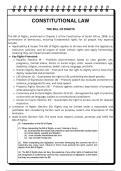
CONSTITUTIONAL LAW
THE BILL OF RIGHTS
The Bill of Rights, enshrined in Chapter 2 of the Constitution of South Africa, 1996, is a
cornerstone of democracy, ensuring fundamental rights for all people. Key aspects
include:
Applicability & Scope: The Bill of Rights applies to all laws and binds the legislature,
executive, judiciary, and all organs of state. Certain rights also apply horizontally,
meaning they can impact private relationships.
Key Rights Protected:
Equality (Section 9) – Prohibits discrimination based on race, gender, sex,
pregnancy, marital status, ethnic or social origin, color, sexual orientation, age,
disability, religion, conscience, belief, culture, language, and birth.
Human Dignity (Section 10) – Everyone has the right to dignity and to have their
dignity respected and protected.
Life (Section 11) – Guarantees the right to life, prohibiting the death penalty.
Freedom of Expression (Section 16) – Protects speech but excludes incitement to
violence, propaganda for war, and hate speech.
Property Rights (Section 25) – Protects against arbitrary deprivation of property
while allowing for land reform.
Customary and Cultural Rights (Section 30 & 31) – Recognizes the right to practice
culture and use language, subject to constitutional compliance.
Access to Courts (Section 34) – Guarantees the right to access courts for dispute
resolution.
Limitation of Rights (Section 36): Rights may be limited under a reasonable and
justifiable test considering factors such as purpose, extent, and importance of the
limitation.
State Duties (Section 7(2)): The state must respect, protect, promote, and fulfill the
Bill of Rights.
, JURISDICTION OF THE COURTS TO HEAR CONSTITUTIONAL MATTERS,
ACCESS TO THE CONSTITUTIONAL COURT, AND THE EXCLUSIVE
JURISDICTION OF THE CONSTITUTIONAL COURT
The Constitutional Court may decide constitutional matters.
The Constitutional Court may decide a non-constitutional matter, if it grants leave to
appeal on the grounds that the matter raises an arguable point of law of general public
importance which it ought to consider.
Only the Constitutional Court may-
decide disputes between organs of state in the national or provincial sphere
concerning the constitutional status, powers or functions of any of those organs
of state;
decide on the constitutionality of any parliamentary or provincial Bill.
However, the threshold procedure of both types of Bill is that the President or
the Premier must give the National Assembly or Provincial Legislature a
chance to accommodate their reservations. If the President or Premier is not
happy with the proposed changes, then the matter is ripe to go to the
Constitutional Court.
decide applications from member s of the National Assembly to declare an Act of
Parliament unconstitutional or from members of the provincial legislature to
declare a provincial act unconstitutional;
Again, there is a threshold requirement before the matter is ripe to be heard:
at least one-third of the members of the National Assembly and 20% of the
members provincial legislature must support the application.
decide on the constitutionality of any amendment to the Constitution;
decide that Parliament or the President has failed to fulfil a constitutional
obligation; or
certify a provincial constitution in terms of sect ion 144.
The only certification is the Constitution of the Western Cape 1 of 1998.
The Constitutional Court makes the final decision whether an Act of Parliament, a
provincial Act or conduct of the President is constitutional.
The Constitutional Court confirms any order of invalidity made by the Supreme Court
of Appeal, t he High Court of South Africa, or a court of similar status, before that
order has any force.
Constitutional Court Rule 18 allows a person, when it is in the interests of justice and
with leave of the Court to bring a matter directly to the Constitutional Court.
Constitutional Court Rule 19 allows a person, when it is in the interests of justice and
with leave of the Court to appeal directly to the Constitutional Court from any other
court
THE BILL OF RIGHTS
The Bill of Rights, enshrined in Chapter 2 of the Constitution of South Africa, 1996, is a
cornerstone of democracy, ensuring fundamental rights for all people. Key aspects
include:
Applicability & Scope: The Bill of Rights applies to all laws and binds the legislature,
executive, judiciary, and all organs of state. Certain rights also apply horizontally,
meaning they can impact private relationships.
Key Rights Protected:
Equality (Section 9) – Prohibits discrimination based on race, gender, sex,
pregnancy, marital status, ethnic or social origin, color, sexual orientation, age,
disability, religion, conscience, belief, culture, language, and birth.
Human Dignity (Section 10) – Everyone has the right to dignity and to have their
dignity respected and protected.
Life (Section 11) – Guarantees the right to life, prohibiting the death penalty.
Freedom of Expression (Section 16) – Protects speech but excludes incitement to
violence, propaganda for war, and hate speech.
Property Rights (Section 25) – Protects against arbitrary deprivation of property
while allowing for land reform.
Customary and Cultural Rights (Section 30 & 31) – Recognizes the right to practice
culture and use language, subject to constitutional compliance.
Access to Courts (Section 34) – Guarantees the right to access courts for dispute
resolution.
Limitation of Rights (Section 36): Rights may be limited under a reasonable and
justifiable test considering factors such as purpose, extent, and importance of the
limitation.
State Duties (Section 7(2)): The state must respect, protect, promote, and fulfill the
Bill of Rights.
, JURISDICTION OF THE COURTS TO HEAR CONSTITUTIONAL MATTERS,
ACCESS TO THE CONSTITUTIONAL COURT, AND THE EXCLUSIVE
JURISDICTION OF THE CONSTITUTIONAL COURT
The Constitutional Court may decide constitutional matters.
The Constitutional Court may decide a non-constitutional matter, if it grants leave to
appeal on the grounds that the matter raises an arguable point of law of general public
importance which it ought to consider.
Only the Constitutional Court may-
decide disputes between organs of state in the national or provincial sphere
concerning the constitutional status, powers or functions of any of those organs
of state;
decide on the constitutionality of any parliamentary or provincial Bill.
However, the threshold procedure of both types of Bill is that the President or
the Premier must give the National Assembly or Provincial Legislature a
chance to accommodate their reservations. If the President or Premier is not
happy with the proposed changes, then the matter is ripe to go to the
Constitutional Court.
decide applications from member s of the National Assembly to declare an Act of
Parliament unconstitutional or from members of the provincial legislature to
declare a provincial act unconstitutional;
Again, there is a threshold requirement before the matter is ripe to be heard:
at least one-third of the members of the National Assembly and 20% of the
members provincial legislature must support the application.
decide on the constitutionality of any amendment to the Constitution;
decide that Parliament or the President has failed to fulfil a constitutional
obligation; or
certify a provincial constitution in terms of sect ion 144.
The only certification is the Constitution of the Western Cape 1 of 1998.
The Constitutional Court makes the final decision whether an Act of Parliament, a
provincial Act or conduct of the President is constitutional.
The Constitutional Court confirms any order of invalidity made by the Supreme Court
of Appeal, t he High Court of South Africa, or a court of similar status, before that
order has any force.
Constitutional Court Rule 18 allows a person, when it is in the interests of justice and
with leave of the Court to bring a matter directly to the Constitutional Court.
Constitutional Court Rule 19 allows a person, when it is in the interests of justice and
with leave of the Court to appeal directly to the Constitutional Court from any other
court