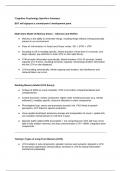
'Cognitive Psychology Specifics Summary'
BUT will signpost a counterpoint / development point
Multi Store Model of Memory theory – Atkinson and Shiffrin
● Memory is the ability to remember things, recalling things without it being physically
present in our environment.
● Flow of information in fixed and linear order: SR → STM → LTM
● Encoding in SR is modality specific, limited duration of less than 0.5 seconds, very
large capacity, pay attention to enter STM or else rapid decay.
● STM encodes information acoustically, limited duration of 18–30 seconds, limited
capacity of 5–9 items, chunking increases capacity, rehearsing transfers information
into the LTM or else displaced.
● LTM encoding semantically, infinite capacity and duration, but interference and
retrieval failure can occur.
Working Memory Model (1974 theory)
● Critique of MSM as overly simplistic; STM to be further compartmentalised and
complex/active.
● Central executive: master component, higher order mental processes (e.g. mental
arithmetic), modality specific, resource allocation to slave components.
● Phonological loop: stores and processes acoustic info. PAS linked to speech
perception, ACP linked to speech production.
● Visuo-spatial sketchpad: temporary storage and manipulation of visual + spatial info,
can visualise mental pictures in real time or past.
● Episodic buffer added 2000 (incomplete + not comprehensive 1974 still may not be
able to fully explain memory), two-way communication LTM + WMM, integrates slave
components.
Tulving’s Types of Long-Term Memory (1972)
● LTM contains 2 sub-components: episodic memory and semantic. Episodic is LTM
for personal experiences (mental diary); semantic is LTM for factual information
(mental encyclopaedia).
, ● Episodic memory linked to time it occurred, transformed due to emotion at time of
recording, context-dependent and continuous.
● Semantic recalled without time being referenced, inputted in a fragmentary way, not
likely to be transformed and not dependent on context.
● Both memories are independent of each other, but semantic needed for episodic – to
draw on prior knowledge for understanding.
Reconstructive Memory Theory – Bartlett (1932)
● Memory is unlike a passive tape recorder, but involves active processing of
fragments which are reconstructed in recall, leading to inaccuracies, distortions etc.
● Fill in gaps with assumptions that make sense with rest of info.
● Schemas are cognitive frameworks which hold knowledge to organise and interpret
info, developed via personal experiences and a mental representation of the world,
allow for mental shortcuts to fill in gaps (e.g. businessmen in suits).
● Confabulation is filling in gaps using pre-existing info + expectations based on
subjective schemas.
● War of Ghosts study to demonstrate reconstructive memory: 20 British
students memorise Native American folk tale, lacked rational order,
supernatural ending, read story twice and tested weeks, months, years
later (6.5 years max). Found: shortened story 330 → 180 words, changed
“canoe” → “boat” (based on schema), 7 omitted title — hence recall is
inaccurate.
● Assimilation is where we change our memories based on what we’ve
learnt (schemas). Other times we may accommodate, which is where we
change memories to fit schemas, e.g. sharpening to add + exaggerate
details or levelling to reduce detail/omission → leaving out detail that
doesn’t fit schema.
(Seen in War of Ghosts) Rationalisation = form of accommodation to change
memories to make more sense.
Case Studies in Cognitive
● Detailed in-depth longitudinal study (lacks objectivity if developing relationship over
long period, interpret data to fit in with theories) to see developments of brain
damage effect on memory. Uses triangulation to collect data via multiple methods
(GP record, observation, interview) which improves consistency of data gathered,
improving reliability.
● Rely on retrospective data about patient’s memory ability before brain damage
(cannot be certain if brain damage caused memory deficits or if it existed before –
BUT will signpost a counterpoint / development point
Multi Store Model of Memory theory – Atkinson and Shiffrin
● Memory is the ability to remember things, recalling things without it being physically
present in our environment.
● Flow of information in fixed and linear order: SR → STM → LTM
● Encoding in SR is modality specific, limited duration of less than 0.5 seconds, very
large capacity, pay attention to enter STM or else rapid decay.
● STM encodes information acoustically, limited duration of 18–30 seconds, limited
capacity of 5–9 items, chunking increases capacity, rehearsing transfers information
into the LTM or else displaced.
● LTM encoding semantically, infinite capacity and duration, but interference and
retrieval failure can occur.
Working Memory Model (1974 theory)
● Critique of MSM as overly simplistic; STM to be further compartmentalised and
complex/active.
● Central executive: master component, higher order mental processes (e.g. mental
arithmetic), modality specific, resource allocation to slave components.
● Phonological loop: stores and processes acoustic info. PAS linked to speech
perception, ACP linked to speech production.
● Visuo-spatial sketchpad: temporary storage and manipulation of visual + spatial info,
can visualise mental pictures in real time or past.
● Episodic buffer added 2000 (incomplete + not comprehensive 1974 still may not be
able to fully explain memory), two-way communication LTM + WMM, integrates slave
components.
Tulving’s Types of Long-Term Memory (1972)
● LTM contains 2 sub-components: episodic memory and semantic. Episodic is LTM
for personal experiences (mental diary); semantic is LTM for factual information
(mental encyclopaedia).
, ● Episodic memory linked to time it occurred, transformed due to emotion at time of
recording, context-dependent and continuous.
● Semantic recalled without time being referenced, inputted in a fragmentary way, not
likely to be transformed and not dependent on context.
● Both memories are independent of each other, but semantic needed for episodic – to
draw on prior knowledge for understanding.
Reconstructive Memory Theory – Bartlett (1932)
● Memory is unlike a passive tape recorder, but involves active processing of
fragments which are reconstructed in recall, leading to inaccuracies, distortions etc.
● Fill in gaps with assumptions that make sense with rest of info.
● Schemas are cognitive frameworks which hold knowledge to organise and interpret
info, developed via personal experiences and a mental representation of the world,
allow for mental shortcuts to fill in gaps (e.g. businessmen in suits).
● Confabulation is filling in gaps using pre-existing info + expectations based on
subjective schemas.
● War of Ghosts study to demonstrate reconstructive memory: 20 British
students memorise Native American folk tale, lacked rational order,
supernatural ending, read story twice and tested weeks, months, years
later (6.5 years max). Found: shortened story 330 → 180 words, changed
“canoe” → “boat” (based on schema), 7 omitted title — hence recall is
inaccurate.
● Assimilation is where we change our memories based on what we’ve
learnt (schemas). Other times we may accommodate, which is where we
change memories to fit schemas, e.g. sharpening to add + exaggerate
details or levelling to reduce detail/omission → leaving out detail that
doesn’t fit schema.
(Seen in War of Ghosts) Rationalisation = form of accommodation to change
memories to make more sense.
Case Studies in Cognitive
● Detailed in-depth longitudinal study (lacks objectivity if developing relationship over
long period, interpret data to fit in with theories) to see developments of brain
damage effect on memory. Uses triangulation to collect data via multiple methods
(GP record, observation, interview) which improves consistency of data gathered,
improving reliability.
● Rely on retrospective data about patient’s memory ability before brain damage
(cannot be certain if brain damage caused memory deficits or if it existed before –