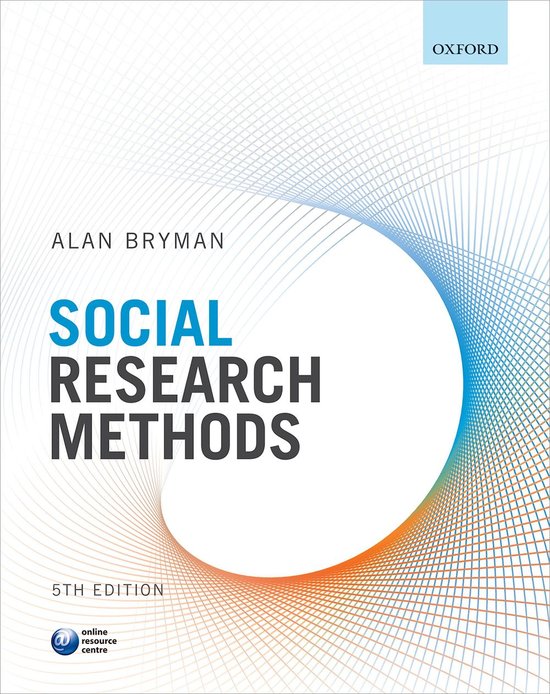
Bryman, A. (2015). Social research methods, 5th edition. Oxford University Press (or 4th edition, 2012)
Introduction to Social Science Methods
Chapter: 1 & 2
What is research about?
Looking for and finding relevant information relevant depending on question you are
asking
Science = research + theory
Theory
Set of statements that are logically connected
- Explain observed regularities, find patterns
- Often about relations between things (e.g. age and running)
- Reduce complexity (make reality less complicated by finding patterns and underlaying
principles)
- Apply to also similar situations be more or less general
Theory is construction:
Theories are not a part of reality (Kant)
Theories are ways to make sense of reality (pragmatists)
Constant a work in progress, useful as long as useful
Different types of theories
Grand Theories
- Explain a lot (e.g. accounting society as a whole)
- Massive complexity reduction
- Very abstract
- Difficult to apply in research
Middle range theories
- Explain more specific types of situation (less general)
- Less abstract
- Better to apply in research
Methods
Deduction (from theory to empirical data)
- Expectation (hypothesis) translating theory in something you can study
- Collecting data (observations)
- Testing theory theory in line with observations
o Confirmation (observations in line with hypotheses)
,Bryman, A. (2015). Social research methods, 5th edition. Oxford University Press (or 4th edition, 2012)
o Falsification (observations contrasts hypotheses)
But…
- Theory doesn’t come out of the blue (some induction)
- E.g. prior research, or observations
Induction (from empirical data to theory)
- Collecting data
- Interpret findings
- Theory building by synthesis of findings
o Grounded theory building theory from the ground up
But..
- You need to know what/where to observe (you need some deduction)
Two types of Empirical circles: deductive and inductive (see slides)
Scientific research is about (social) reality
Social reality ontology
- What is reality how should we consider the being of things?
- What is social reality is there a social reality? Is this reality external to us?
Objectivism
- Social reality exists
- Objective part of reality
- External to us
- Can’t individually control it but has impact on our behavior and thinking
o E.g. gender roles, national identity, social class system controls our way of
thinking
Constructivism
- Social reality only real in mind (only exists in the mind of individual people)
- Intersubjective
- Constructed through interaction
- Our behavior and thinking has impact on social reality
o E.g. gender roles, national identity, social class system are constructions by our
behavior and thinking
Also, something in between (Thomas Theorem)
- Once a social reality has been constructed it does become real
How we understand epistemology
- What is the nature of knowledge?
- Which types of knowledge and when scientific?
- What is a proper way of studying things
Positivism (Comte)
- Social reality is objective and factual (just like physical reality e.g. gravity)
- Human behavior is regular looking for general and universal laws
, Bryman, A. (2015). Social research methods, 5th edition. Oxford University Press (or 4th edition, 2012)
- Explaining behavior by finding its causes
- Studying facts by measuring/counting human behavior
Interpretivism
- Social reality is constituent of people subjective
- People don’t behave like atoms people making interpretations of surroundings
- Interpretation interpretations
o Verstehen (Weber)
o Hermeneutics
o Symbolic interactionism
- More about meaning than causes
Epistemologies: Positivism & Interpretivism
Ontology: Objectivism & Constructionism
Relation theory-research: Deductive & Inductive
Research strategy: Quantitative & Qualitive
Values
- Research should be neutral free of personal values
- But is that possible?
o Topics (personal and popularity)
o Interpretations of findings (personal inclinations shine through)
- Be aware of your values and be open about them
Practical considerations
- Research should be only about contents and not about practical compromises
- But is that possible?
o Topics
o Availability of prior knowledge topic
o Some topics more difficult to study than others
o But also, money, time, expertise and preferences
- What are the most important things to study and how can I do this in the best way
possible
In conclusion, don’t be naïve!
Introduction to Social Science Methods
Chapter: 1 & 2
What is research about?
Looking for and finding relevant information relevant depending on question you are
asking
Science = research + theory
Theory
Set of statements that are logically connected
- Explain observed regularities, find patterns
- Often about relations between things (e.g. age and running)
- Reduce complexity (make reality less complicated by finding patterns and underlaying
principles)
- Apply to also similar situations be more or less general
Theory is construction:
Theories are not a part of reality (Kant)
Theories are ways to make sense of reality (pragmatists)
Constant a work in progress, useful as long as useful
Different types of theories
Grand Theories
- Explain a lot (e.g. accounting society as a whole)
- Massive complexity reduction
- Very abstract
- Difficult to apply in research
Middle range theories
- Explain more specific types of situation (less general)
- Less abstract
- Better to apply in research
Methods
Deduction (from theory to empirical data)
- Expectation (hypothesis) translating theory in something you can study
- Collecting data (observations)
- Testing theory theory in line with observations
o Confirmation (observations in line with hypotheses)
,Bryman, A. (2015). Social research methods, 5th edition. Oxford University Press (or 4th edition, 2012)
o Falsification (observations contrasts hypotheses)
But…
- Theory doesn’t come out of the blue (some induction)
- E.g. prior research, or observations
Induction (from empirical data to theory)
- Collecting data
- Interpret findings
- Theory building by synthesis of findings
o Grounded theory building theory from the ground up
But..
- You need to know what/where to observe (you need some deduction)
Two types of Empirical circles: deductive and inductive (see slides)
Scientific research is about (social) reality
Social reality ontology
- What is reality how should we consider the being of things?
- What is social reality is there a social reality? Is this reality external to us?
Objectivism
- Social reality exists
- Objective part of reality
- External to us
- Can’t individually control it but has impact on our behavior and thinking
o E.g. gender roles, national identity, social class system controls our way of
thinking
Constructivism
- Social reality only real in mind (only exists in the mind of individual people)
- Intersubjective
- Constructed through interaction
- Our behavior and thinking has impact on social reality
o E.g. gender roles, national identity, social class system are constructions by our
behavior and thinking
Also, something in between (Thomas Theorem)
- Once a social reality has been constructed it does become real
How we understand epistemology
- What is the nature of knowledge?
- Which types of knowledge and when scientific?
- What is a proper way of studying things
Positivism (Comte)
- Social reality is objective and factual (just like physical reality e.g. gravity)
- Human behavior is regular looking for general and universal laws
, Bryman, A. (2015). Social research methods, 5th edition. Oxford University Press (or 4th edition, 2012)
- Explaining behavior by finding its causes
- Studying facts by measuring/counting human behavior
Interpretivism
- Social reality is constituent of people subjective
- People don’t behave like atoms people making interpretations of surroundings
- Interpretation interpretations
o Verstehen (Weber)
o Hermeneutics
o Symbolic interactionism
- More about meaning than causes
Epistemologies: Positivism & Interpretivism
Ontology: Objectivism & Constructionism
Relation theory-research: Deductive & Inductive
Research strategy: Quantitative & Qualitive
Values
- Research should be neutral free of personal values
- But is that possible?
o Topics (personal and popularity)
o Interpretations of findings (personal inclinations shine through)
- Be aware of your values and be open about them
Practical considerations
- Research should be only about contents and not about practical compromises
- But is that possible?
o Topics
o Availability of prior knowledge topic
o Some topics more difficult to study than others
o But also, money, time, expertise and preferences
- What are the most important things to study and how can I do this in the best way
possible
In conclusion, don’t be naïve!