STRESS ADVANCED INFORMATION 2022
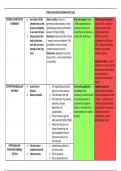
GENERAL ADAPTATION Hans Selye (1936) Alarm reaction: stressor is Research support: Selye GAS may not be general:
SYNDROME viewed stress as the perceived, initial reaction is shock (1936) subjected rats to Mason (1971) replicated
process of adapting (physiological systems activated to extreme stressors and Selye’s procedure with
to an acute stressor. prepare for fight or flight). found the same responses monkeys and found
Stress protects the Resistance: body resists the stressor as GAS after 6-48 hours. different reactions –
body in the short – energy stores are depleted - PNS challenges the validity of
term but can cause activated to conserve energy GAS – shows that specific
damage in the long (stressor becomes chronic). stressors can produce
term. Exhaustion: adaptation to chronic specific responses.
stressor fails – stress-related illness
is now likely). Ungeneralisable: research
conducted on animals stress
in humans is more complex
as it is affected by
cognitive/environmental
factors.
SYMPATHOMEDULLARY Acute stress = 1. The hypothalamus (brain) Real-world application: Cognitive appraisal:
PATHWAY physical. detects an acute stressor. knowledge of the physiological explanations
Adrenal medulla. 2. This stimulates the SNS physiology of stress has led ignore psychological factors
3. This stimulates the adrenal to the development of in stress – Speisman et al.
medulla to release treatment for Addison’s (1964) concluded that the
adrenaline and disease – self-administer interpretation of stressors
noradrenaline. hydrocortisone to mobilise as threats cannot be
4. These hormones get the the SNS. explained by a purely
body ready for fight or flight. physiological theory.
5. When the stressor is no
longer threatening, the
parasympathetic branch
returns the body to its
normal state.
HYPOTHALAMIC- Chronic stress = 1. Hypothalamus detects a
PITUITARY-ADRENAL emotional/mental. chronic stressor.
SYSTEM Adrenal cortex. 2. CRF is produced.
3. This is detected by the
, anterior pituitary gland and
stimulates it to release ACTH
into the bloodstream.
4. This simulates the adrenal
cortex to release cortisol.
5. This affects glucose
metabolism by mobilising
and restoring energy
supplies, lowers sensitivity to
pain and supresses the
immune system.
LIFE CHANGES Significant and Life changes cause stress because Research support: Lietzen Individual differences:
infrequent events in we must psychologically extend et al. (2011) followed Byrne and Whyte (1980)
people’s lives. ourselves to cope with the change. 16,000 adults who did not tried to predict who would
Measures through Life changes: relationship changes have asthma - found that a experience MI based on
Holmes and Rahe’s financial state, moving house. high level of life change SSRS scores - found that it
SSRS. Rahe (1970): a single-blind stress predicted asthma was not possible (lacks
Rahe (1970) prospective study of US navy onset. validity) as stress does not
personnel. affect everyone in the same
LCU score for each ppt based way.
on 6 months prior to active
duty was calculated.
Illnesses were reported and
an illness score was
calculated for each ppt.
Found that high LCU ratings
predicted illness.
Life changes were a predictor
of stress-related illness.
DAILY HASSLES Relatively minor but Kanner et al. (1981): hassles and Research support: Correlation not causation:
frequent uplifts scale. Ivancevich (1986) asked we cannot conclude that
aggravations of 100 ppts completed the participants to complete daily hassles cause stress -
everyday life that HSUP every month for 9 the HSUP. Found that daily ignores psychological
culminate in stress. months. hassles were strong factors (depression may
Measures through Participants also completed predictors of poor health, cause people to experience
GENERAL ADAPTATION Hans Selye (1936) Alarm reaction: stressor is Research support: Selye GAS may not be general:
SYNDROME viewed stress as the perceived, initial reaction is shock (1936) subjected rats to Mason (1971) replicated
process of adapting (physiological systems activated to extreme stressors and Selye’s procedure with
to an acute stressor. prepare for fight or flight). found the same responses monkeys and found
Stress protects the Resistance: body resists the stressor as GAS after 6-48 hours. different reactions –
body in the short – energy stores are depleted - PNS challenges the validity of
term but can cause activated to conserve energy GAS – shows that specific
damage in the long (stressor becomes chronic). stressors can produce
term. Exhaustion: adaptation to chronic specific responses.
stressor fails – stress-related illness
is now likely). Ungeneralisable: research
conducted on animals stress
in humans is more complex
as it is affected by
cognitive/environmental
factors.
SYMPATHOMEDULLARY Acute stress = 1. The hypothalamus (brain) Real-world application: Cognitive appraisal:
PATHWAY physical. detects an acute stressor. knowledge of the physiological explanations
Adrenal medulla. 2. This stimulates the SNS physiology of stress has led ignore psychological factors
3. This stimulates the adrenal to the development of in stress – Speisman et al.
medulla to release treatment for Addison’s (1964) concluded that the
adrenaline and disease – self-administer interpretation of stressors
noradrenaline. hydrocortisone to mobilise as threats cannot be
4. These hormones get the the SNS. explained by a purely
body ready for fight or flight. physiological theory.
5. When the stressor is no
longer threatening, the
parasympathetic branch
returns the body to its
normal state.
HYPOTHALAMIC- Chronic stress = 1. Hypothalamus detects a
PITUITARY-ADRENAL emotional/mental. chronic stressor.
SYSTEM Adrenal cortex. 2. CRF is produced.
3. This is detected by the
, anterior pituitary gland and
stimulates it to release ACTH
into the bloodstream.
4. This simulates the adrenal
cortex to release cortisol.
5. This affects glucose
metabolism by mobilising
and restoring energy
supplies, lowers sensitivity to
pain and supresses the
immune system.
LIFE CHANGES Significant and Life changes cause stress because Research support: Lietzen Individual differences:
infrequent events in we must psychologically extend et al. (2011) followed Byrne and Whyte (1980)
people’s lives. ourselves to cope with the change. 16,000 adults who did not tried to predict who would
Measures through Life changes: relationship changes have asthma - found that a experience MI based on
Holmes and Rahe’s financial state, moving house. high level of life change SSRS scores - found that it
SSRS. Rahe (1970): a single-blind stress predicted asthma was not possible (lacks
Rahe (1970) prospective study of US navy onset. validity) as stress does not
personnel. affect everyone in the same
LCU score for each ppt based way.
on 6 months prior to active
duty was calculated.
Illnesses were reported and
an illness score was
calculated for each ppt.
Found that high LCU ratings
predicted illness.
Life changes were a predictor
of stress-related illness.
DAILY HASSLES Relatively minor but Kanner et al. (1981): hassles and Research support: Correlation not causation:
frequent uplifts scale. Ivancevich (1986) asked we cannot conclude that
aggravations of 100 ppts completed the participants to complete daily hassles cause stress -
everyday life that HSUP every month for 9 the HSUP. Found that daily ignores psychological
culminate in stress. months. hassles were strong factors (depression may
Measures through Participants also completed predictors of poor health, cause people to experience