BIOL 301 QUIZ 1 WITH COMPLETE
SOLUTIONS
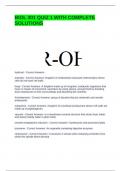
hydroxyl - Correct Answers -
animalia - Correct Answers -kingdom of multicellular eukaryotic heterotrophs whose
cells do not have cell walls
fungi - Correct Answers -A kingdom made up of nongreen, eukaryotic organisms that
have no means of movement, reproduce by using spores, and get food by breaking
down substances in their surroundings and absorbing the nutrients
Archebacteria - Correct Answers -group of bacteria that are anaerobic and aerobic
prokaryotes
eubacteria - Correct Answers -Kingdom of unicellular prokaryotes whose cell walls are
made up of peptidoglycan
vacuole - Correct Answers -is a membrane covered structure that stores food, water,
and waste (mainly water in plant cells)
smooth endoplasmic reticulum - Correct Answers -Synthesizes and processes lipids
lysosome - Correct Answers -An organelle containing digestive enzymes
centrosome - Correct Answers -A structure in animal cells containing centrioles from
which the spindle fibers develop
, protista - Correct Answers -Kingdom composed of eukaryotes that are not classified as
plants, animals, or fungi
plantae - Correct Answers -Kingdom of multicellular photosynthetic autotrophs that have
cell walls containing cellulose
emergent properties - Correct Answers -New properties that arise with each step
upward in the hierarchy of life, owing to the arrangement and interactions of parts as
complexity increases.
synergy - Correct Answers -the interaction or cooperation of two or more organizations,
substances, or other agents to produce a combined effect greater than the sum of their
separate effects
n - Correct Answers -principle quantum number indicating shell/energy level
l - Correct Answers -orbital angular momentum quantum number indicating subshell
(s=0, p=1, d=2, f=3)
ml - Correct Answers -magnetic quantum number indicating orbitals of a given shell (-l
to +l)
ms - Correct Answers -spin magnetic quantum number indicating an electron's spin
(+1/2 or - 1/2)
aufbau principle - Correct Answers -electron's occupy orbitals in order of increasing
energy
Hund's Rule - Correct Answers -electrons must first occupy empty orbitals before
double occupying orbitals
Pauli Exclusion Principle - Correct Answers -electrons with the same n, l, and ml
numbers must have different ms (spins)
ribosomes - Correct Answers -site of protein synthesis
rough endoplasmic reticulum - Correct Answers -transport and storage of proteins
nucleoid - Correct Answers -A dense region of DNA in a prokaryotic cell
nucleus - Correct Answers -contains chromosomes, rich in DNA
nucleolus - Correct Answers -Found inside the nucleus and produces ribosomes
golgi apparatus - Correct Answers -stack of membranes in the cell that modifies, sorts,
and packages proteins from the endoplasmic reticulum
SOLUTIONS
hydroxyl - Correct Answers -
animalia - Correct Answers -kingdom of multicellular eukaryotic heterotrophs whose
cells do not have cell walls
fungi - Correct Answers -A kingdom made up of nongreen, eukaryotic organisms that
have no means of movement, reproduce by using spores, and get food by breaking
down substances in their surroundings and absorbing the nutrients
Archebacteria - Correct Answers -group of bacteria that are anaerobic and aerobic
prokaryotes
eubacteria - Correct Answers -Kingdom of unicellular prokaryotes whose cell walls are
made up of peptidoglycan
vacuole - Correct Answers -is a membrane covered structure that stores food, water,
and waste (mainly water in plant cells)
smooth endoplasmic reticulum - Correct Answers -Synthesizes and processes lipids
lysosome - Correct Answers -An organelle containing digestive enzymes
centrosome - Correct Answers -A structure in animal cells containing centrioles from
which the spindle fibers develop
, protista - Correct Answers -Kingdom composed of eukaryotes that are not classified as
plants, animals, or fungi
plantae - Correct Answers -Kingdom of multicellular photosynthetic autotrophs that have
cell walls containing cellulose
emergent properties - Correct Answers -New properties that arise with each step
upward in the hierarchy of life, owing to the arrangement and interactions of parts as
complexity increases.
synergy - Correct Answers -the interaction or cooperation of two or more organizations,
substances, or other agents to produce a combined effect greater than the sum of their
separate effects
n - Correct Answers -principle quantum number indicating shell/energy level
l - Correct Answers -orbital angular momentum quantum number indicating subshell
(s=0, p=1, d=2, f=3)
ml - Correct Answers -magnetic quantum number indicating orbitals of a given shell (-l
to +l)
ms - Correct Answers -spin magnetic quantum number indicating an electron's spin
(+1/2 or - 1/2)
aufbau principle - Correct Answers -electron's occupy orbitals in order of increasing
energy
Hund's Rule - Correct Answers -electrons must first occupy empty orbitals before
double occupying orbitals
Pauli Exclusion Principle - Correct Answers -electrons with the same n, l, and ml
numbers must have different ms (spins)
ribosomes - Correct Answers -site of protein synthesis
rough endoplasmic reticulum - Correct Answers -transport and storage of proteins
nucleoid - Correct Answers -A dense region of DNA in a prokaryotic cell
nucleus - Correct Answers -contains chromosomes, rich in DNA
nucleolus - Correct Answers -Found inside the nucleus and produces ribosomes
golgi apparatus - Correct Answers -stack of membranes in the cell that modifies, sorts,
and packages proteins from the endoplasmic reticulum