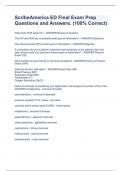
,ENC1501 Assignment 2 (COMPLETE ANSWERS)
2025 - DUE 2025; 100% TRUSTED Comple
Multiple choice,assured excellence
QUESTION 1 (10marks) 1.1 Define the following terms with
examples using your own words. If you copy from the study
guide, you will be penalised. 1.1.1 Remedial (2) 1.1.2 Coherent
(2) 1.1.3 Colloquial language (2) 1.1.4 Didactics (2) 1.1.5 SWOT
analysis (2) (10) QUESTION2 (10 marks) 2.1 Distinguish between
formal and informal language and state when each should be in
the conversation. Give examples to support your responses. (10
ASSESSMENT 2: WRITTEN ASSESSMENT 100 MARKS
ENC1501/ASSESSMENT 2/0/2025 3 SECTION B (40 Marks)
QUESTION 3 3.1. Discuss different aspects of sound and indicate
how you will use them to enhance the listening skills in your
Foundation Phase class. (10) Read the following case study As a
Grade R teacher, you noticed that your learners are not
participating actively during your lesson presentation. The HOD
advised you that you need to dramatise the words to bring
them to life and make them more effective. 3.2. Explain why
drama can be more effective than speaking when
communicating with your Grade R learners. (10) 3.3 Do you
think Bloom’s taxonomy should be implemented in the
Foundation Phase? Analyse why Foundation Phase teachers
should use it to assess learners. (10) 3.4 After reading the
article
, QUESTION 1 (10 Marks)
1.1 Define the following terms with examples using your own
words.
1.1.1 Remedial (2 marks)
Remedial refers to extra help given to learners who are
struggling to keep up with the rest of the class. For example, if
a learner has difficulty reading, the teacher may provide
remedial reading lessons after school to help them improve.
1.1.2 Coherent (2 marks)
Coherent means something is clear, logical, and easy to
understand. For instance, a coherent paragraph has well-
organised sentences that connect smoothly and make sense
together.
1.1.3 Colloquial language (2 marks)
Colloquial language is everyday spoken language that people
use in informal conversations. For example, saying “gonna”
instead of “going to” is using colloquial language.
1.1.4 Didactics (2 marks)
Didactics refers to teaching methods or the science of
teaching. For example, using stories to teach moral lessons is a
didactic method.
2025 - DUE 2025; 100% TRUSTED Comple
Multiple choice,assured excellence
QUESTION 1 (10marks) 1.1 Define the following terms with
examples using your own words. If you copy from the study
guide, you will be penalised. 1.1.1 Remedial (2) 1.1.2 Coherent
(2) 1.1.3 Colloquial language (2) 1.1.4 Didactics (2) 1.1.5 SWOT
analysis (2) (10) QUESTION2 (10 marks) 2.1 Distinguish between
formal and informal language and state when each should be in
the conversation. Give examples to support your responses. (10
ASSESSMENT 2: WRITTEN ASSESSMENT 100 MARKS
ENC1501/ASSESSMENT 2/0/2025 3 SECTION B (40 Marks)
QUESTION 3 3.1. Discuss different aspects of sound and indicate
how you will use them to enhance the listening skills in your
Foundation Phase class. (10) Read the following case study As a
Grade R teacher, you noticed that your learners are not
participating actively during your lesson presentation. The HOD
advised you that you need to dramatise the words to bring
them to life and make them more effective. 3.2. Explain why
drama can be more effective than speaking when
communicating with your Grade R learners. (10) 3.3 Do you
think Bloom’s taxonomy should be implemented in the
Foundation Phase? Analyse why Foundation Phase teachers
should use it to assess learners. (10) 3.4 After reading the
article
, QUESTION 1 (10 Marks)
1.1 Define the following terms with examples using your own
words.
1.1.1 Remedial (2 marks)
Remedial refers to extra help given to learners who are
struggling to keep up with the rest of the class. For example, if
a learner has difficulty reading, the teacher may provide
remedial reading lessons after school to help them improve.
1.1.2 Coherent (2 marks)
Coherent means something is clear, logical, and easy to
understand. For instance, a coherent paragraph has well-
organised sentences that connect smoothly and make sense
together.
1.1.3 Colloquial language (2 marks)
Colloquial language is everyday spoken language that people
use in informal conversations. For example, saying “gonna”
instead of “going to” is using colloquial language.
1.1.4 Didactics (2 marks)
Didactics refers to teaching methods or the science of
teaching. For example, using stories to teach moral lessons is a
didactic method.