1
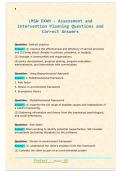
LMSW EXAM - Assessment and
Intervention Planning Questions and
Correct Answers
Question: Indirect practice
Answer: (1) improve the effectiveness and efficiency of service provision
and (2) bring about changes in policies, programs, or budgets,
(3) changes in communities and organizations.
(4) policy development, program planing, program evaluation,
administration, and intervention with communities.
Question: Using Biopsychosocial Approach
Answer: 1. Multidimensional framework
2. Risk factor
3. Person-in-environment framework
4. Ecosystems theory
Question: Multidimensional framework
Answer: (1) examine the full range of possible causes and explanations of
a client's functioning.
(2) Gathering information and theory from the biophysical,psychological,
and social dimensions.
Question: Risk factor
Answer: When working to identify potential causal factors, SW consider
precipitants (activating situations) to the problems.
Question: Person-in-environment framework
Answer: (1) understand the client's situation from this framework
(2) Consider the client as part of an environmental system
Pretest - Stuvia US
,2
Question: Ecosystms theory
Answer: It concerned with the study and description of human beings and
other living systems and the transactions between them, and it proposes
that psychological prepossess are manifestations of interaction between
and among biological, interpersonal, cultural political, economic, legal,
and organizational forces and that theses forces interact continually and
influence a persons' behavior during her entire lifespan.
Question: The phases of Assessment
Answer: 1. Data collection - avoid jumping to conclusions about the
nature or causes of the client's problem at this time.
2. Organizing and Studying the data - should include client's strengths
and deficiencies
Question: The presenting problem
Answer: Consists of symptoms and issues, or difficulties
"I have trouble forming relationships with men"
"I'm so depressed"
"My husband and I can't stop fighting"
Problems may also include others such as family members, coworkers.
Question: Questions to explore in problem assessment
Answer: 1. problems and concerns
2. Legal mandates
3. Health or safety issues
4. signs and symptoms - it is something observed by you rather than
reported by the client
5. individuals/ systems
6. interact
7. severity
8. duration
9. where, when and frequency
10. consequences
11. emotional reactions
Pretest - Stuvia US
, 3
12. meanings
13. developmental stage or life transition
14. other issues
15. coping skills
16. skills, strengths, resources
17. cultural, social and social class
18. support system
19. external resources
Question: Guidelines for conducting a competent assessment
Answer: 1. Follow the principles of relevance and salience - limited
sessions under managed care.
2. Address top priorities FIRST
3. Gather information from a variety of sources
4. Recognize the uniqueness of the client - Should not draw final
conclusions about client.
5. Adopt a strengths perspective
6. Be aware of factors that can affect a client's response - Malingering /
defensiveness
7. View assessment as both a product and a process
Question: Address top priorities FIRST
Answer: 1. Start where the client is - "What the client sees as her primary
problem or concern?"
2. Legal mandates - should be addressed at the begining
3. Health /Safety concerns
Question: Malingering
Answer: "Faking bad"
Question: Defensiveness
Answer: "Faking good"
Pretest - Stuvia US
LMSW EXAM - Assessment and
Intervention Planning Questions and
Correct Answers
Question: Indirect practice
Answer: (1) improve the effectiveness and efficiency of service provision
and (2) bring about changes in policies, programs, or budgets,
(3) changes in communities and organizations.
(4) policy development, program planing, program evaluation,
administration, and intervention with communities.
Question: Using Biopsychosocial Approach
Answer: 1. Multidimensional framework
2. Risk factor
3. Person-in-environment framework
4. Ecosystems theory
Question: Multidimensional framework
Answer: (1) examine the full range of possible causes and explanations of
a client's functioning.
(2) Gathering information and theory from the biophysical,psychological,
and social dimensions.
Question: Risk factor
Answer: When working to identify potential causal factors, SW consider
precipitants (activating situations) to the problems.
Question: Person-in-environment framework
Answer: (1) understand the client's situation from this framework
(2) Consider the client as part of an environmental system
Pretest - Stuvia US
,2
Question: Ecosystms theory
Answer: It concerned with the study and description of human beings and
other living systems and the transactions between them, and it proposes
that psychological prepossess are manifestations of interaction between
and among biological, interpersonal, cultural political, economic, legal,
and organizational forces and that theses forces interact continually and
influence a persons' behavior during her entire lifespan.
Question: The phases of Assessment
Answer: 1. Data collection - avoid jumping to conclusions about the
nature or causes of the client's problem at this time.
2. Organizing and Studying the data - should include client's strengths
and deficiencies
Question: The presenting problem
Answer: Consists of symptoms and issues, or difficulties
"I have trouble forming relationships with men"
"I'm so depressed"
"My husband and I can't stop fighting"
Problems may also include others such as family members, coworkers.
Question: Questions to explore in problem assessment
Answer: 1. problems and concerns
2. Legal mandates
3. Health or safety issues
4. signs and symptoms - it is something observed by you rather than
reported by the client
5. individuals/ systems
6. interact
7. severity
8. duration
9. where, when and frequency
10. consequences
11. emotional reactions
Pretest - Stuvia US
, 3
12. meanings
13. developmental stage or life transition
14. other issues
15. coping skills
16. skills, strengths, resources
17. cultural, social and social class
18. support system
19. external resources
Question: Guidelines for conducting a competent assessment
Answer: 1. Follow the principles of relevance and salience - limited
sessions under managed care.
2. Address top priorities FIRST
3. Gather information from a variety of sources
4. Recognize the uniqueness of the client - Should not draw final
conclusions about client.
5. Adopt a strengths perspective
6. Be aware of factors that can affect a client's response - Malingering /
defensiveness
7. View assessment as both a product and a process
Question: Address top priorities FIRST
Answer: 1. Start where the client is - "What the client sees as her primary
problem or concern?"
2. Legal mandates - should be addressed at the begining
3. Health /Safety concerns
Question: Malingering
Answer: "Faking bad"
Question: Defensiveness
Answer: "Faking good"
Pretest - Stuvia US