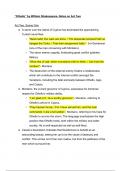
“Othello” by William Shakespeare- Notes on Act Two
Act Two, Scene One
● A storm over the island of Cyprus has decimated the approaching
Turkish naval fleet.
○ “News lads! Our wars are done. / The desperate tempest hath so
banged the Turks, / That their designment halts.”- 3rd Gentleman
(one of the men conversing with Montano).
○ The storm seems ungodly, foreboding great conflict (pathetic
fallacy).
○ “What ribs of oak, when mountains melt on them, / Can hold the
mortise?”- Montano
○ The destruction of the external enemy fosters a restlessness
which will contribute to the internal conflict amongst the
Venetians, including the fatal animosity between Othello, Iago,
and Cassio.
● Montano, the current governor of Cyprus, expresses his immense
respect for Othello’s military ability.
○ “I am glad on’t; ‘tis a worthy governor.”- Montano, referring to
Othello’s arrival in Cyprus.
○ “Pray heaven he be; / For I have served him, and the man
commands / Like a full soldier.”- Montano, referring to his hope for
Othello to survive the storm. The language emphasises the high
position that Othello holds, both within the military and wider
society. He is well-respected as well as well-liked.
● Cassio’s description indicates that Desdemona is beheld as an
astounding beauty, setting her up to be the cause of jealousy and
conflict. This comes not of her own malice, but from the pettiness of the
men which surround her.
, ○ “He hath achieved a maid / That paragons description and wild
fame; / One that excels the quirks of blazoning pens, / And in
th’essential vesture of creation / Does tire the ingener.”- Cassio
● Iago and Desdemona arrive safely in Cyprus.
○ Cassio claims that she has survived as would a divine goddess,
emphasising his infatuation with her beauty.
○ “Tempests themselves… As having sense of beauty, do omit /
Their mortal natures, letting go safely by / The divine
Desdemona.”- Cassio
● Iago’s treatment of his wife, Emilia, increases the distaste with which the
audience views him. There seems to be little, if any, affection between
the pair.
○ “Sir, would she give you so much of her lips / As of her tongue
she oft bestows on me, / You would have enough.”- Iago, to
Cassio, about Emilia.
○ Iago’s criticism of his wife’s temper seems overly harsh, as
Desdemona is quick to assert that Emilia “has no speech” (ie. has
a quiet disposition).
● There is an overt discussion about women in society, and their virtues
and vices. Iago asserts that women are only polite in public, and are
actually wicked creatures. This can be interpreted as a sign of his bitter
attitude.
○ “Come on, come on; you are pictures out of doors, bells in your
parlours, wild-cats in your kitchens, saints in your injuries, devils
being offended, players in your housewifery, and housewives in
your beds.”- Iago, to Emilia and Desdemona
○ Iago slips out of verse and into prose, matching the vulgar and
unsophisticated attitudes which he is expressing.
○ Iago’s metaphors imply that a wife’s true purpose is to please her
husband in bed. This contributes to the theme of “love versus
lust” that appears throughout the play.
Act Two, Scene One
● A storm over the island of Cyprus has decimated the approaching
Turkish naval fleet.
○ “News lads! Our wars are done. / The desperate tempest hath so
banged the Turks, / That their designment halts.”- 3rd Gentleman
(one of the men conversing with Montano).
○ The storm seems ungodly, foreboding great conflict (pathetic
fallacy).
○ “What ribs of oak, when mountains melt on them, / Can hold the
mortise?”- Montano
○ The destruction of the external enemy fosters a restlessness
which will contribute to the internal conflict amongst the
Venetians, including the fatal animosity between Othello, Iago,
and Cassio.
● Montano, the current governor of Cyprus, expresses his immense
respect for Othello’s military ability.
○ “I am glad on’t; ‘tis a worthy governor.”- Montano, referring to
Othello’s arrival in Cyprus.
○ “Pray heaven he be; / For I have served him, and the man
commands / Like a full soldier.”- Montano, referring to his hope for
Othello to survive the storm. The language emphasises the high
position that Othello holds, both within the military and wider
society. He is well-respected as well as well-liked.
● Cassio’s description indicates that Desdemona is beheld as an
astounding beauty, setting her up to be the cause of jealousy and
conflict. This comes not of her own malice, but from the pettiness of the
men which surround her.
, ○ “He hath achieved a maid / That paragons description and wild
fame; / One that excels the quirks of blazoning pens, / And in
th’essential vesture of creation / Does tire the ingener.”- Cassio
● Iago and Desdemona arrive safely in Cyprus.
○ Cassio claims that she has survived as would a divine goddess,
emphasising his infatuation with her beauty.
○ “Tempests themselves… As having sense of beauty, do omit /
Their mortal natures, letting go safely by / The divine
Desdemona.”- Cassio
● Iago’s treatment of his wife, Emilia, increases the distaste with which the
audience views him. There seems to be little, if any, affection between
the pair.
○ “Sir, would she give you so much of her lips / As of her tongue
she oft bestows on me, / You would have enough.”- Iago, to
Cassio, about Emilia.
○ Iago’s criticism of his wife’s temper seems overly harsh, as
Desdemona is quick to assert that Emilia “has no speech” (ie. has
a quiet disposition).
● There is an overt discussion about women in society, and their virtues
and vices. Iago asserts that women are only polite in public, and are
actually wicked creatures. This can be interpreted as a sign of his bitter
attitude.
○ “Come on, come on; you are pictures out of doors, bells in your
parlours, wild-cats in your kitchens, saints in your injuries, devils
being offended, players in your housewifery, and housewives in
your beds.”- Iago, to Emilia and Desdemona
○ Iago slips out of verse and into prose, matching the vulgar and
unsophisticated attitudes which he is expressing.
○ Iago’s metaphors imply that a wife’s true purpose is to please her
husband in bed. This contributes to the theme of “love versus
lust” that appears throughout the play.