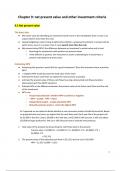
Chapter 9: net present value and other investment criteria
9.1 Net present value
The basic idea
● We create value by identifying an investment worth more in the marketplace than it costs us to
acquire (worth more than the cost)
● Capital budgeting is about trying to determine whether a proposed investment or project will be
worth more, once it is in place, than it costs (worth more than the cost)
● Net present value (NPV): the difference between an investment's market value and its cost
○ Searching for investments with positive net present values
○ If the different is positive, the investment is worth undertaking bc it would have a
positive estimated net present value
Estimating NPV
● Answering this question: would this be a good investment? Does the investment have a positive
NPV?
● a negative NPV would decrease the total value of the stock
1. Estimate the future cash flows we expect the new business to product
2. estimate the present value of those cash flows by using a discounted cash flow procedure
(discounted cash flow (DCF) valuation)
3. Estimate NPV as the difference between the present value of the future cash flows and the cost
of the investment
● NPV rule:
○ Accept-reject decision: whether NPV is positive or negative
○ + NPV = accept; - NPV = reject
○ Independent project - accept all positive NPV
○ Mutually exclusive project - select the highest NPV
Ex: Supposed we are asked to decide whether a new consumer product should be launched. Based
on projected sales and costs, we expect that the cash flows over the 5 year life of the project will
be $2,000 in the first 2 years, $4,000 in the next two, and $5,000 in the last year. It will cost about
$10,000 to begin production. We use a 10% discount rate to evaluate new products.
1. Total value of the product by discounting the cash flows back to the present:
Present value = $2,000/1.1 + $2,000/1.1^2 + $4,000/1.1^3 + $4,000/1.1^4 +
$5,000/1.1^5
= $12,313
2. The present value of the expected cash flows is $12,313 but the cost is $10,000
NPV = 12,313-10,000 = 2,313
1
, 3. The NPV is positive, we should take on the project
9.2 The payback rule
● Payback: the length of time it takes to recover our initial investment or "get our bait back"
Defining the rule
● Answer the question: how many years do we have to wait until the accumulated cash flows from
this investment equal or exceed the cost of the investment?
● Based on liquidity
● The payback period rule:
○ an investment is acceptable if its calculated payback period is less than some
prespecified number of years
○ Independent project - accept both project
○ Mutually exclusive project (and not given a cut-off period)- select the shortest payback
period project
Ex: This project costs $500. Cash flow year 1: $100, year 2: $200, year 3: $500. What is the payback
period for this investment?
● The initial cost is $500. After the first 2 years, the cash flows total $300 ($100+$200).
● After the third year, the total cash flow is $800 ($100+$200+$500), so the project pays back
sometime between the end of year 2 and the end of year 3
● The accumulated cash flows for the first 2 years are $300, need $200 in the third year to recover
(for the total $500 cost)
○ Have to wait 200/500=0.4 years to recover the $200
● The payback period is 2.4 years (2+0.4 years), or about two years and five months
Analyzing the rule
● Calculate the payback period by adding up the future cash flows
● There is no discounting involved, so the time value of money is ignored
● Fails to consider any risk differences
● Biggest problem is coming up with the right cutoff period: we can't have an objective basis for
choosing a particular number
9.3 the discounted payback
2
9.1 Net present value
The basic idea
● We create value by identifying an investment worth more in the marketplace than it costs us to
acquire (worth more than the cost)
● Capital budgeting is about trying to determine whether a proposed investment or project will be
worth more, once it is in place, than it costs (worth more than the cost)
● Net present value (NPV): the difference between an investment's market value and its cost
○ Searching for investments with positive net present values
○ If the different is positive, the investment is worth undertaking bc it would have a
positive estimated net present value
Estimating NPV
● Answering this question: would this be a good investment? Does the investment have a positive
NPV?
● a negative NPV would decrease the total value of the stock
1. Estimate the future cash flows we expect the new business to product
2. estimate the present value of those cash flows by using a discounted cash flow procedure
(discounted cash flow (DCF) valuation)
3. Estimate NPV as the difference between the present value of the future cash flows and the cost
of the investment
● NPV rule:
○ Accept-reject decision: whether NPV is positive or negative
○ + NPV = accept; - NPV = reject
○ Independent project - accept all positive NPV
○ Mutually exclusive project - select the highest NPV
Ex: Supposed we are asked to decide whether a new consumer product should be launched. Based
on projected sales and costs, we expect that the cash flows over the 5 year life of the project will
be $2,000 in the first 2 years, $4,000 in the next two, and $5,000 in the last year. It will cost about
$10,000 to begin production. We use a 10% discount rate to evaluate new products.
1. Total value of the product by discounting the cash flows back to the present:
Present value = $2,000/1.1 + $2,000/1.1^2 + $4,000/1.1^3 + $4,000/1.1^4 +
$5,000/1.1^5
= $12,313
2. The present value of the expected cash flows is $12,313 but the cost is $10,000
NPV = 12,313-10,000 = 2,313
1
, 3. The NPV is positive, we should take on the project
9.2 The payback rule
● Payback: the length of time it takes to recover our initial investment or "get our bait back"
Defining the rule
● Answer the question: how many years do we have to wait until the accumulated cash flows from
this investment equal or exceed the cost of the investment?
● Based on liquidity
● The payback period rule:
○ an investment is acceptable if its calculated payback period is less than some
prespecified number of years
○ Independent project - accept both project
○ Mutually exclusive project (and not given a cut-off period)- select the shortest payback
period project
Ex: This project costs $500. Cash flow year 1: $100, year 2: $200, year 3: $500. What is the payback
period for this investment?
● The initial cost is $500. After the first 2 years, the cash flows total $300 ($100+$200).
● After the third year, the total cash flow is $800 ($100+$200+$500), so the project pays back
sometime between the end of year 2 and the end of year 3
● The accumulated cash flows for the first 2 years are $300, need $200 in the third year to recover
(for the total $500 cost)
○ Have to wait 200/500=0.4 years to recover the $200
● The payback period is 2.4 years (2+0.4 years), or about two years and five months
Analyzing the rule
● Calculate the payback period by adding up the future cash flows
● There is no discounting involved, so the time value of money is ignored
● Fails to consider any risk differences
● Biggest problem is coming up with the right cutoff period: we can't have an objective basis for
choosing a particular number
9.3 the discounted payback
2