Henry VII Economy
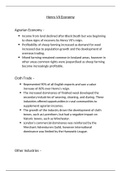
Agrarian Economy –
Income from land declined after Black Death but was beginning
to show signs of recovery by Henry VII’s reign.
Profitability of sheep farming increased as demand for wool
increased due to population growth and the development of
overseas trading.
Mixed farming remained common in lowland areas, however in
other areas common rights were jeopardised as sheep farming
became increasingly profitable.
Cloth Trade –
Represented 90% of all English exports and saw a value
increase of 60% over Henry’s reign.
The increased dominance of finished wool developed the
secondary industries of weaving, cleaning, and dyeing. These
industries offered opportunities in rural communities to
supplement agrarian incomes.
The growth of the industry drove the development of cloth
towns, such as Lavenhorn, but had a negative impact on
historic towns, such as Winchester.
London’s commercial dominance was reinforced by the
Merchant Adventurers Guild, however international
dominance was limited by the Hanseatic League.
Other Industries –
Agrarian Economy –
Income from land declined after Black Death but was beginning
to show signs of recovery by Henry VII’s reign.
Profitability of sheep farming increased as demand for wool
increased due to population growth and the development of
overseas trading.
Mixed farming remained common in lowland areas, however in
other areas common rights were jeopardised as sheep farming
became increasingly profitable.
Cloth Trade –
Represented 90% of all English exports and saw a value
increase of 60% over Henry’s reign.
The increased dominance of finished wool developed the
secondary industries of weaving, cleaning, and dyeing. These
industries offered opportunities in rural communities to
supplement agrarian incomes.
The growth of the industry drove the development of cloth
towns, such as Lavenhorn, but had a negative impact on
historic towns, such as Winchester.
London’s commercial dominance was reinforced by the
Merchant Adventurers Guild, however international
dominance was limited by the Hanseatic League.
Other Industries –