Aneesa Ahmed
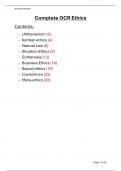
Complete OCR Ethics
Contents:
- Utilitarianism (2)
- Kantian ethics (4)
- Natural Law (6)
- Situation Ethics (9)
- Euthanasia (12)
- Business Ethics (16)
- Sexual ethics (19)
- Conscience (25)
- Meta-ethics (28)
Page 1 of 33
,Aneesa Ahmed
1-Utilitarianism
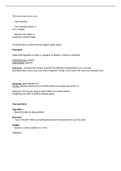
Principle of Utility —> working out what produces the most pleasure and eliminates
evil for the largest number of people
ISSUE:
Alasdair Macintyre —> utilitarianism justifies horrendous acts
‘Men are happy with their lot never entails what their lot ought to be’ —> pleasure
being the centre of the issue is inaccurate and leads to unjust outcomes
W.D.Ross —> pleasure should no be the only factor that we consider to decide what to
do in an action (Kant would say pleasure is an emotion which clouds your judgment-
Burning house analogy)
Anscombe —> ‘Bentham and Mill do not notice the difficulty of the concept of
pleasure’
Karl Popper —> ‘human suffering makes a direct moral appeal for help’ —> instead of
prioritising pleasure we need to focus on minimising pain
Act Utilitarianism
Jeremy Bentham: ‘the nature of mankind is places under the governance of two
sovereign masters: pain and pleasure’
- He argues that we are hedonists who focus on pleasure above all else
- Book: ‘An Introduction to the Principles of Morals and Legislation’
Hedonic Calculus:
7 factors that need to be considered and weighed up
- Intensity
- Duration
- Certainty
- Propinquity (how soon it will happen)
- Fecundity (how probable it is that it will cause further pleasure)
- Pruitt
- Extent
Strengths:
- Straightforward/ easy to calculate with structure
- Common currency- we know what pleasure is
ISSUES:
- Unpredictable (bc it is teleological and we cannot see the future)
Page 2 of 33
,Aneesa Ahmed
- Incalculable (Louis Pojman- how can you compare the love a 30yr old has with a
new lover and a 3yr old with a new toy)
- Immeasurable (Louis Pojman- ‘the calculus is encumbered with too many
variable and has issues assigning scores to them’)
Teleological theory:
Meaning that it determines what is right by looking at the outcome of the situation NOT
the action (deontological)
ISSUES:
- Doesn’t take intention into account (Kant- there is something instinctively wrong
about judging morality solely on the outcome of an action)
- Allows for bad actions to be justified e.g. Torturing a terrorist for information/
pedophillia ring
Bernard Williams —> utilitarianism denies moral integrity as it easy to do callous thing
in the name of bringing about maximum pleasure to maximum people
BUT this is an extreme case/ exception and applying the HC to this scenario e.g.
duration and intensity this wouldn’t be excepted
BUT still allowing for exploitation of the minority (goes against Kants 2nd CI and denies
dignity
Rule Utilitarianism
- Attempts to overcome issues with act util
- Following rules that are justified by the principle of utility for every situation
- Argues that there are higher and lower pleasure. Qualitative approach
John Stuart Mill —> ‘some kinds of pleasure are more desirable and more valuable
than others… quality must be considered as well as quantity’
Low pleasures: pleasing the body, short term pleasure, animal functions
High pleasures: fine dining, mentally progressive activities, may involve a sacrifice
- Following rules leads to the best overall outcome
- Makes moral conduct mor straightforward
- Allows some rules to be made e.g. truth telling
Swine analogy:
‘It is better to be human dissatisfied than a pig satisfies’
ISSUES:
- Complicates the simplicity of utilitarianism’s
Page 3 of 33
, Aneesa Ahmed
- You cannot compare such different types of pleasure
- Elitist view of what Mill and his friends enjoyed doing and could afford
- Places sticking to the rule over individual need
- STILL doesn’t protect the minority and leads to exploitation
Preference Utilitarianism- Peter Singer
- Satisfying preferences over maximising overall pleasure
- Focus on the rational preferred actions of the many
- Altruistic approach which focussed on the many not the individual
2-Kant
Book: Groundwork of Metaphysics and Morals
A priori analytical —> something that is true by definition
A priori synthetic —> something that needs evidence to support it (Kantian Ethics)
Duty
- Do things because they are objectively right NOT because of feelings/ emotions
- Using reason to detain what is you duty
W.D.Ross —> moral decisions are obvious when we consider what we ought to do using
reason
ISSUE:
- We are not solely motivated by duty but also emotions and feelings, this is our
true nature (BUT Kant would argue this is flawed, Burning House analogy- in the
furthest house is your mother and in the closest house is a stranger, it is you duty
to save the stranger and if you don’t both could die)
- ^ Fletcher provides a better and more humanistic
- Not all people can use their reasons e.g. people with mental disorders
Augustine —> reason is fundamentally flawed because of the fall of man and original
sin which is passed down through generations
Bernard Williams —> emotions makes morality natural
Duties change —> e.g. women’s duties was to look after the house and tend to the
children but now they are working
Conflicting Duties:
- Duty cannot be objectively defined
Page 4 of 33
Complete OCR Ethics
Contents:
- Utilitarianism (2)
- Kantian ethics (4)
- Natural Law (6)
- Situation Ethics (9)
- Euthanasia (12)
- Business Ethics (16)
- Sexual ethics (19)
- Conscience (25)
- Meta-ethics (28)
Page 1 of 33
,Aneesa Ahmed
1-Utilitarianism
Principle of Utility —> working out what produces the most pleasure and eliminates
evil for the largest number of people
ISSUE:
Alasdair Macintyre —> utilitarianism justifies horrendous acts
‘Men are happy with their lot never entails what their lot ought to be’ —> pleasure
being the centre of the issue is inaccurate and leads to unjust outcomes
W.D.Ross —> pleasure should no be the only factor that we consider to decide what to
do in an action (Kant would say pleasure is an emotion which clouds your judgment-
Burning house analogy)
Anscombe —> ‘Bentham and Mill do not notice the difficulty of the concept of
pleasure’
Karl Popper —> ‘human suffering makes a direct moral appeal for help’ —> instead of
prioritising pleasure we need to focus on minimising pain
Act Utilitarianism
Jeremy Bentham: ‘the nature of mankind is places under the governance of two
sovereign masters: pain and pleasure’
- He argues that we are hedonists who focus on pleasure above all else
- Book: ‘An Introduction to the Principles of Morals and Legislation’
Hedonic Calculus:
7 factors that need to be considered and weighed up
- Intensity
- Duration
- Certainty
- Propinquity (how soon it will happen)
- Fecundity (how probable it is that it will cause further pleasure)
- Pruitt
- Extent
Strengths:
- Straightforward/ easy to calculate with structure
- Common currency- we know what pleasure is
ISSUES:
- Unpredictable (bc it is teleological and we cannot see the future)
Page 2 of 33
,Aneesa Ahmed
- Incalculable (Louis Pojman- how can you compare the love a 30yr old has with a
new lover and a 3yr old with a new toy)
- Immeasurable (Louis Pojman- ‘the calculus is encumbered with too many
variable and has issues assigning scores to them’)
Teleological theory:
Meaning that it determines what is right by looking at the outcome of the situation NOT
the action (deontological)
ISSUES:
- Doesn’t take intention into account (Kant- there is something instinctively wrong
about judging morality solely on the outcome of an action)
- Allows for bad actions to be justified e.g. Torturing a terrorist for information/
pedophillia ring
Bernard Williams —> utilitarianism denies moral integrity as it easy to do callous thing
in the name of bringing about maximum pleasure to maximum people
BUT this is an extreme case/ exception and applying the HC to this scenario e.g.
duration and intensity this wouldn’t be excepted
BUT still allowing for exploitation of the minority (goes against Kants 2nd CI and denies
dignity
Rule Utilitarianism
- Attempts to overcome issues with act util
- Following rules that are justified by the principle of utility for every situation
- Argues that there are higher and lower pleasure. Qualitative approach
John Stuart Mill —> ‘some kinds of pleasure are more desirable and more valuable
than others… quality must be considered as well as quantity’
Low pleasures: pleasing the body, short term pleasure, animal functions
High pleasures: fine dining, mentally progressive activities, may involve a sacrifice
- Following rules leads to the best overall outcome
- Makes moral conduct mor straightforward
- Allows some rules to be made e.g. truth telling
Swine analogy:
‘It is better to be human dissatisfied than a pig satisfies’
ISSUES:
- Complicates the simplicity of utilitarianism’s
Page 3 of 33
, Aneesa Ahmed
- You cannot compare such different types of pleasure
- Elitist view of what Mill and his friends enjoyed doing and could afford
- Places sticking to the rule over individual need
- STILL doesn’t protect the minority and leads to exploitation
Preference Utilitarianism- Peter Singer
- Satisfying preferences over maximising overall pleasure
- Focus on the rational preferred actions of the many
- Altruistic approach which focussed on the many not the individual
2-Kant
Book: Groundwork of Metaphysics and Morals
A priori analytical —> something that is true by definition
A priori synthetic —> something that needs evidence to support it (Kantian Ethics)
Duty
- Do things because they are objectively right NOT because of feelings/ emotions
- Using reason to detain what is you duty
W.D.Ross —> moral decisions are obvious when we consider what we ought to do using
reason
ISSUE:
- We are not solely motivated by duty but also emotions and feelings, this is our
true nature (BUT Kant would argue this is flawed, Burning House analogy- in the
furthest house is your mother and in the closest house is a stranger, it is you duty
to save the stranger and if you don’t both could die)
- ^ Fletcher provides a better and more humanistic
- Not all people can use their reasons e.g. people with mental disorders
Augustine —> reason is fundamentally flawed because of the fall of man and original
sin which is passed down through generations
Bernard Williams —> emotions makes morality natural
Duties change —> e.g. women’s duties was to look after the house and tend to the
children but now they are working
Conflicting Duties:
- Duty cannot be objectively defined
Page 4 of 33