Chapter 17
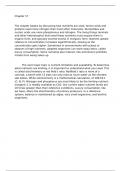
The chapter begins by discussing how nutrients are used. Amino acids and
proteins need more nitrogen than most other molecules. Nucleotides and
nucleic acids use more phosphorous and nitrogen. The living things (animals
and other heterotrophs) that need these nutrients must acquire them in
organic form, and typically excrete excess in inorganic form. Nutrient uptake
relative to concentration increases logarithmically, slowing as the
concentration gets higher. Sometimes in environments with pulses or
seasons of high nutrients, adapted organisms can store away extra, called
luxury consumption. Some nutrients also interact, like ammonium prohibits
nitrate from being taken up.
The next major topic is nutrient limitation and availability. To determine
what nutrients are limiting, it is important to understand what you need. This
is called stoichiometry or red field’s ratio. Redfield’s ratio is more of a
concept, a barrel with 12 slats can only hold as much water as the shortest
slat allows. While stoichiometry is a mathematical calculation, of 106:16:1
(C: N: P). Nitrogen and phosphorus are most likely to be the limiting nutrient,
inorganic C is readily available as CO2. Our current water nutrient levels are
10 times greater than their reference conditions. Luxury consumption, like
we have, alters the stoichiometry of primary producers. In a reference
system, balance is maintained by algae, very small organisms, and benthic
organisms.
The chapter begins by discussing how nutrients are used. Amino acids and
proteins need more nitrogen than most other molecules. Nucleotides and
nucleic acids use more phosphorous and nitrogen. The living things (animals
and other heterotrophs) that need these nutrients must acquire them in
organic form, and typically excrete excess in inorganic form. Nutrient uptake
relative to concentration increases logarithmically, slowing as the
concentration gets higher. Sometimes in environments with pulses or
seasons of high nutrients, adapted organisms can store away extra, called
luxury consumption. Some nutrients also interact, like ammonium prohibits
nitrate from being taken up.
The next major topic is nutrient limitation and availability. To determine
what nutrients are limiting, it is important to understand what you need. This
is called stoichiometry or red field’s ratio. Redfield’s ratio is more of a
concept, a barrel with 12 slats can only hold as much water as the shortest
slat allows. While stoichiometry is a mathematical calculation, of 106:16:1
(C: N: P). Nitrogen and phosphorus are most likely to be the limiting nutrient,
inorganic C is readily available as CO2. Our current water nutrient levels are
10 times greater than their reference conditions. Luxury consumption, like
we have, alters the stoichiometry of primary producers. In a reference
system, balance is maintained by algae, very small organisms, and benthic
organisms.