

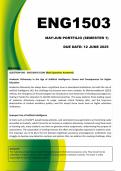
ENG1503
MAY/JUN PORTFILIO (SEMESTER 1)..
DUE DATE: 12 JUNE 2025..
PREVIEW:
QUESTION ONE - DISCURSIVE ESSAY (Both Questions Answered)
Academic Dishonesty in the Age of Artificial Intelligence: Causes and Consequences for Higher
Education
Academic dishonesty has always been a significant issue in educational institutions, but with the rise of
artificial intelligence (AI), this challenge has become even more complex. As Mohammadkarimi (2023)
reflects, the emergence of AI technologies has introduced a new dimension of cheating and plagiarism,
making it harder for educators to identify dishonest practices. This essay explores three leading causes
of academic dishonesty—improper AI usage, reduced critical thinking skills, and the long-term
deterioration of student workforce quality—and the impact these issues have on higher education
institutions.
Improper Use of Artificial Intelligence
AI tools such as ChatGPT, paraphrasing websites, and automated essay generators are becoming easily
accessible to students, which has led to an increase in academic dishonesty. Instead of using these tools
as learning aids, many students use them to generate entire assignments, undermining the purpose of
assessments. The automation of writing removes the effort and originality expected in academic work.
This improper use of AI blurs the line between legitimate assistance and plagiarism. Institutions now
struggle to develop new detection systems and policies that can address this evolving challenge, often
falling behind the rapid development of these technologies.
Reduction
Disclaimer:in Critical Thinking Skills
The materials provided are intended for educational and informational purposes only. They should not be
Another
submittedsignificant
as originalcause of used
work or academic dishonesty
in violation of any is the decline
academic in students’
institution's critical
policies. thinking
The buyer abilities. The
is solely
over-reliance
responsible foron
howdigital tools discourages
the materials are used. students from engaging deeply with content. Instead of
analyzing, questioning, and reflecting, students often seek instant answers online. This trend undermines
the cognitive development that higher education aims to foster. When students bypass the intellectual
process of learning, they not only cheat the system but also cheat themselves. As this culture of shortcuts
spreads, it erodes the academic integrity of institutions and diminishes the value of qualifications.
MAY/JUN PORTFILIO (SEMESTER 1)..
DUE DATE: 12 JUNE 2025..
PREVIEW:
QUESTION ONE - DISCURSIVE ESSAY (Both Questions Answered)
Academic Dishonesty in the Age of Artificial Intelligence: Causes and Consequences for Higher
Education
Academic dishonesty has always been a significant issue in educational institutions, but with the rise of
artificial intelligence (AI), this challenge has become even more complex. As Mohammadkarimi (2023)
reflects, the emergence of AI technologies has introduced a new dimension of cheating and plagiarism,
making it harder for educators to identify dishonest practices. This essay explores three leading causes
of academic dishonesty—improper AI usage, reduced critical thinking skills, and the long-term
deterioration of student workforce quality—and the impact these issues have on higher education
institutions.
Improper Use of Artificial Intelligence
AI tools such as ChatGPT, paraphrasing websites, and automated essay generators are becoming easily
accessible to students, which has led to an increase in academic dishonesty. Instead of using these tools
as learning aids, many students use them to generate entire assignments, undermining the purpose of
assessments. The automation of writing removes the effort and originality expected in academic work.
This improper use of AI blurs the line between legitimate assistance and plagiarism. Institutions now
struggle to develop new detection systems and policies that can address this evolving challenge, often
falling behind the rapid development of these technologies.
Reduction
Disclaimer:in Critical Thinking Skills
The materials provided are intended for educational and informational purposes only. They should not be
Another
submittedsignificant
as originalcause of used
work or academic dishonesty
in violation of any is the decline
academic in students’
institution's critical
policies. thinking
The buyer abilities. The
is solely
over-reliance
responsible foron
howdigital tools discourages
the materials are used. students from engaging deeply with content. Instead of
analyzing, questioning, and reflecting, students often seek instant answers online. This trend undermines
the cognitive development that higher education aims to foster. When students bypass the intellectual
process of learning, they not only cheat the system but also cheat themselves. As this culture of shortcuts
spreads, it erodes the academic integrity of institutions and diminishes the value of qualifications.


