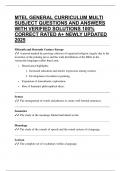
MTEL GENERAL CURRICULUM MULTI
SUBJECT QUESTIONS AND ANSWERS
WITH VERIFIED SOLUTIONS 100%
CORRECT RATED A+ NEWLY UPDATED
2025
Fifteenth and Sixteenth Century Europe
✔✔ A period marked by growing criticism of organized religion, largely due to the
invention of the printing press and the wide distribution of the Bible in the
vernacular languages rather than Latin.
Renaissance highlights:
1. Increased education and artistic expression among women.
2. Development of realism in painting.
Expansion of transatlantic exploration.
Rise of humanist philosophical ideas.
Syntax
✔✔ The arrangement of words and phrases to create well-formed sentences.
Semantics
✔✔ The study of the meanings behind individual words.
Phonology
✔✔ The study of the sounds of speech and the sound system of a language.
Lexicon
✔✔ The complete set of vocabulary within a language.
, Biographical Approach to Literacy
✔✔ Analyzing literature by connecting the author’s personal history, actions, and
events in their life to the work produced.
Elizabethan Age in England
✔✔ The period of Queen Elizabeth I’s rule (1558–1603), known as a golden era or
English Renaissance.
Plays were influenced by Greek tragedy and aimed to entertain the public.
These works generally avoided heavy political, religious, or ideological
themes.
Pindar's Olympian i - ANSWER✔✔choral ode to a Sicilian ruler, it is a "lyric"
Euripides Medena - ANSWER✔✔based on classical greek tragedy, based on the
myth of jason and medea
Sophocles Antigone - ANSWER✔✔classical greek tragedy - The play expands on
the Theban legend that predated it and picks up where Aeschylus' Seven Against
Thebes ends.
Homer's The Odyssey - ANSWER✔✔The first "epic" style greek tragedy written -
story of Odysseus a greek soldier journeying back to his home after the Trojan War
dramatic form "the comedy" - ANSWER✔✔amuse or delight the audience and the
action in a comedy ends happily
allegory - ANSWER✔✔represents abstract concepts as characters
SUBJECT QUESTIONS AND ANSWERS
WITH VERIFIED SOLUTIONS 100%
CORRECT RATED A+ NEWLY UPDATED
2025
Fifteenth and Sixteenth Century Europe
✔✔ A period marked by growing criticism of organized religion, largely due to the
invention of the printing press and the wide distribution of the Bible in the
vernacular languages rather than Latin.
Renaissance highlights:
1. Increased education and artistic expression among women.
2. Development of realism in painting.
Expansion of transatlantic exploration.
Rise of humanist philosophical ideas.
Syntax
✔✔ The arrangement of words and phrases to create well-formed sentences.
Semantics
✔✔ The study of the meanings behind individual words.
Phonology
✔✔ The study of the sounds of speech and the sound system of a language.
Lexicon
✔✔ The complete set of vocabulary within a language.
, Biographical Approach to Literacy
✔✔ Analyzing literature by connecting the author’s personal history, actions, and
events in their life to the work produced.
Elizabethan Age in England
✔✔ The period of Queen Elizabeth I’s rule (1558–1603), known as a golden era or
English Renaissance.
Plays were influenced by Greek tragedy and aimed to entertain the public.
These works generally avoided heavy political, religious, or ideological
themes.
Pindar's Olympian i - ANSWER✔✔choral ode to a Sicilian ruler, it is a "lyric"
Euripides Medena - ANSWER✔✔based on classical greek tragedy, based on the
myth of jason and medea
Sophocles Antigone - ANSWER✔✔classical greek tragedy - The play expands on
the Theban legend that predated it and picks up where Aeschylus' Seven Against
Thebes ends.
Homer's The Odyssey - ANSWER✔✔The first "epic" style greek tragedy written -
story of Odysseus a greek soldier journeying back to his home after the Trojan War
dramatic form "the comedy" - ANSWER✔✔amuse or delight the audience and the
action in a comedy ends happily
allegory - ANSWER✔✔represents abstract concepts as characters