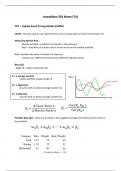
InvestMan 254 Notes (T4)
Ch7 – Capital Asset Pricing Model (CAPM)
CAPM = formula used to calc expected return of a security given its level of systema6c risk.
Measuring Market Risk:
- Market por;olio = por;olio of all assets in the economy.
- Beta = sensi6vity of a stocks return to the return on the market por;olio.
Beta calculates the value of market risk exposure.
- market risk = different securi6es have different exposure levels.
Beta (β)
- higher β = higher systema6c risk
β = 1 average security
- market por;olio always has β = 1
β > 1 Aggressive
- security with an above-average market risk
β < 1 Defensive
- security with an below-average market risk
Por3olio Beta (βP) = beta of a por;olio is the weighted average of the betas of the shares in
the por;olio.
,CAPM
- use CAPM to calculate the expected rate of return you required on an asset, given level of
systema6c risk exposure.
Security Market Line (SML)
- indicates the required rates of return that you will have on any asset, given its level
of systema6c risk.
(rela6onship btwn required return and beta)
- slope = CAPM
For a systema6c risk of β = 1 (same as market por;olio) → calc expected return
- higher risk = requires higher return
Working out alpha (⍺) = difference btwn ACTUAL return and EXPECTED return
, CAPM and Index Models
An index model is useful since it makes use of:
- realised returns & not expected returns
- actual portfolios (All Share Index) rather than the theoretical market portfolio
To move from an expectation model to a realised-return framework, the following simple
regression equation in realised excess returns holds:
Security Market Line (SML)
- indicates a security’s excess return as a func6on of the market’s excess return.
CAPM and MulIfactor Models
- includes risk in small shares that should be compensated for.
- Why is it beWer? –has 2 extra risk factors
Farma-French 3 Factor
Ch7 – Capital Asset Pricing Model (CAPM)
CAPM = formula used to calc expected return of a security given its level of systema6c risk.
Measuring Market Risk:
- Market por;olio = por;olio of all assets in the economy.
- Beta = sensi6vity of a stocks return to the return on the market por;olio.
Beta calculates the value of market risk exposure.
- market risk = different securi6es have different exposure levels.
Beta (β)
- higher β = higher systema6c risk
β = 1 average security
- market por;olio always has β = 1
β > 1 Aggressive
- security with an above-average market risk
β < 1 Defensive
- security with an below-average market risk
Por3olio Beta (βP) = beta of a por;olio is the weighted average of the betas of the shares in
the por;olio.
,CAPM
- use CAPM to calculate the expected rate of return you required on an asset, given level of
systema6c risk exposure.
Security Market Line (SML)
- indicates the required rates of return that you will have on any asset, given its level
of systema6c risk.
(rela6onship btwn required return and beta)
- slope = CAPM
For a systema6c risk of β = 1 (same as market por;olio) → calc expected return
- higher risk = requires higher return
Working out alpha (⍺) = difference btwn ACTUAL return and EXPECTED return
, CAPM and Index Models
An index model is useful since it makes use of:
- realised returns & not expected returns
- actual portfolios (All Share Index) rather than the theoretical market portfolio
To move from an expectation model to a realised-return framework, the following simple
regression equation in realised excess returns holds:
Security Market Line (SML)
- indicates a security’s excess return as a func6on of the market’s excess return.
CAPM and MulIfactor Models
- includes risk in small shares that should be compensated for.
- Why is it beWer? –has 2 extra risk factors
Farma-French 3 Factor