Law notes I
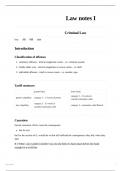
Criminal Law
key: AR MR case
Introduction
Classification of offenses
1. summary offenses - tried in magistrate courts - i.e. common assault
2. triable either way - tried in magistrate or crown courts - i.e. theft
3. indictable offenses - tried in crown courts - i.e. murder, rape
Tariff sentences
greater harm lesser harm
category 2 - 51 weeks in
greater culpability category 1 - 1-3 years in prison
custody/community order
category 2 - 51 weeks in
less culpability category 3 - community order/Band A
custody/community order
Causation
factual causation: did d. cause the consequence
but for test
but for the actions of d., would the victim still suffered the consequences they did, when they
did?
R v White - put cyanide in mother’s tea, but she died of a heart attack before she drank
enough for it to kill her
Law notes I 1
, legal causation: was d. the main contributing factor to the unlawful act that led to the
consequence
de minimis principle
d. doesn’t need to be the sole or even main cause - they must have made more than a
minimum contribution
R v Pagett - used girlfriend as human shield
intervening acts
could be from a third party (independent of d.’s actions), the victim (can only break the chain
of causation if their actions are unexpected) or of nature (such as a tsunami)
R v Jordan - victim was stabbed but only died due to allergic reaction to antibiotics in hospital
R v Roberts - victim jumped out of moving car after d. (driver) made sexual advances
thin skull rule
“take the victim as you found them”
R v Blaue - Jehovah’s witness refused blood transfusion, which would have saved her life, d.
was found guilty
Elements of Liability
Actus reus
the “guilty act”
types of crimes -
conduct crimes : AR is the prohibited conduct - i.e. drunk driving
consequence crimes : AR must result in a consequence - i.e. assault occasioning ABH
state of affairs : AR must be a state of affairs for which d. is responsible for
R v. Larsonneur (illegal alien)
d.’s actions must have been voluntary to be held liable for the offense
there are exceptions to this - i.e. murder
omissions
Law notes I 2
, cannot count as AR for an offense unless it falls under one of the following scenarios :
1. statutory duty - an act of parliament creates liability
2. contractual duty - contractual obligations create liability
R v Pittwood - forgot to close train gate, led to death of train driver
3. duty arising from a relationship - often familial
4. duty arising from an official duty - i.e. police
R v Dytham - d. (officer) watched man get thrown out of a club and get beat up and did
nothing while on duty
5. duty undertaken voluntarily
R v Evans - d.s were taking care of a recovering heroine addict and bought her more heroine,
on which she overdosed
6. duty arises from setting off a chain of events
R v Miller - fell asleep with cigarette lit in hand, burnt house down, guilty of arson
*the duty of doctors varies by case, as they can stop treatment if it is seen to be in the patients
best interest
Mens rea
the “guilty mind”
a decision to bring about, in so far as it lies within the accused’s power, the prohibited
consequence, no matter whether the accused desired that consequence or not
levels of MR :
1. direct intention - a decision to bring about the criminal consequence
2. oblique intent - where d. has other aims but the consequence was virtually certain ; R v
Woolin - 3 month old baby died
3. recklessness - where d. is aware of the possible consequences but takes the risk anyways
; R v Cunningham (1957) - Ripped a gas metre off the wall
4. negligence - failure to meet the standards of the reasonable person
Law notes I 3
Criminal Law
key: AR MR case
Introduction
Classification of offenses
1. summary offenses - tried in magistrate courts - i.e. common assault
2. triable either way - tried in magistrate or crown courts - i.e. theft
3. indictable offenses - tried in crown courts - i.e. murder, rape
Tariff sentences
greater harm lesser harm
category 2 - 51 weeks in
greater culpability category 1 - 1-3 years in prison
custody/community order
category 2 - 51 weeks in
less culpability category 3 - community order/Band A
custody/community order
Causation
factual causation: did d. cause the consequence
but for test
but for the actions of d., would the victim still suffered the consequences they did, when they
did?
R v White - put cyanide in mother’s tea, but she died of a heart attack before she drank
enough for it to kill her
Law notes I 1
, legal causation: was d. the main contributing factor to the unlawful act that led to the
consequence
de minimis principle
d. doesn’t need to be the sole or even main cause - they must have made more than a
minimum contribution
R v Pagett - used girlfriend as human shield
intervening acts
could be from a third party (independent of d.’s actions), the victim (can only break the chain
of causation if their actions are unexpected) or of nature (such as a tsunami)
R v Jordan - victim was stabbed but only died due to allergic reaction to antibiotics in hospital
R v Roberts - victim jumped out of moving car after d. (driver) made sexual advances
thin skull rule
“take the victim as you found them”
R v Blaue - Jehovah’s witness refused blood transfusion, which would have saved her life, d.
was found guilty
Elements of Liability
Actus reus
the “guilty act”
types of crimes -
conduct crimes : AR is the prohibited conduct - i.e. drunk driving
consequence crimes : AR must result in a consequence - i.e. assault occasioning ABH
state of affairs : AR must be a state of affairs for which d. is responsible for
R v. Larsonneur (illegal alien)
d.’s actions must have been voluntary to be held liable for the offense
there are exceptions to this - i.e. murder
omissions
Law notes I 2
, cannot count as AR for an offense unless it falls under one of the following scenarios :
1. statutory duty - an act of parliament creates liability
2. contractual duty - contractual obligations create liability
R v Pittwood - forgot to close train gate, led to death of train driver
3. duty arising from a relationship - often familial
4. duty arising from an official duty - i.e. police
R v Dytham - d. (officer) watched man get thrown out of a club and get beat up and did
nothing while on duty
5. duty undertaken voluntarily
R v Evans - d.s were taking care of a recovering heroine addict and bought her more heroine,
on which she overdosed
6. duty arises from setting off a chain of events
R v Miller - fell asleep with cigarette lit in hand, burnt house down, guilty of arson
*the duty of doctors varies by case, as they can stop treatment if it is seen to be in the patients
best interest
Mens rea
the “guilty mind”
a decision to bring about, in so far as it lies within the accused’s power, the prohibited
consequence, no matter whether the accused desired that consequence or not
levels of MR :
1. direct intention - a decision to bring about the criminal consequence
2. oblique intent - where d. has other aims but the consequence was virtually certain ; R v
Woolin - 3 month old baby died
3. recklessness - where d. is aware of the possible consequences but takes the risk anyways
; R v Cunningham (1957) - Ripped a gas metre off the wall
4. negligence - failure to meet the standards of the reasonable person
Law notes I 3