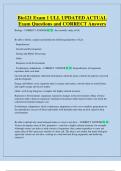
Bio121 Exam 1 ULL UPDATED ACTUAL
Exam Questions and CORRECT Answers
Biology - CORRECT ANSWER - the scientific study of life
Be able to define, explain and identify the following properties of Life
· Reproduction
· Growth and Development
· Energy and Matter Processing
· Order
· Response to the Environment
· Evolutionary Adaptations - CORRECT ANSWER - Reproduction: all organisms
reproduce their own kind
Growth and Development: inherited information carried by genes controls the pattern of growth
and development
Energy and Matter: every organism takes in energy and matter, converts them to useful forms,
and expels energy and excess matter
Order: each living thing has a complex but highly ordered structure
Repsonse to Environment: organisms respond to changes in the environment. Many of these
responses help to keep an organism's internal environment within narrow limits even when the
external environment changes a lot.
Evolutionary Adaptations: Such evolutionary adaptations evolve over countless generations by
the reproductive success of those individuals with heritable traits that are best suited to their
environments
Be able to defend why most biologist believe a virus is not alive. - CORRECT ANSWER -
Viruses do display some of life's properties—each has a highly ordered structure, for example.
Although viruses can infect a wide variety of organisms, they cannot reproduce or carry out
many other of life's processes outside of a host cell. The idea is not settled, but many biologists
agree that viruses are not alive, existing in a state between living organisms and nonliving
chemical
,Biosphere - CORRECT ANSWER - Consists of all life on Earth
Ecosystem - CORRECT ANSWER - all the living organisms in one particular area
Community - CORRECT ANSWER - consists of all the interacting populations occupying
an ecosystem
Population - CORRECT ANSWER - a group of interacting individuals of one species
living within a particular area
Organism - CORRECT ANSWER - an individual living being
Organ System - CORRECT ANSWER - a group of organ that work together to perform a
vital body function
Organ - CORRECT ANSWER - consists of multiple tissue that cooperate to perform a
specific task
Tissue - CORRECT ANSWER - an intergrated group of similar cells that work together to
perform a specific task
Cell - CORRECT ANSWER - the fundamental unit of life
organelle - CORRECT ANSWER - component of the cell that performs a specific function
molecule - CORRECT ANSWER - a group of atoms bonded together
atom - CORRECT ANSWER - the fundamental unit of matter
, Be able to identify and categorize the Major themes of Biology:
· Energy and Matter Pathways
· Interconnection between elements of biological systems
· Structure and Function
· Information Flow
· Evolution - CORRECT ANSWER -
Be able to recognize and order the steps of the Scientific Method - CORRECT ANSWER -
1. Observation
2. Question
3. Hypothesis
4. Experiment
5. Results
6. Conclusion
Data - CORRECT ANSWER - recorded observations
Facts - CORRECT ANSWER - is a verifiable piece of information considered to be
objectively true based on all current evidence
Hypothesis - CORRECT ANSWER - is a proposed explanation for a set of observations
Theory - CORRECT ANSWER - a well sustained explanation that is comprehensive and
able to explain many observations
Experiment - CORRECT ANSWER - a scientific test
Negative Control - CORRECT ANSWER - a group for which no change is expected
Exam Questions and CORRECT Answers
Biology - CORRECT ANSWER - the scientific study of life
Be able to define, explain and identify the following properties of Life
· Reproduction
· Growth and Development
· Energy and Matter Processing
· Order
· Response to the Environment
· Evolutionary Adaptations - CORRECT ANSWER - Reproduction: all organisms
reproduce their own kind
Growth and Development: inherited information carried by genes controls the pattern of growth
and development
Energy and Matter: every organism takes in energy and matter, converts them to useful forms,
and expels energy and excess matter
Order: each living thing has a complex but highly ordered structure
Repsonse to Environment: organisms respond to changes in the environment. Many of these
responses help to keep an organism's internal environment within narrow limits even when the
external environment changes a lot.
Evolutionary Adaptations: Such evolutionary adaptations evolve over countless generations by
the reproductive success of those individuals with heritable traits that are best suited to their
environments
Be able to defend why most biologist believe a virus is not alive. - CORRECT ANSWER -
Viruses do display some of life's properties—each has a highly ordered structure, for example.
Although viruses can infect a wide variety of organisms, they cannot reproduce or carry out
many other of life's processes outside of a host cell. The idea is not settled, but many biologists
agree that viruses are not alive, existing in a state between living organisms and nonliving
chemical
,Biosphere - CORRECT ANSWER - Consists of all life on Earth
Ecosystem - CORRECT ANSWER - all the living organisms in one particular area
Community - CORRECT ANSWER - consists of all the interacting populations occupying
an ecosystem
Population - CORRECT ANSWER - a group of interacting individuals of one species
living within a particular area
Organism - CORRECT ANSWER - an individual living being
Organ System - CORRECT ANSWER - a group of organ that work together to perform a
vital body function
Organ - CORRECT ANSWER - consists of multiple tissue that cooperate to perform a
specific task
Tissue - CORRECT ANSWER - an intergrated group of similar cells that work together to
perform a specific task
Cell - CORRECT ANSWER - the fundamental unit of life
organelle - CORRECT ANSWER - component of the cell that performs a specific function
molecule - CORRECT ANSWER - a group of atoms bonded together
atom - CORRECT ANSWER - the fundamental unit of matter
, Be able to identify and categorize the Major themes of Biology:
· Energy and Matter Pathways
· Interconnection between elements of biological systems
· Structure and Function
· Information Flow
· Evolution - CORRECT ANSWER -
Be able to recognize and order the steps of the Scientific Method - CORRECT ANSWER -
1. Observation
2. Question
3. Hypothesis
4. Experiment
5. Results
6. Conclusion
Data - CORRECT ANSWER - recorded observations
Facts - CORRECT ANSWER - is a verifiable piece of information considered to be
objectively true based on all current evidence
Hypothesis - CORRECT ANSWER - is a proposed explanation for a set of observations
Theory - CORRECT ANSWER - a well sustained explanation that is comprehensive and
able to explain many observations
Experiment - CORRECT ANSWER - a scientific test
Negative Control - CORRECT ANSWER - a group for which no change is expected