

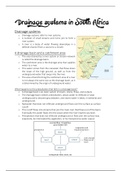
Drainage systems in South Africa
Drainage systems
o Drainage systems refer to river systems.
o A number of small streams and rivers join to form a
river system.
o A river is a body of water flowing downslope in a
defined channel from a source to a mouth.
A drainage basin and a catchment area
o The area drained by a river system or stream network
is called the drainage basin.
o The catchment area is the drainage area that supplies
water to a river.
o This water comes from the rainwater that flows down
the slope of the high ground, as well as from the
underground water that seeps into the river.
o The area of land forming the catchment area of a river
is not always the same size as the drainage basin, as it
is determined by the origin of underground water.
What happens to the precipitation that falls in a drainage basin?
o A drainage basin is an open system of inputs, stores, flows, and outputs.
o The drainage basin collects precipitation, allows water to infiltrate or seep
underground to become groundwater, and stores water in lakes, in wetlands and
underground.
o Rainwater that does not infiltrate underground flows over the surface as surface
runoff.
o This runoff flows into streams that join the main river that flows out of the basin.
Eventually this water flows into the ocean when the river reaches sea level.
o Precipitation that does not infiltrate underground or flow over the surface may
evaporate, be intercepted by vegetation, or be transpired as water vapour.
, Features of a drainage basin: watershed, tributary, river
mouth, source and confluence
A drainage basin has several features.
Watershed:
o The high ground separating one drainage basin from the adjacent drainage basin
o The size of a drainage basin is determined by the position of the watershed.
Stream/ River Network:
o Within the drainage basin, individual streams and rivers join together
Tributaries:
o The individual river channels that form the stream network
Confluence:
o The point where one river in the network joins another.
Interfluves/Spurs:
o The ridges of high ground between the individual channels of the stream network.
Source:
o The place where a stream or river begins
o This is usually in mountainous terrain where the precipitation flowing over the land
erodes a small channel. Rivers can also rise at springs or where there is melting ice.
Mouth:
o Where the river flows into a sea or lake.
Important watersheds in South Africa
o Drakensberg Mountains
o Witwatersrand
o Mountains south of the plateau
Drainage systems
o Drainage systems refer to river systems.
o A number of small streams and rivers join to form a
river system.
o A river is a body of water flowing downslope in a
defined channel from a source to a mouth.
A drainage basin and a catchment area
o The area drained by a river system or stream network
is called the drainage basin.
o The catchment area is the drainage area that supplies
water to a river.
o This water comes from the rainwater that flows down
the slope of the high ground, as well as from the
underground water that seeps into the river.
o The area of land forming the catchment area of a river
is not always the same size as the drainage basin, as it
is determined by the origin of underground water.
What happens to the precipitation that falls in a drainage basin?
o A drainage basin is an open system of inputs, stores, flows, and outputs.
o The drainage basin collects precipitation, allows water to infiltrate or seep
underground to become groundwater, and stores water in lakes, in wetlands and
underground.
o Rainwater that does not infiltrate underground flows over the surface as surface
runoff.
o This runoff flows into streams that join the main river that flows out of the basin.
Eventually this water flows into the ocean when the river reaches sea level.
o Precipitation that does not infiltrate underground or flow over the surface may
evaporate, be intercepted by vegetation, or be transpired as water vapour.
, Features of a drainage basin: watershed, tributary, river
mouth, source and confluence
A drainage basin has several features.
Watershed:
o The high ground separating one drainage basin from the adjacent drainage basin
o The size of a drainage basin is determined by the position of the watershed.
Stream/ River Network:
o Within the drainage basin, individual streams and rivers join together
Tributaries:
o The individual river channels that form the stream network
Confluence:
o The point where one river in the network joins another.
Interfluves/Spurs:
o The ridges of high ground between the individual channels of the stream network.
Source:
o The place where a stream or river begins
o This is usually in mountainous terrain where the precipitation flowing over the land
erodes a small channel. Rivers can also rise at springs or where there is melting ice.
Mouth:
o Where the river flows into a sea or lake.
Important watersheds in South Africa
o Drakensberg Mountains
o Witwatersrand
o Mountains south of the plateau


