1
Ch14.3 – Mass Spectrometry
Mass Spectrometry (MS)
A Mass Spectrometry (MS) is the study of the interaction between matter and an energy source other
than electromagnetic radiation. Mass spectrometry is used primarily to determine the molecular weight
and molecular formula of a compound (David Klein, Organic Chemistry. 2nd ed)
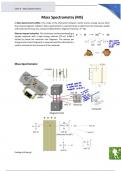
Electron Impact Ionization, This technique involves bombarding a
sample molecule with a high energy electron (70 eV, 6,694.4
kJ/mol) to break the molecule into fragment. The masses per
= Add these
charge (m/z) of each fragment is measured and the information is all together
used to reconstruct the structure of the molecule. to get the
at om
Mass Spectrometer
species
charge
isdetected by
magnet (cation
To
detect
e
Feeling chil-laxing!
, 2
Ch14.3 – Mass Spectrometry
Molecular ion (M+): the radical cation corresponding to the mass of the __________________________.
intact molecular
Really big Peak
Fragments: the ions of smaller molecular weights.
small peak
Relative abundance: Relative amount of each species.
Base peak: the species that has the highest relative abundance (100%).
- molecular ion
fragments
Information in Mass Spectrum
(1) M+ peak - Molecular weight
- Nitrogen Rule
- Rule of Thirteen
(2) M+2 peak: Br and Cl
(3) Fragmentation Pattern
Feeling chil-laxing!
Ch14.3 – Mass Spectrometry
Mass Spectrometry (MS)
A Mass Spectrometry (MS) is the study of the interaction between matter and an energy source other
than electromagnetic radiation. Mass spectrometry is used primarily to determine the molecular weight
and molecular formula of a compound (David Klein, Organic Chemistry. 2nd ed)
Electron Impact Ionization, This technique involves bombarding a
sample molecule with a high energy electron (70 eV, 6,694.4
kJ/mol) to break the molecule into fragment. The masses per
= Add these
charge (m/z) of each fragment is measured and the information is all together
used to reconstruct the structure of the molecule. to get the
at om
Mass Spectrometer
species
charge
isdetected by
magnet (cation
To
detect
e
Feeling chil-laxing!
, 2
Ch14.3 – Mass Spectrometry
Molecular ion (M+): the radical cation corresponding to the mass of the __________________________.
intact molecular
Really big Peak
Fragments: the ions of smaller molecular weights.
small peak
Relative abundance: Relative amount of each species.
Base peak: the species that has the highest relative abundance (100%).
- molecular ion
fragments
Information in Mass Spectrum
(1) M+ peak - Molecular weight
- Nitrogen Rule
- Rule of Thirteen
(2) M+2 peak: Br and Cl
(3) Fragmentation Pattern
Feeling chil-laxing!