

SIMPLE?
Subject: Mathematics. INTEREST CALCULATED ON ORIGINAL
AMOUNT.
COMPOUND?
CALCULATED ON THE AMOUNT WITH
INTEREST. ‘INTEREST ON INTEREST’
Topic: Financial Mathematics.
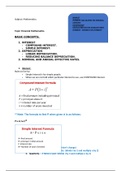
BASIC CONCEPTS:
1. INTEREST
- COMPOUND INTEREST.
- SIMPLE INTEREST.
2. DEPRECIATION
- LINEAR DEPRECIATION.
- REDUCING BALANCE DEPRECIATION.
3. NOMINAL AND ANNUAL EFFECTIVE RATES.
1. Interest:
Rules to live by:
- Simple interest is for simple people.
- When we are not told which particular interest to use, use COMPOUND interest.
***Note: The formula to find P when given A is as follows:
PA(1i)n
Simple Interest Formula
A= P x i x n
A= final amount
P= principal / initial amount
I= interest rate
- Different compounding periods:
N= Number1. of years invested.
Annually. – once a year. (n and i don’t change)
2. Semi-annually. – every six months. (divide i by 2 and multiply n by 2)
3. Quarterly. – 4 times a year. (divide i by 4 and multiply n by 4)
, 4. Monthly. – every month. (divide i by 12 and multiply n by 12.)
Example:
(on White Board)
2. Depreciation:
? - an item losing value over a period of time.
- Linear depreciation. (SIMPLE)
AP(1i.n)
- Reducing balance depreciation.
AP(1i)n
3. Nominal and Annual Effective Rates.
You need to know the formula off by heart.
Nominal rate ? Does take the compounding period into account and is therefore
more accurate.
Effective rate? Does not take the compounding period into account. (NOT AS
ACCURATE)
Examples:
Subject: Mathematics. INTEREST CALCULATED ON ORIGINAL
AMOUNT.
COMPOUND?
CALCULATED ON THE AMOUNT WITH
INTEREST. ‘INTEREST ON INTEREST’
Topic: Financial Mathematics.
BASIC CONCEPTS:
1. INTEREST
- COMPOUND INTEREST.
- SIMPLE INTEREST.
2. DEPRECIATION
- LINEAR DEPRECIATION.
- REDUCING BALANCE DEPRECIATION.
3. NOMINAL AND ANNUAL EFFECTIVE RATES.
1. Interest:
Rules to live by:
- Simple interest is for simple people.
- When we are not told which particular interest to use, use COMPOUND interest.
***Note: The formula to find P when given A is as follows:
PA(1i)n
Simple Interest Formula
A= P x i x n
A= final amount
P= principal / initial amount
I= interest rate
- Different compounding periods:
N= Number1. of years invested.
Annually. – once a year. (n and i don’t change)
2. Semi-annually. – every six months. (divide i by 2 and multiply n by 2)
3. Quarterly. – 4 times a year. (divide i by 4 and multiply n by 4)
, 4. Monthly. – every month. (divide i by 12 and multiply n by 12.)
Example:
(on White Board)
2. Depreciation:
? - an item losing value over a period of time.
- Linear depreciation. (SIMPLE)
AP(1i.n)
- Reducing balance depreciation.
AP(1i)n
3. Nominal and Annual Effective Rates.
You need to know the formula off by heart.
Nominal rate ? Does take the compounding period into account and is therefore
more accurate.
Effective rate? Does not take the compounding period into account. (NOT AS
ACCURATE)
Examples:


