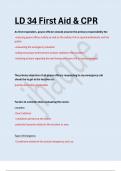
LD 34 First Aid & CPR
As first responders, peace officers should assume the primary responsibility for:
-ensuring peace officer safety as well as the safety of ill or injured individuals and the
public
-evaluating the emergency situation
-taking necessary enforcement actions related to the incident
-initiating actions regarding the well-being and care of ill or injured persons
The primary objective of all peace officers responding to any emergency call
should be to get to the location as:
quickly and safely as possible
Factors to consider when evaluating the scene:
Location
-Exact address
-conditions present at the scene
-potential hazards related to the incident or area
Type of Emergency
-Conditions related to the actual emergency such as:
,- a vehicle collision involving injuries
- an individual complaining of severe chest pain
- a person injured as a result of criminal action
Nature of Ill/Injured Person(s)
-Number of victims
-apparent age of the victim(s)
-whether victim(s) is conscious or unconscious
-Appearance of injury
Need for additional resources
-Fire department
- Additional Law Enforcement
- EMS
- Public utility services
- Other specialty units
Urgent Enforcement actions required
- Protection of victim(s) from aggressor(s)
- Control of suspect(s) and/or bystanders
- Immediate protection of a crime scene
,When determining appropriate safety precautions to take, peace officers should
consider possible dangers from:
- Exposure to biological hazards
- Armed suspects, angry bystanders, etc.
- Unsafe scene conditions
- Environmental hazards
- Animals
Based on this initial assessment peace officers may be required to provide:
Basic care for the victim (basic EMS)
Peace Officers may be required to continue additional enforcement actions
including:
-documenting their initial observations when first arriving at the scene
- maintaining control of the scene to protect potential evidence
- identifying and isolating witnesses and involved parties
- recording statements or information provided by the victims, witnesses, etc.
- noting whether items were moved in order to render medical emergency services
- any other investigative actions required
Pathogens
, Agents that are spread through the air or by contact with another person's blood or
body fluids that cause infection and disease
Infection and disease are caused by
pathogens
Bacteria
Microscopic organisms that can live in water, soil, or organic material, or within the
bodies of plans, animals, and humans.
Virus
Submicroscopic agent that is capable of infecting living cells.
Two primary methods which pathogens can be transferred from one human being
to another:
AIRBORNE PATHOGENS: spread by tiny droplets sprayed during breathing, coughing,
or sneezing.
BLOOD BORNE PATHOGENS: may be spread when the blood or other body fluids of
one person comes into contact with an open wound or sore of another.
As first responders, peace officers should assume the primary responsibility for:
-ensuring peace officer safety as well as the safety of ill or injured individuals and the
public
-evaluating the emergency situation
-taking necessary enforcement actions related to the incident
-initiating actions regarding the well-being and care of ill or injured persons
The primary objective of all peace officers responding to any emergency call
should be to get to the location as:
quickly and safely as possible
Factors to consider when evaluating the scene:
Location
-Exact address
-conditions present at the scene
-potential hazards related to the incident or area
Type of Emergency
-Conditions related to the actual emergency such as:
,- a vehicle collision involving injuries
- an individual complaining of severe chest pain
- a person injured as a result of criminal action
Nature of Ill/Injured Person(s)
-Number of victims
-apparent age of the victim(s)
-whether victim(s) is conscious or unconscious
-Appearance of injury
Need for additional resources
-Fire department
- Additional Law Enforcement
- EMS
- Public utility services
- Other specialty units
Urgent Enforcement actions required
- Protection of victim(s) from aggressor(s)
- Control of suspect(s) and/or bystanders
- Immediate protection of a crime scene
,When determining appropriate safety precautions to take, peace officers should
consider possible dangers from:
- Exposure to biological hazards
- Armed suspects, angry bystanders, etc.
- Unsafe scene conditions
- Environmental hazards
- Animals
Based on this initial assessment peace officers may be required to provide:
Basic care for the victim (basic EMS)
Peace Officers may be required to continue additional enforcement actions
including:
-documenting their initial observations when first arriving at the scene
- maintaining control of the scene to protect potential evidence
- identifying and isolating witnesses and involved parties
- recording statements or information provided by the victims, witnesses, etc.
- noting whether items were moved in order to render medical emergency services
- any other investigative actions required
Pathogens
, Agents that are spread through the air or by contact with another person's blood or
body fluids that cause infection and disease
Infection and disease are caused by
pathogens
Bacteria
Microscopic organisms that can live in water, soil, or organic material, or within the
bodies of plans, animals, and humans.
Virus
Submicroscopic agent that is capable of infecting living cells.
Two primary methods which pathogens can be transferred from one human being
to another:
AIRBORNE PATHOGENS: spread by tiny droplets sprayed during breathing, coughing,
or sneezing.
BLOOD BORNE PATHOGENS: may be spread when the blood or other body fluids of
one person comes into contact with an open wound or sore of another.