CHAPTER TWO
CELL DIVISION: MEIOSIS
STRUCTURE OF CHROMOSOMES
1. Chromatin Network unwinds to form chromosomes
2. Chromosomes are long strands of DNA wrapped by outer protein covering
3. DNA is made up of nucleotides
CHROMOSOMES IN SOMATIC AND SEX CELLS
● Somatic cells: made of 46 chromosomes. They are diploid.
● Sex cells: made of 23 chromosomes. They are haploid.
● 22 pairs of autosomes, 1 pair of gonosomes (X and/or Y chromosomes)
● Female has XX gonosomes
● Male has XY gonosomes
● One gonosome is maternal whilst the other is paternal but they are
identical in terms of type/order of gene(s).
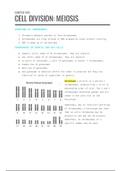
Karyotype:a picture of a person's
chromosomes. Ordered from 1 to 22 in
descending order of size. The X and Y
chromosomes determine gender and are
shown in the 23rd slot on the
karyotype.
Sometimes, due to incorrect splitting
of chromosomes, a karyotype may show
that an extra chromosome may be
present or one may not be present.
Sometimes, no chromosomes of a
specific number may be seen.
, MEIOSIS
● Dividing one cell into four cells
● Occurs during gametogenesis
Gametogenesis: process which take place wherein gametes (sex cells) are formed
CHROMOSOME NUMBER
● Human chromosome number is 46
● The halving effect, which brings the chromosome number per sex cell down
to 23, is very important (to prevent chromosome number from doubling
eternally. ie 23,46,92...)
● The doubling effect allows the chromosome number to increase back up to
46. It happens when two haploid cells (Sperm and ovum) fuze to form a
diploid cell.
● Having one too many or one too little chromosomes may lead to
deformities such as down syndrome.
MEIOSIS BEFORE FERTILISATION (DURING GAMETE FORMATION)
● ie Humans
● Takes place when the gametes are formed
● It halves the chromosome number with the halving effect
● Fusion of two haploid cells creates a diploid cell (zygote)
MEIOSIS AFTER FERTILISATION
● ie Algae
● Haploid spores give rise to haploid gametes
● Fertilization results in a diploid zygote
● Zygote undergoes meiosis to produce haploid spores
MEIOSIS IN MOSS/FERNS
● Alternates between haploid gametophytes and diploid sporophytes
● The halving effect allows for this alternation
CELL DIVISION: MEIOSIS
STRUCTURE OF CHROMOSOMES
1. Chromatin Network unwinds to form chromosomes
2. Chromosomes are long strands of DNA wrapped by outer protein covering
3. DNA is made up of nucleotides
CHROMOSOMES IN SOMATIC AND SEX CELLS
● Somatic cells: made of 46 chromosomes. They are diploid.
● Sex cells: made of 23 chromosomes. They are haploid.
● 22 pairs of autosomes, 1 pair of gonosomes (X and/or Y chromosomes)
● Female has XX gonosomes
● Male has XY gonosomes
● One gonosome is maternal whilst the other is paternal but they are
identical in terms of type/order of gene(s).
Karyotype:a picture of a person's
chromosomes. Ordered from 1 to 22 in
descending order of size. The X and Y
chromosomes determine gender and are
shown in the 23rd slot on the
karyotype.
Sometimes, due to incorrect splitting
of chromosomes, a karyotype may show
that an extra chromosome may be
present or one may not be present.
Sometimes, no chromosomes of a
specific number may be seen.
, MEIOSIS
● Dividing one cell into four cells
● Occurs during gametogenesis
Gametogenesis: process which take place wherein gametes (sex cells) are formed
CHROMOSOME NUMBER
● Human chromosome number is 46
● The halving effect, which brings the chromosome number per sex cell down
to 23, is very important (to prevent chromosome number from doubling
eternally. ie 23,46,92...)
● The doubling effect allows the chromosome number to increase back up to
46. It happens when two haploid cells (Sperm and ovum) fuze to form a
diploid cell.
● Having one too many or one too little chromosomes may lead to
deformities such as down syndrome.
MEIOSIS BEFORE FERTILISATION (DURING GAMETE FORMATION)
● ie Humans
● Takes place when the gametes are formed
● It halves the chromosome number with the halving effect
● Fusion of two haploid cells creates a diploid cell (zygote)
MEIOSIS AFTER FERTILISATION
● ie Algae
● Haploid spores give rise to haploid gametes
● Fertilization results in a diploid zygote
● Zygote undergoes meiosis to produce haploid spores
MEIOSIS IN MOSS/FERNS
● Alternates between haploid gametophytes and diploid sporophytes
● The halving effect allows for this alternation