
Chapter 3: The Self
WHAT IS THE SELF?
Brain Researchers self = illusion. Did not find any spot in the brain that seems to correspond to
the self.
THE SELF’S MAIN JOBS
Self’s naturally feel selfish & in many situations they have strong impulses to do what is best
for themselves.
Designed to know & do what is best for them.
Selfishness must be kept under control is society is to operate effectively.
Incorporate morals & other values of the culture (tell you to do what is best for the group)
Able to understand these social morals & other values and to be able to act on them.
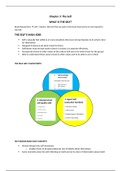
THE SELF HAS 3 MAIN PARTS:
1. Self-knowledge
(self-concept)
Information about the self:
1. Self-awareness
2. Self_esteem
3. Self-deception
2. Interpersonal- 3. Agent Self
self (public self) (executive function)
1. Self-presentation 1. decision making
2. member of groups.
2. self-control
3. Relationships partner.
3. taking charge of situations
4. Social Roles
5. Reputation
4. active responding
SELF-KNOWLEDGE (SELF-CONCEPT)
Human beings have self-awareness.
o Enables them to develop elaborate sets of beliefs about themselves.
Some moments show the self reflecting on itself and on its store of information about itself.
,INTERPERSONAL SELF (PUBLIC SELF)
Helps the person connect socially to other people.
Most people have a certain image they try to convey on another.
Public-self resembles the self-concept (BUT ARE NOT THE SAME). People work hard to
present a particular image to others, even if it’s not exactly the full, precise truth as they
know it.
o The self is often working in complex ways to gain social acceptance & maintain
interpersonal relationships.
AGENT-SELF (EXECUTIVE FUNCTION)
Part that get things done.
Enables self to make choices & exert control, including:
o Self-control
o Control over other people & things.
Actions reveal the self as not just a knower but also a doer!
WHO MAKES THE SELF: THE INDIVIDUAL OR SOCIETY???
The self comes into being at the point of interaction between the inner biological processes of the
human body & the sociocultural network to which the person belongs.
A TRUE OR REAL SELF ???
Sociologist Ralph Turner
Different cultures may differ in their ideas about the true self by placing emphasis on
either two main approaches:
o Approach emphasises the inner feelings as the true self.
o Focusses on the way the person acts in public, especially in official roles.
Point = cultures disagree as to whether the public actions or the inner feelings count as the
more real or true side of the self.
o Public actions can be used as a coping mechanism.
Person’s coping ability is influenced by his/her upbringing & background.
, CULTURE AND INTERDEPENDANCE
Cultural differences involves independents vs. interdependence.
This dimension of difference involves different attitudes toward the self & different
motivations as to what the self mainly tries to accomplish.
o Results = different emphases about what the self is.
Independent self-construal
o Emphasises what makes the self different & sets apart from others.
o
Interdependent self-construal
o Emphasises what connects the self to other people & groups.
o
WHAT IS THE SELF?
Brain Researchers self = illusion. Did not find any spot in the brain that seems to correspond to
the self.
THE SELF’S MAIN JOBS
Self’s naturally feel selfish & in many situations they have strong impulses to do what is best
for themselves.
Designed to know & do what is best for them.
Selfishness must be kept under control is society is to operate effectively.
Incorporate morals & other values of the culture (tell you to do what is best for the group)
Able to understand these social morals & other values and to be able to act on them.
THE SELF HAS 3 MAIN PARTS:
1. Self-knowledge
(self-concept)
Information about the self:
1. Self-awareness
2. Self_esteem
3. Self-deception
2. Interpersonal- 3. Agent Self
self (public self) (executive function)
1. Self-presentation 1. decision making
2. member of groups.
2. self-control
3. Relationships partner.
3. taking charge of situations
4. Social Roles
5. Reputation
4. active responding
SELF-KNOWLEDGE (SELF-CONCEPT)
Human beings have self-awareness.
o Enables them to develop elaborate sets of beliefs about themselves.
Some moments show the self reflecting on itself and on its store of information about itself.
,INTERPERSONAL SELF (PUBLIC SELF)
Helps the person connect socially to other people.
Most people have a certain image they try to convey on another.
Public-self resembles the self-concept (BUT ARE NOT THE SAME). People work hard to
present a particular image to others, even if it’s not exactly the full, precise truth as they
know it.
o The self is often working in complex ways to gain social acceptance & maintain
interpersonal relationships.
AGENT-SELF (EXECUTIVE FUNCTION)
Part that get things done.
Enables self to make choices & exert control, including:
o Self-control
o Control over other people & things.
Actions reveal the self as not just a knower but also a doer!
WHO MAKES THE SELF: THE INDIVIDUAL OR SOCIETY???
The self comes into being at the point of interaction between the inner biological processes of the
human body & the sociocultural network to which the person belongs.
A TRUE OR REAL SELF ???
Sociologist Ralph Turner
Different cultures may differ in their ideas about the true self by placing emphasis on
either two main approaches:
o Approach emphasises the inner feelings as the true self.
o Focusses on the way the person acts in public, especially in official roles.
Point = cultures disagree as to whether the public actions or the inner feelings count as the
more real or true side of the self.
o Public actions can be used as a coping mechanism.
Person’s coping ability is influenced by his/her upbringing & background.
, CULTURE AND INTERDEPENDANCE
Cultural differences involves independents vs. interdependence.
This dimension of difference involves different attitudes toward the self & different
motivations as to what the self mainly tries to accomplish.
o Results = different emphases about what the self is.
Independent self-construal
o Emphasises what makes the self different & sets apart from others.
o
Interdependent self-construal
o Emphasises what connects the self to other people & groups.
o


