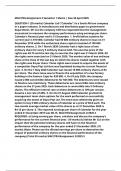
MAC3703 Assignment 2 Semester 1 Memo | Due 30 April 2025
QUESTION 1 (20 marks) Calendar Ltd (“Calendar”) is a South African company
in a paper industry. It manufactures and distributes paper to government
department. Mr Cut the company CEO has requested that the management
accountant to measure the company performance using earnings per share.
Calendar’s financial year end is 31 December. 1. Profit before taxation for
current year is R10 000. Calendar had 50 000 ordinary shares in issue on 31
December 2019 while the authorised share capital consisted of 100 000
ordinary shares. 2. On 1 March 2020 Calendar had a right issue of one
ordinary share for every 5 ordinary shares held. The exercise price of the
rights was R3.75 and the last day to exercise the right was 31 March 2020. All
the rights were exercised on 31 March 2020. The market value of one ordinary
share at the close of the last day on which the shares traded together with
the rights was R4 per share. These rights were issued to acquire the assets of
a competitor Days (Pty) Ltd that was liquidated during the current financial
year. 3. On the 1 May 2020 Calendar was issued 10 000 ordinary shares at R4
per share. The share issue was to finance the acquisition of a new factory
building in the Eastern Cape for R30 000. 4. On 01 July 2020, the company
issued 2 000 convertible debentures for R25 000. The debentures were issued
to finance new machinery. These debentures are convertible into ordinary
shares on the 31 June 2025. Each debenture is convertible into 5 Ordinary
shares. The effective interest rate on these debentures is 10% per annum.
Assume a tax rate of 28%. 5. On the 01 August 2020 Calendar granted its
management team share options for the work performed on successfully
acquiring the assets of Days (Pty) Ltd. The team was collectively given an
option to buy 5 000 ordinary shares of Calendar at a price of R3.8 each. The
two-month average market value of the shares as at 31 December 2020 is
R4.15 per share. 6. The reported earnings per share of Calendar for the year
ended 31 December 2019 was R0.15. MAC3703/Assignment 2/2025 4
REQUIRED: a) Using earning per share, calculate and discuss the company’s
performance for the current financial year. (10 marks) b) Advise Mr Cut on the
impact that the potential ordinary shares will have on the financial
performance of the company for the year ended 31 December 2020. (10
marks) (Note: Please use the diluted earnings per share to determine the
impact of potential ordinary shares on the financial performance of the
company) (Total 20 marks) MAC3703/Assignment 2/2025 5
,a) Basic Earnings Per Share (10 marks) Step 1: Determine Basic EPS formula:
Basic EPS
Profit attributable to ordinary shareholders
Weighted average number of ordinary shares Basic EPS=
Weighted average number of ordinary shares
Profit attributable to ordinary shareholders
Step 2: Adjust Profit after Tax
Given:
Profit before tax = R10,000
Tax rate = 28%
Profit after tax
𝑅 10 , 000 × ( 1 − 0.28 )
𝑅 7 , 200 Profit after tax=R10,000×(1−0.28)=R7,200 Step 3: Calculate Weighted
Average Number of Shares
Let's go through the changes step by step:
a) Shares in issue at start (1 Jan 2020): 50,000 shares.
b) Rights issue – 1 March 2020 Ratio: 1 for every 5 → new shares = 50, =
10,000
Rights issue is bonus element, hence we must apply a bonus adjustment factor.
, Theoretical Ex-right Price (TERP)
( 5 × 𝑅 4 ) + ( 1 × 𝑅 3.75 ) 6
𝑅 20 + 𝑅 3.75 6
𝑅 3.9583 Theoretical Ex-right Price (TERP)= 6
(5×R4)+(1×R3.75)
6 R20+R3.75 =R3.9583 Bonus factor
Market price before rights TERP
𝑅 4 𝑅 3.9583
1.0105 Bonus factor= TERP
Market price before rights
R3.9583 R4 =1.0105 So we adjust all prior shares by 1.0105 to reflect the bonus
element.
Adjusted opening shares = 50,000 × 1.0105 = 50,525
Rights shares (10,000) issued on 31 March 2020 → weighted for 9/12 = 7,500
c) New issue – 1 May 2020 10,000 shares, weighted 8/12 = 6,667
Total Weighted Average Shares =
= 50 , 525 + 7 , 500 + 6 , 667
64 , 692 =50,525+7,500+6,667=64,692 Step 4: Calculate Basic EPS
QUESTION 1 (20 marks) Calendar Ltd (“Calendar”) is a South African company
in a paper industry. It manufactures and distributes paper to government
department. Mr Cut the company CEO has requested that the management
accountant to measure the company performance using earnings per share.
Calendar’s financial year end is 31 December. 1. Profit before taxation for
current year is R10 000. Calendar had 50 000 ordinary shares in issue on 31
December 2019 while the authorised share capital consisted of 100 000
ordinary shares. 2. On 1 March 2020 Calendar had a right issue of one
ordinary share for every 5 ordinary shares held. The exercise price of the
rights was R3.75 and the last day to exercise the right was 31 March 2020. All
the rights were exercised on 31 March 2020. The market value of one ordinary
share at the close of the last day on which the shares traded together with
the rights was R4 per share. These rights were issued to acquire the assets of
a competitor Days (Pty) Ltd that was liquidated during the current financial
year. 3. On the 1 May 2020 Calendar was issued 10 000 ordinary shares at R4
per share. The share issue was to finance the acquisition of a new factory
building in the Eastern Cape for R30 000. 4. On 01 July 2020, the company
issued 2 000 convertible debentures for R25 000. The debentures were issued
to finance new machinery. These debentures are convertible into ordinary
shares on the 31 June 2025. Each debenture is convertible into 5 Ordinary
shares. The effective interest rate on these debentures is 10% per annum.
Assume a tax rate of 28%. 5. On the 01 August 2020 Calendar granted its
management team share options for the work performed on successfully
acquiring the assets of Days (Pty) Ltd. The team was collectively given an
option to buy 5 000 ordinary shares of Calendar at a price of R3.8 each. The
two-month average market value of the shares as at 31 December 2020 is
R4.15 per share. 6. The reported earnings per share of Calendar for the year
ended 31 December 2019 was R0.15. MAC3703/Assignment 2/2025 4
REQUIRED: a) Using earning per share, calculate and discuss the company’s
performance for the current financial year. (10 marks) b) Advise Mr Cut on the
impact that the potential ordinary shares will have on the financial
performance of the company for the year ended 31 December 2020. (10
marks) (Note: Please use the diluted earnings per share to determine the
impact of potential ordinary shares on the financial performance of the
company) (Total 20 marks) MAC3703/Assignment 2/2025 5
,a) Basic Earnings Per Share (10 marks) Step 1: Determine Basic EPS formula:
Basic EPS
Profit attributable to ordinary shareholders
Weighted average number of ordinary shares Basic EPS=
Weighted average number of ordinary shares
Profit attributable to ordinary shareholders
Step 2: Adjust Profit after Tax
Given:
Profit before tax = R10,000
Tax rate = 28%
Profit after tax
𝑅 10 , 000 × ( 1 − 0.28 )
𝑅 7 , 200 Profit after tax=R10,000×(1−0.28)=R7,200 Step 3: Calculate Weighted
Average Number of Shares
Let's go through the changes step by step:
a) Shares in issue at start (1 Jan 2020): 50,000 shares.
b) Rights issue – 1 March 2020 Ratio: 1 for every 5 → new shares = 50, =
10,000
Rights issue is bonus element, hence we must apply a bonus adjustment factor.
, Theoretical Ex-right Price (TERP)
( 5 × 𝑅 4 ) + ( 1 × 𝑅 3.75 ) 6
𝑅 20 + 𝑅 3.75 6
𝑅 3.9583 Theoretical Ex-right Price (TERP)= 6
(5×R4)+(1×R3.75)
6 R20+R3.75 =R3.9583 Bonus factor
Market price before rights TERP
𝑅 4 𝑅 3.9583
1.0105 Bonus factor= TERP
Market price before rights
R3.9583 R4 =1.0105 So we adjust all prior shares by 1.0105 to reflect the bonus
element.
Adjusted opening shares = 50,000 × 1.0105 = 50,525
Rights shares (10,000) issued on 31 March 2020 → weighted for 9/12 = 7,500
c) New issue – 1 May 2020 10,000 shares, weighted 8/12 = 6,667
Total Weighted Average Shares =
= 50 , 525 + 7 , 500 + 6 , 667
64 , 692 =50,525+7,500+6,667=64,692 Step 4: Calculate Basic EPS