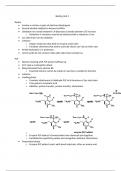
BioOrg Unit 2
Redox
• Involve a net loss or gain of electrons/hydrogens
• Second alcohol oxidized to ketone by NAD+
• Oxidation rxn: bonds between CH decrease as bonds between CO increase
o Oxidation ½ reactions need to be balanced with a reduction ½ rxn
• Cys side chain can do oxidation
• Cofactor
o Helper molecules that bind to enzyme active sites
o Facilitate chemistry that amino acid side chains can’t do on their own
• Amide hydrolysis is in proteases
• Amino acids do not contain redox-able side chains except Cys
PLP
• Alanine reacting with PLP pushes halfway up
• First step is nucleophilic attack
• Biosynthesized from vitamin B6
o Essential vitamin cannot be made on own but is needed to function
• Cofactor
• Loading phase
o Covalent attachment of aldehyde PLP to N-terminus of Lys side chain
o Uses generic enzymatic acid
o Addition, proton transfer, proton transfer, elimination
o
o Enzyme-PLP adduct is formed when two chemicals join together
o Facilitated by specificity pocket and recognition element interactions
• Preparation phase
o Enzyme-PLP adduct reacts with bond substrate, often an amino acid
,o N-terminus attacks iminium
o Addition, proton transfer, elimination
o
o Trans-imination reaction
§ One imine to another
o Side chain ejected as a leaving group
o Removal/augmentation/transformation of either carboxylate group, alpha
proton, or side chain
o Carboxylate group
§ Amino acid transformed and active site restored for serine racemase
§ Chiral, non-racemic starting PLP-dependent enzyme
§ Alpha proton loss
§ Non-oxidative
• Catalytic cycle
• Creates loaded PLP cofactor and amino acid with scrambled alpha
stereochemistry
• Protonate halfway
• Trans-imination from previously ejected side chain
§ Oxidative
• Tautomer of non-oxidative process
• Protonate halfway
• Hydrolysis by water
• Creates PAP in a reduced form
o Alpha proton
§ PLP-dependent transformation
§ CO2 loss instead of alpha proton loss
§ Same as carboxylate group otherwise
, o Side chain
§ Covalently attached to PLP
§ Side chain loss instead of alpha proton loss
§ Same as carboxylate group otherwise
• For any given amino acid, there are 6 possible PLP-dependent transformations
o 3 oxidative, 3 non-oxidative
o 2 involve side chain loss, 2 alpha proton loss, 2 carboxylate loss
• If the alpha C is not oxidized, electrons go all the way back up
o If oxidized, go half the way back up
• Amino acid side chains are not portable
• PLP-dependent catalysis
o Steps
§ Binding to dependent enzyme
§ Loading phase, when PLP covalently binds to enzyme
§ Preparation phase, where substrate covalently binds to PLP
§ Chemistry phase, where amino acid substrate transforms into new
product
§ Turnover phase, which is either oxidative or non oxidative
o Catalytic cycle in non-oxidative
o In an enzyme, H2O is bound to the active site
o Loading phase happens once
o Restore loaded PLP enzyme adduct and free product
o Reductive amination creates PAP, the oxidized product
o Active site distinguishes between targets and modes of reactivity
o Aromaticity is temporarily disrupted
§ After preparation and loading phases
§ Sigma energy flow acts as a pi bond
§ Specificity pockets are variable
§ Tautomerize as a last resort
§ Conjugation pattern removes alpha proton
§ Enzymatic acid above and below alpha carbon
§ Sends electrons to alpha carbon
§ Pi bond strengthened from CH being weakened
§ Racemic
o Energetics
§ Enzymes
• Speed up SàR and RàS conversion
• Facilitate racemization
• Cannot epimerize (convert one enantiomer to another)
• Catalysis is difficult to find an uncatalyzed version
o Base removes alpha proton and alpha proton is placed
back randomly
§ S and R products have the same energy catalyzed and uncatalyzed
Redox
• Involve a net loss or gain of electrons/hydrogens
• Second alcohol oxidized to ketone by NAD+
• Oxidation rxn: bonds between CH decrease as bonds between CO increase
o Oxidation ½ reactions need to be balanced with a reduction ½ rxn
• Cys side chain can do oxidation
• Cofactor
o Helper molecules that bind to enzyme active sites
o Facilitate chemistry that amino acid side chains can’t do on their own
• Amide hydrolysis is in proteases
• Amino acids do not contain redox-able side chains except Cys
PLP
• Alanine reacting with PLP pushes halfway up
• First step is nucleophilic attack
• Biosynthesized from vitamin B6
o Essential vitamin cannot be made on own but is needed to function
• Cofactor
• Loading phase
o Covalent attachment of aldehyde PLP to N-terminus of Lys side chain
o Uses generic enzymatic acid
o Addition, proton transfer, proton transfer, elimination
o
o Enzyme-PLP adduct is formed when two chemicals join together
o Facilitated by specificity pocket and recognition element interactions
• Preparation phase
o Enzyme-PLP adduct reacts with bond substrate, often an amino acid
,o N-terminus attacks iminium
o Addition, proton transfer, elimination
o
o Trans-imination reaction
§ One imine to another
o Side chain ejected as a leaving group
o Removal/augmentation/transformation of either carboxylate group, alpha
proton, or side chain
o Carboxylate group
§ Amino acid transformed and active site restored for serine racemase
§ Chiral, non-racemic starting PLP-dependent enzyme
§ Alpha proton loss
§ Non-oxidative
• Catalytic cycle
• Creates loaded PLP cofactor and amino acid with scrambled alpha
stereochemistry
• Protonate halfway
• Trans-imination from previously ejected side chain
§ Oxidative
• Tautomer of non-oxidative process
• Protonate halfway
• Hydrolysis by water
• Creates PAP in a reduced form
o Alpha proton
§ PLP-dependent transformation
§ CO2 loss instead of alpha proton loss
§ Same as carboxylate group otherwise
, o Side chain
§ Covalently attached to PLP
§ Side chain loss instead of alpha proton loss
§ Same as carboxylate group otherwise
• For any given amino acid, there are 6 possible PLP-dependent transformations
o 3 oxidative, 3 non-oxidative
o 2 involve side chain loss, 2 alpha proton loss, 2 carboxylate loss
• If the alpha C is not oxidized, electrons go all the way back up
o If oxidized, go half the way back up
• Amino acid side chains are not portable
• PLP-dependent catalysis
o Steps
§ Binding to dependent enzyme
§ Loading phase, when PLP covalently binds to enzyme
§ Preparation phase, where substrate covalently binds to PLP
§ Chemistry phase, where amino acid substrate transforms into new
product
§ Turnover phase, which is either oxidative or non oxidative
o Catalytic cycle in non-oxidative
o In an enzyme, H2O is bound to the active site
o Loading phase happens once
o Restore loaded PLP enzyme adduct and free product
o Reductive amination creates PAP, the oxidized product
o Active site distinguishes between targets and modes of reactivity
o Aromaticity is temporarily disrupted
§ After preparation and loading phases
§ Sigma energy flow acts as a pi bond
§ Specificity pockets are variable
§ Tautomerize as a last resort
§ Conjugation pattern removes alpha proton
§ Enzymatic acid above and below alpha carbon
§ Sends electrons to alpha carbon
§ Pi bond strengthened from CH being weakened
§ Racemic
o Energetics
§ Enzymes
• Speed up SàR and RàS conversion
• Facilitate racemization
• Cannot epimerize (convert one enantiomer to another)
• Catalysis is difficult to find an uncatalyzed version
o Base removes alpha proton and alpha proton is placed
back randomly
§ S and R products have the same energy catalyzed and uncatalyzed