
LML4801
Assignment 2 Semester 1 2025
Unique Number:
Due Date: 24 April 2025
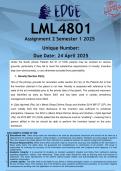
Under the South African Patents Act 57 of 1978, patents may be revoked on various
grounds, particularly if they fail to meet the substantive requirements of novelty, inventive
step (non-obviousness), or are otherwise excluded from patentability.
1. Novelty (Section 25(5))
One of the primary grounds for revocation under section 61(1)(c) of the Patents Act is that
the invention claimed in the patent is not new. Novelty is assessed with reference to the
state of the art immediately prior to the priority date of the patent. The compound maxorevo
was identified as early as March 2001 and has been used in cardiac arrhythmia
management medicine since 2004.
In Cipla Agrimed (Pty) Ltd v Merck Sharp Dohme Group and Another 2014 BIP 27 (CP), the
court initially held that mere disclosure of the invention was sufficient to constitute
anticipation. However, the SCA in Merck Sharp Dohme Group and Another v Cipla Agrimed
(Pty) Ltd 2015 BIP 101 (SCA) added that the disclosure must be "enabling"—meaning that a
person skilled in the art should be able to perform the invention based on the prior
disclosure.
DISCLAIMER & TERMS OF USE
Educational Aid: These study notes are intended to be used as educational resources and should not be seen as a
replacement for individual research, critical analysis, or professional consultation. Students are encouraged to perform
their own research and seek advice from their instructors or academic advisors for specific assignment guidelines.
Personal Responsibility: While every effort has been made to ensure the accuracy and reliability of the information in
these study notes, the seller does not guarantee the completeness or correctness of all content. The buyer is
responsible for verifying the accuracy of the information and exercising their own judgment when applying it to their
assignments.
Academic Integrity: It is essential for students to maintain academic integrity and follow their institution's policies
regarding plagiarism, citation, and referencing. These study notes should be used as learning tools and sources of
inspiration. Any direct reproduction of the content without proper citation and acknowledgment may be considered
academic misconduct.
Limited Liability: The seller shall not be liable for any direct or indirect damages, losses, or consequences arising from
the use of these notes. This includes, but is not limited to, poor academic performance, penalties, or any other negative
consequences resulting from the application or misuse of the information provided.
, For additional support +27 81 278 3372
Under the South African Patents Act 57 of 1978, patents may be revoked on various
grounds, particularly if they fail to meet the substantive requirements of novelty,
inventive step (non-obviousness), or are otherwise excluded from patentability.
1. Novelty (Section 25(5))
One of the primary grounds for revocation under section 61(1)(c) of the Patents Act
is that the invention claimed in the patent is not new. Novelty is assessed with
reference to the state of the art immediately prior to the priority date of the patent.
The compound maxorevo was identified as early as March 2001 and has been used
in cardiac arrhythmia management medicine since 2004.
In Cipla Agrimed (Pty) Ltd v Merck Sharp Dohme Group and Another 2014 BIP 27
(CP), the court initially held that mere disclosure of the invention was sufficient to
constitute anticipation. However, the SCA in Merck Sharp Dohme Group and
Another v Cipla Agrimed (Pty) Ltd 2015 BIP 101 (SCA) added that the disclosure
must be "enabling"—meaning that a person skilled in the art should be able to
perform the invention based on the prior disclosure.
In this scenario, if maxorevo and its use for treating arrhythmia were already known
in 2004, R.D. Gen must show that the specific dosage regime (once daily for seven
days using a rapid-release tablet for a compound with a 12-hour or less half-life) was
also disclosed in an enabling manner. If the prior art does not clearly and sufficiently
teach this particular dosage regime, then the invention may still be novel.
Likelihood of Success: Moderate
Success depends on whether the precise dosage and method of treatment were
known or could be inferred from earlier disclosures. If not, the patent may withstand
this challenge.
2. Inventive Step (Section 25(10))
The Patents Act provides in s 25(10) that an invention is only patentable if it involves
an inventive step—meaning that it must not be obvious to a person skilled in the art.
The applicable test involves a multi-step process drawn from Roman Roller CC v
Assignment 2 Semester 1 2025
Unique Number:
Due Date: 24 April 2025
Under the South African Patents Act 57 of 1978, patents may be revoked on various
grounds, particularly if they fail to meet the substantive requirements of novelty, inventive
step (non-obviousness), or are otherwise excluded from patentability.
1. Novelty (Section 25(5))
One of the primary grounds for revocation under section 61(1)(c) of the Patents Act is that
the invention claimed in the patent is not new. Novelty is assessed with reference to the
state of the art immediately prior to the priority date of the patent. The compound maxorevo
was identified as early as March 2001 and has been used in cardiac arrhythmia
management medicine since 2004.
In Cipla Agrimed (Pty) Ltd v Merck Sharp Dohme Group and Another 2014 BIP 27 (CP), the
court initially held that mere disclosure of the invention was sufficient to constitute
anticipation. However, the SCA in Merck Sharp Dohme Group and Another v Cipla Agrimed
(Pty) Ltd 2015 BIP 101 (SCA) added that the disclosure must be "enabling"—meaning that a
person skilled in the art should be able to perform the invention based on the prior
disclosure.
DISCLAIMER & TERMS OF USE
Educational Aid: These study notes are intended to be used as educational resources and should not be seen as a
replacement for individual research, critical analysis, or professional consultation. Students are encouraged to perform
their own research and seek advice from their instructors or academic advisors for specific assignment guidelines.
Personal Responsibility: While every effort has been made to ensure the accuracy and reliability of the information in
these study notes, the seller does not guarantee the completeness or correctness of all content. The buyer is
responsible for verifying the accuracy of the information and exercising their own judgment when applying it to their
assignments.
Academic Integrity: It is essential for students to maintain academic integrity and follow their institution's policies
regarding plagiarism, citation, and referencing. These study notes should be used as learning tools and sources of
inspiration. Any direct reproduction of the content without proper citation and acknowledgment may be considered
academic misconduct.
Limited Liability: The seller shall not be liable for any direct or indirect damages, losses, or consequences arising from
the use of these notes. This includes, but is not limited to, poor academic performance, penalties, or any other negative
consequences resulting from the application or misuse of the information provided.
, For additional support +27 81 278 3372
Under the South African Patents Act 57 of 1978, patents may be revoked on various
grounds, particularly if they fail to meet the substantive requirements of novelty,
inventive step (non-obviousness), or are otherwise excluded from patentability.
1. Novelty (Section 25(5))
One of the primary grounds for revocation under section 61(1)(c) of the Patents Act
is that the invention claimed in the patent is not new. Novelty is assessed with
reference to the state of the art immediately prior to the priority date of the patent.
The compound maxorevo was identified as early as March 2001 and has been used
in cardiac arrhythmia management medicine since 2004.
In Cipla Agrimed (Pty) Ltd v Merck Sharp Dohme Group and Another 2014 BIP 27
(CP), the court initially held that mere disclosure of the invention was sufficient to
constitute anticipation. However, the SCA in Merck Sharp Dohme Group and
Another v Cipla Agrimed (Pty) Ltd 2015 BIP 101 (SCA) added that the disclosure
must be "enabling"—meaning that a person skilled in the art should be able to
perform the invention based on the prior disclosure.
In this scenario, if maxorevo and its use for treating arrhythmia were already known
in 2004, R.D. Gen must show that the specific dosage regime (once daily for seven
days using a rapid-release tablet for a compound with a 12-hour or less half-life) was
also disclosed in an enabling manner. If the prior art does not clearly and sufficiently
teach this particular dosage regime, then the invention may still be novel.
Likelihood of Success: Moderate
Success depends on whether the precise dosage and method of treatment were
known or could be inferred from earlier disclosures. If not, the patent may withstand
this challenge.
2. Inventive Step (Section 25(10))
The Patents Act provides in s 25(10) that an invention is only patentable if it involves
an inventive step—meaning that it must not be obvious to a person skilled in the art.
The applicable test involves a multi-step process drawn from Roman Roller CC v



