

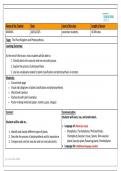
Name of the Teacher Date Level of the class Length of lesson
XXXXXXX 18/01/2025 secondary students. 60 Minutes
Topic: The Plant Kingdom and Photosynthesis
Learning Outcomes:
At the end of this lesson, most students will be able to:
1. Classify plants into vascular and non-vascular groups.
2. Explain the process of photosynthesis.
3. Use key vocabulary related to plant classification and photosynthesis in context.
Materials:
• Course book page
• Visual aids (diagrams of plant classification and photosynthesis)
• Word bank handout
• Flashcards with plant examples
• Poster-making materials (paper, markers, glue, images)
Content: Communication:
Students will learn, use, and understand…
Students will be able to…
• Language of: (Words for input)
1. Identify and classify different types of plants. Bryophytes, Tracheophytes, Photosynthesis,
2. Describe the process of photosynthesis and its importance. Chloroplasts,Vascular ,tissue, Spores, Non-vascular
3. Compare and contrast vascular and non-vascular plants. plants,Vascular plant,Flowering plants, Pteridophytes
• Language for: (Additional language needed)
pg. 1 Lesson Plan 150823
, Describing processes (e.g., "Plants use sunlight to…"),
comparing (e.g., "Unlike bryophytes, tracheophytes
have…").
• Language through: (Sentence stems for task (if applicable) and
output)
Sentence stems: "Photosynthesis occurs in…", "Bryophytes
do not have…".
Cognition: (*remember to include the Bloom stages students will be using) Culture:
1. (Bloom’s stages used in the lesson) 1. Reflect on how plant life supports ecosystems worldwide.
2. Understanding (Comprehension) 2. Understand the role of photosynthesis in global climate
3. Applying (Application) stability.
4. Analyzing differences between plant types (Analysis) 3. Explore how plants contribute to different environments.
Assessment Criteria:
• Correct classification of plants in sorting activity.
• Accurate explanations in group presentations.
• Participation in discussions and activities.
• Quality of poster and clarity of scientific explanations.
pg. 2 Lesson Plan 150823
XXXXXXX 18/01/2025 secondary students. 60 Minutes
Topic: The Plant Kingdom and Photosynthesis
Learning Outcomes:
At the end of this lesson, most students will be able to:
1. Classify plants into vascular and non-vascular groups.
2. Explain the process of photosynthesis.
3. Use key vocabulary related to plant classification and photosynthesis in context.
Materials:
• Course book page
• Visual aids (diagrams of plant classification and photosynthesis)
• Word bank handout
• Flashcards with plant examples
• Poster-making materials (paper, markers, glue, images)
Content: Communication:
Students will learn, use, and understand…
Students will be able to…
• Language of: (Words for input)
1. Identify and classify different types of plants. Bryophytes, Tracheophytes, Photosynthesis,
2. Describe the process of photosynthesis and its importance. Chloroplasts,Vascular ,tissue, Spores, Non-vascular
3. Compare and contrast vascular and non-vascular plants. plants,Vascular plant,Flowering plants, Pteridophytes
• Language for: (Additional language needed)
pg. 1 Lesson Plan 150823
, Describing processes (e.g., "Plants use sunlight to…"),
comparing (e.g., "Unlike bryophytes, tracheophytes
have…").
• Language through: (Sentence stems for task (if applicable) and
output)
Sentence stems: "Photosynthesis occurs in…", "Bryophytes
do not have…".
Cognition: (*remember to include the Bloom stages students will be using) Culture:
1. (Bloom’s stages used in the lesson) 1. Reflect on how plant life supports ecosystems worldwide.
2. Understanding (Comprehension) 2. Understand the role of photosynthesis in global climate
3. Applying (Application) stability.
4. Analyzing differences between plant types (Analysis) 3. Explore how plants contribute to different environments.
Assessment Criteria:
• Correct classification of plants in sorting activity.
• Accurate explanations in group presentations.
• Participation in discussions and activities.
• Quality of poster and clarity of scientific explanations.
pg. 2 Lesson Plan 150823


