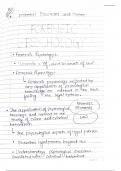
Human endocrine system
Responds to external changes
Communicates throughout body via chemicles (hormones) >> secreted by
glands or tissue
Hormone
Organic chemical substance (protein/steroid) secreted by endocrine gland and
travels via blood to organ which regulates metabolic activities.
Don’t last long (broken down by enzymes)
Types
1. Peptide (amino-acid)
2. Steroid
Endocrine gland
Vascular, ductless gland
Target organ
Hormone only affects that cell/tissue
Exo and endocrine glands
Exo – carried in ducts where it is needed
Endo – carried in blood stream
1. Hypothalamus
In brain (glandular and nervous tissue)
Secretes oxytocin
Hormones ADH (anti-diuretic hormone) >>detects increased of low water
levels (asmolarity). – helps reserve water (when dehydrated) by blood
reabsorbing water in collecting ducts in water from kidney (less water is lost
in urine)
2. Pituitary gland (master gland)
Sends stimulating hormones to glands
, Growth disorders: when too little or too much GH is released.
1. Hypersecretion – too much
2. Hyposecretion – too little
3. Thyroid gland
Secretes thyroxin (iodin is needed)
Function
Increases basal metabolism (amount of energy body needs at rest)
production of body heat in all body cells by controlling rate of cellular
respiration
Promotes normal function of heart
Promotes normal function of nervous system by increasing nervous activity
+ sharpening alertness +reflexes
Disorders
Hypo = too low (can be treated by iodine supplements/synthetics) but once
physical/mental abnormalities >> cant fix
Responds to external changes
Communicates throughout body via chemicles (hormones) >> secreted by
glands or tissue
Hormone
Organic chemical substance (protein/steroid) secreted by endocrine gland and
travels via blood to organ which regulates metabolic activities.
Don’t last long (broken down by enzymes)
Types
1. Peptide (amino-acid)
2. Steroid
Endocrine gland
Vascular, ductless gland
Target organ
Hormone only affects that cell/tissue
Exo and endocrine glands
Exo – carried in ducts where it is needed
Endo – carried in blood stream
1. Hypothalamus
In brain (glandular and nervous tissue)
Secretes oxytocin
Hormones ADH (anti-diuretic hormone) >>detects increased of low water
levels (asmolarity). – helps reserve water (when dehydrated) by blood
reabsorbing water in collecting ducts in water from kidney (less water is lost
in urine)
2. Pituitary gland (master gland)
Sends stimulating hormones to glands
, Growth disorders: when too little or too much GH is released.
1. Hypersecretion – too much
2. Hyposecretion – too little
3. Thyroid gland
Secretes thyroxin (iodin is needed)
Function
Increases basal metabolism (amount of energy body needs at rest)
production of body heat in all body cells by controlling rate of cellular
respiration
Promotes normal function of heart
Promotes normal function of nervous system by increasing nervous activity
+ sharpening alertness +reflexes
Disorders
Hypo = too low (can be treated by iodine supplements/synthetics) but once
physical/mental abnormalities >> cant fix