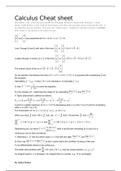
Calculus Cheat sheet
Disclaimer: this is not actually meant for cheating. Research shows that making a “cheat
sheet” right before a test with all hard topics and then not actually using it during the test, is
an effective way to practice. This was the “cheat sheet” I made for Calculus variant 2 (2WBB0)
and I hope it can prove to be useful to you.
a d
() ()
b and e are perpendicular if a × d+ b ×e +c ×f =0.
c f
x x
Line l through a
⃗ and b⃗ with both of the form
() ()
y is: y =⃗a + λ ×( ⃗b−⃗a ).
z z
x x
⃗ , e⃗ ,
A plane through 3 vectors d
z () ()
⃗f of the form y is: y = ⃗d+ λ × ( d⃗ −⃗e )+ μ ×( ⃗d−⃗f ).
z
k
⃗ ⃗ ⃗
The normal vector of this is n=( d−⃗e ) × ( d− f )= l .
m ()
So the equation that follows from this is k × x +l × y +m × z=d . d is acquired after substituting d
⃗ into
the equation.
'
(a): 1) Use f ( b )=a to calculate b. 2) Calculate f ' (x).
Calculating ( f −1 )
−1 ' 1
3) Use ( f ) ( a )= to solve the equation.
f ' (b)
For the domain of f-1, determine the range of f by calculating lim f (x ) and lim f (x) .
x →e x→ ∞
A Taylor polynomial is defined as follows:
f ' ( a) f '' (a) 2
f n( a) n
Pn ( x )=f ( a )+ ( x−a )+ ( x −a ) +…+ ( x−a ) .
1! 2! n!
A point is a global maximum of f in x = a if f is decreasing when x ≥ a (for f ’(x) ≤ 0) and f is increasing
when x ≤ a (for f ‘(x) ≥ 0).
The linearization of f is f ( x )=f ( a ) + f ' ( a ) ( x −a ) at x = a.
B
When you have ∫ A dx =B+ c ∫ A dx , do: ( 1−c )∫ A dx=B and then ∫ A dx = 1−c .
dy g( x) dy g( x)
f ( t ) dt=f ( g ( x ) ) × g '( x ) and f ( t ) dt=f ( g ( x ) ) × g' ( x ) −f ( h ( x ) ) ×h' ( x ) .
dx a dx h(x)
f ( x )= A for x< c (with A and B both consisting of x’s and c’s) is
Determining all c for which { B for x ≥ c
continuous can be done as follows:
1) Determine c. 2) Use f(x) which nears x = c from left and right: lim f (x ) and lim f (x ).
x ↓c x ↑c
3) Then use lim f (x )=lim f ( x ) to find c (since that is the condition to being continuous.
x ↓c x ↑c
To be differentiable means to be continuous.
dy
The initial value-problem with =ky and y ( 0 )= y 0 has the unique solution y= y 0 × e kt.
dt
An integral equal to ∞ is divergent. An integral that is a number, e.g. 15 is convergent.
By Isabel Rutten
Disclaimer: this is not actually meant for cheating. Research shows that making a “cheat
sheet” right before a test with all hard topics and then not actually using it during the test, is
an effective way to practice. This was the “cheat sheet” I made for Calculus variant 2 (2WBB0)
and I hope it can prove to be useful to you.
a d
() ()
b and e are perpendicular if a × d+ b ×e +c ×f =0.
c f
x x
Line l through a
⃗ and b⃗ with both of the form
() ()
y is: y =⃗a + λ ×( ⃗b−⃗a ).
z z
x x
⃗ , e⃗ ,
A plane through 3 vectors d
z () ()
⃗f of the form y is: y = ⃗d+ λ × ( d⃗ −⃗e )+ μ ×( ⃗d−⃗f ).
z
k
⃗ ⃗ ⃗
The normal vector of this is n=( d−⃗e ) × ( d− f )= l .
m ()
So the equation that follows from this is k × x +l × y +m × z=d . d is acquired after substituting d
⃗ into
the equation.
'
(a): 1) Use f ( b )=a to calculate b. 2) Calculate f ' (x).
Calculating ( f −1 )
−1 ' 1
3) Use ( f ) ( a )= to solve the equation.
f ' (b)
For the domain of f-1, determine the range of f by calculating lim f (x ) and lim f (x) .
x →e x→ ∞
A Taylor polynomial is defined as follows:
f ' ( a) f '' (a) 2
f n( a) n
Pn ( x )=f ( a )+ ( x−a )+ ( x −a ) +…+ ( x−a ) .
1! 2! n!
A point is a global maximum of f in x = a if f is decreasing when x ≥ a (for f ’(x) ≤ 0) and f is increasing
when x ≤ a (for f ‘(x) ≥ 0).
The linearization of f is f ( x )=f ( a ) + f ' ( a ) ( x −a ) at x = a.
B
When you have ∫ A dx =B+ c ∫ A dx , do: ( 1−c )∫ A dx=B and then ∫ A dx = 1−c .
dy g( x) dy g( x)
f ( t ) dt=f ( g ( x ) ) × g '( x ) and f ( t ) dt=f ( g ( x ) ) × g' ( x ) −f ( h ( x ) ) ×h' ( x ) .
dx a dx h(x)
f ( x )= A for x< c (with A and B both consisting of x’s and c’s) is
Determining all c for which { B for x ≥ c
continuous can be done as follows:
1) Determine c. 2) Use f(x) which nears x = c from left and right: lim f (x ) and lim f (x ).
x ↓c x ↑c
3) Then use lim f (x )=lim f ( x ) to find c (since that is the condition to being continuous.
x ↓c x ↑c
To be differentiable means to be continuous.
dy
The initial value-problem with =ky and y ( 0 )= y 0 has the unique solution y= y 0 × e kt.
dt
An integral equal to ∞ is divergent. An integral that is a number, e.g. 15 is convergent.
By Isabel Rutten