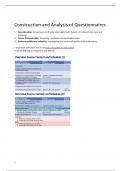
Construction and Analysis of Questionnaires
1. Operationalize: Converting non-directly observable traits, beliefs, or behaviors into concrete
questions
2. Assess dimensionality: ‘Clustering’ questions into meaningful scales
3. Evaluate validity and reliability: Investigating the (technical) quality of the scale scores
* Important definitions are in red (red is important for the exam!)
*Lecture 5/6/7/8 are important and difficult
1
,LECTURE 1: INTRODUCTION TO QUESTIONNAIRES
DEFINITION OF A QUESTIONNAIRE
• Maximum performance is about abilities for the test (focus is on obtaining highest scores)
• Typical performance is a typical questionnaire (focus on representative answers)
• A questionnaire is not the same as a test (questionnaire collects data about the topic e.g.
emotions or feelings)
2
,What is an ‘Item’?
What is a Purpose of a Questionnaire?
• Note: time to respond is limited
Examples
• The slide is important for the exam!
• What you see in the picture: 3 items on the left side / Likert scale on the right side
• The three items can be summarized (when you check reliability, validity and parametric data) →
then you have a psychometric scale.
3
, Questionnaires contain multiple ‘scales’
• Ignorance is bliss = sometimes not knowing information is good (not knowing can prevent
stress, worry or anxiety).
• What is latent and what is not, what is an item?
measurement in sciences
• Why? Because height is directly observable
• Height is directly observable. Some latent is not directly observable so we have to come up with
good questions.
4
1. Operationalize: Converting non-directly observable traits, beliefs, or behaviors into concrete
questions
2. Assess dimensionality: ‘Clustering’ questions into meaningful scales
3. Evaluate validity and reliability: Investigating the (technical) quality of the scale scores
* Important definitions are in red (red is important for the exam!)
*Lecture 5/6/7/8 are important and difficult
1
,LECTURE 1: INTRODUCTION TO QUESTIONNAIRES
DEFINITION OF A QUESTIONNAIRE
• Maximum performance is about abilities for the test (focus is on obtaining highest scores)
• Typical performance is a typical questionnaire (focus on representative answers)
• A questionnaire is not the same as a test (questionnaire collects data about the topic e.g.
emotions or feelings)
2
,What is an ‘Item’?
What is a Purpose of a Questionnaire?
• Note: time to respond is limited
Examples
• The slide is important for the exam!
• What you see in the picture: 3 items on the left side / Likert scale on the right side
• The three items can be summarized (when you check reliability, validity and parametric data) →
then you have a psychometric scale.
3
, Questionnaires contain multiple ‘scales’
• Ignorance is bliss = sometimes not knowing information is good (not knowing can prevent
stress, worry or anxiety).
• What is latent and what is not, what is an item?
measurement in sciences
• Why? Because height is directly observable
• Height is directly observable. Some latent is not directly observable so we have to come up with
good questions.
4