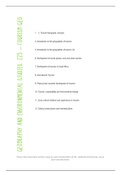
GE0gRAPHY AND ENVIRONMENTAL STUDIES 225 – TOURISM GEO
1 – 3. Tourism Geography concepts
4. Introduction to the geographies of tourism
5. Introduction to the geographies of tourism [2]
6. Development of tourist places; rural and urban tourism
7. Development of tourism in South Africa
8. International Tourism
9. Physical and economic development of tourism
10. Tourism, sustainability and environmental change
11. Socio-cultural relations and experiences in tourism
12. Cultural constructions and invented places
These notes have been written using my own interpretation of the textbook and lectures, use at
your own discretion.
,1 – 3. TOURISM GEOGRAPHY CONCEPTS
EDU-TOURISM:
® Any type of program in which participants travel to a location with the primary motive being engaging in
or having a learning experience.
® Travelling to acquire knowledge, ‘vacationing to learn’
® This includes but is not limited to: academic tourism, going on a cooking or wine course in France,
attending a dance course in Spain, etc.
ACADEMIC TOURISM:
® This is a sub-type of edu-tourism
® Has to do with student mobility across countries for the purpose of studying.
® Can be domestic or international
® This tourism has a greater impact than conventional tourism
® E.g. a person from Johannesburg studying at Stellenbosch or somebody from China coming to South
Africa to study
ACCOMMODATION PROVIDERS:
® A significant component of the global tourism industry
® Tourism must include an overnight stay away from the tourist’s normal place of residence
® Accommodation generally accounts for the largest part of the tourist’s spending in the tourism
destination
® EXAMPLES: hotels, bed & breakfasts, static caravans, camping sites
® Global chain hotels à multinational corporations
® There is a distinction between serviced vs. non-serviced types of accommodation
® Boutique hotels vs. budget hotels (low cost)
ADVENTURE TOURISM:
® ‘Tourism’ and ‘adventure’ are inextricably linked
® What separates sport and adventure is the idea of risk-taking
® Adventure tourism can be categorized as ‘soft’ or ‘hard’ activity
® Generally defined as a type of tourism that requires significant physical or mental effort
® May involve real or perceived risk and a certain level of excitement
® EXAMPLES: space tourism and cave jumping
AGRITOURISM (FARM TOURISM):
® Serves the tourist’s desire to get away/unwind
® A form of rural tourism
® Farms diversify: income from produce is decreasing
® Agritourism is defined as rural enterprises which incorporate both a working farm environment and a
commercial tourism component
These notes have been written using my own interpretation of the textbook and lectures, use at
your own discretion.
,AIR TRANSPORT:
® One of the most important sectors of the tourism industry
® Increasing fuel prices; aircrafts are becoming more and more fuel efficient to prevent extreme increases
in flight costs due to increasing fuel prices
® Scheduled airlines: clearly defined and published schedule
® Charter airlines: are usually flying regular services on behalf of large package tour operators or for large
groups and/or events
® Low-cost carriers: offer regular scheduled services at very low prices; added services such as checked-
in luggage come at an extra cost.
ARTS TOURISM:
® Theatre, dance, music and visual arts
® Places of performing arts, art galleries museums etc. are important to tourists.
® Includes participating in arts events such as music festivals
BACKPACKING:
® ‘rapidly expanding phenomenon’
Backpackers can be defined as travelers who:
® Are predominantly young (<40) and independent
® Stay for a longer period of time
® Focus on participatory and informal holidays
® Have a flexible travel plan
® Emphasise meeting other travelers
BUSINESS TOURISM:
® People who are undertaking a trip away from their usual place of residence and work and spending at
least on night away from home.
® Predominant form of tourism in many urban areas
CARRYING CAPACITY:
® The maximum numbers of tourists that can be supported without causing excessive environmental
deterioration and without leading to a decline in visitor satisfaction
® Carrying capacity remains one of the main tools by which maximum visitor numbers are assessed
® Links to sustainable tourism
® There are believed to be six types of carrying capacity
1. Physical
2. Environmental
3. Economic
4. Socio-cultural
5. Infrastructural
6. Perceptual
COASTAL AND MARINE TOURISM
® A fascination with visiting coastal areas to partake in a multitude of different activities
® Divided into 3 typologies of coastal and marine tourism: aquatic, shore-based, and air based
These notes have been written using my own interpretation of the textbook and lectures, use at
your own discretion.
, ® An important challenge for coastal resorts and coastal management is how to reconcile tourism activity
and attempt to maintain sustainable coastal systems
COMMUNITY-BASED TOURISM:
® A bottom-up approach to tourism planning and development
® ‘a sustainable, community-owned and community-based tourism initiative that enhances conservation
and in which the local community is fully involved throughout its development and management and are
the main beneficiaries through community development’
CRISIS MANAGEMENT:
® The idea that ‘image is everything’
® Crisis: unstable time for a hospitality organisation or for a tourism destination with a distinct possibility
an undesirable outcome which may interfere with the normal operations of the destination and jeopardize
the public image
® Managing these crises in an organised way is very important for the successful future outcomes for an
organisation or destination
® A crisis can be a natural event like an earthquake or hurricane; a man-made disaster like a bombing or
war; accidental such as a fire; or reputational such as service failure or poor safety management.
CRUISE TOURISM:
® Defined as a multi-centre holiday where you take your hotel with you from centre to centre
DARK TOURISM:
® Also known as thanotourism
® Defined as the act of travel to sites of death, disaster or the seemingly macabre
DESTINATION IMAGE:
® Each destination has its own recognisable image
® This image has a major functioning in the marketing of the destination
ECOTOURISM:
® Responsible travel to natural areas which conserve the environment and sustains the well-being of local
people
® Ecotourism stakeholders: eco-tourists, eco-tour operators, host communities, host governments,
conservation groups, academics
There are many benefits to ecotourism:
® Monetary benefits
® Enhanced appreciation of natural environments
® Educational value of exposing visitors to nature and conservation
® Its potential to motivate the designation of additional natural areas for conservation and protection
EVENTS AND FESTIVALS:
® Puts your place on the map
® Events include: meetings, incentives, conferences, exhibitions, festivals, arts, sports, etc.
These notes have been written using my own interpretation of the textbook and lectures, use at
your own discretion.
1 – 3. Tourism Geography concepts
4. Introduction to the geographies of tourism
5. Introduction to the geographies of tourism [2]
6. Development of tourist places; rural and urban tourism
7. Development of tourism in South Africa
8. International Tourism
9. Physical and economic development of tourism
10. Tourism, sustainability and environmental change
11. Socio-cultural relations and experiences in tourism
12. Cultural constructions and invented places
These notes have been written using my own interpretation of the textbook and lectures, use at
your own discretion.
,1 – 3. TOURISM GEOGRAPHY CONCEPTS
EDU-TOURISM:
® Any type of program in which participants travel to a location with the primary motive being engaging in
or having a learning experience.
® Travelling to acquire knowledge, ‘vacationing to learn’
® This includes but is not limited to: academic tourism, going on a cooking or wine course in France,
attending a dance course in Spain, etc.
ACADEMIC TOURISM:
® This is a sub-type of edu-tourism
® Has to do with student mobility across countries for the purpose of studying.
® Can be domestic or international
® This tourism has a greater impact than conventional tourism
® E.g. a person from Johannesburg studying at Stellenbosch or somebody from China coming to South
Africa to study
ACCOMMODATION PROVIDERS:
® A significant component of the global tourism industry
® Tourism must include an overnight stay away from the tourist’s normal place of residence
® Accommodation generally accounts for the largest part of the tourist’s spending in the tourism
destination
® EXAMPLES: hotels, bed & breakfasts, static caravans, camping sites
® Global chain hotels à multinational corporations
® There is a distinction between serviced vs. non-serviced types of accommodation
® Boutique hotels vs. budget hotels (low cost)
ADVENTURE TOURISM:
® ‘Tourism’ and ‘adventure’ are inextricably linked
® What separates sport and adventure is the idea of risk-taking
® Adventure tourism can be categorized as ‘soft’ or ‘hard’ activity
® Generally defined as a type of tourism that requires significant physical or mental effort
® May involve real or perceived risk and a certain level of excitement
® EXAMPLES: space tourism and cave jumping
AGRITOURISM (FARM TOURISM):
® Serves the tourist’s desire to get away/unwind
® A form of rural tourism
® Farms diversify: income from produce is decreasing
® Agritourism is defined as rural enterprises which incorporate both a working farm environment and a
commercial tourism component
These notes have been written using my own interpretation of the textbook and lectures, use at
your own discretion.
,AIR TRANSPORT:
® One of the most important sectors of the tourism industry
® Increasing fuel prices; aircrafts are becoming more and more fuel efficient to prevent extreme increases
in flight costs due to increasing fuel prices
® Scheduled airlines: clearly defined and published schedule
® Charter airlines: are usually flying regular services on behalf of large package tour operators or for large
groups and/or events
® Low-cost carriers: offer regular scheduled services at very low prices; added services such as checked-
in luggage come at an extra cost.
ARTS TOURISM:
® Theatre, dance, music and visual arts
® Places of performing arts, art galleries museums etc. are important to tourists.
® Includes participating in arts events such as music festivals
BACKPACKING:
® ‘rapidly expanding phenomenon’
Backpackers can be defined as travelers who:
® Are predominantly young (<40) and independent
® Stay for a longer period of time
® Focus on participatory and informal holidays
® Have a flexible travel plan
® Emphasise meeting other travelers
BUSINESS TOURISM:
® People who are undertaking a trip away from their usual place of residence and work and spending at
least on night away from home.
® Predominant form of tourism in many urban areas
CARRYING CAPACITY:
® The maximum numbers of tourists that can be supported without causing excessive environmental
deterioration and without leading to a decline in visitor satisfaction
® Carrying capacity remains one of the main tools by which maximum visitor numbers are assessed
® Links to sustainable tourism
® There are believed to be six types of carrying capacity
1. Physical
2. Environmental
3. Economic
4. Socio-cultural
5. Infrastructural
6. Perceptual
COASTAL AND MARINE TOURISM
® A fascination with visiting coastal areas to partake in a multitude of different activities
® Divided into 3 typologies of coastal and marine tourism: aquatic, shore-based, and air based
These notes have been written using my own interpretation of the textbook and lectures, use at
your own discretion.
, ® An important challenge for coastal resorts and coastal management is how to reconcile tourism activity
and attempt to maintain sustainable coastal systems
COMMUNITY-BASED TOURISM:
® A bottom-up approach to tourism planning and development
® ‘a sustainable, community-owned and community-based tourism initiative that enhances conservation
and in which the local community is fully involved throughout its development and management and are
the main beneficiaries through community development’
CRISIS MANAGEMENT:
® The idea that ‘image is everything’
® Crisis: unstable time for a hospitality organisation or for a tourism destination with a distinct possibility
an undesirable outcome which may interfere with the normal operations of the destination and jeopardize
the public image
® Managing these crises in an organised way is very important for the successful future outcomes for an
organisation or destination
® A crisis can be a natural event like an earthquake or hurricane; a man-made disaster like a bombing or
war; accidental such as a fire; or reputational such as service failure or poor safety management.
CRUISE TOURISM:
® Defined as a multi-centre holiday where you take your hotel with you from centre to centre
DARK TOURISM:
® Also known as thanotourism
® Defined as the act of travel to sites of death, disaster or the seemingly macabre
DESTINATION IMAGE:
® Each destination has its own recognisable image
® This image has a major functioning in the marketing of the destination
ECOTOURISM:
® Responsible travel to natural areas which conserve the environment and sustains the well-being of local
people
® Ecotourism stakeholders: eco-tourists, eco-tour operators, host communities, host governments,
conservation groups, academics
There are many benefits to ecotourism:
® Monetary benefits
® Enhanced appreciation of natural environments
® Educational value of exposing visitors to nature and conservation
® Its potential to motivate the designation of additional natural areas for conservation and protection
EVENTS AND FESTIVALS:
® Puts your place on the map
® Events include: meetings, incentives, conferences, exhibitions, festivals, arts, sports, etc.
These notes have been written using my own interpretation of the textbook and lectures, use at
your own discretion.