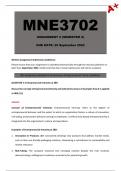
,MNE3702 Assignment 2 2025 - DUE 22 March 2025
;100 % TRUSTED workings, Expert Solved,
Explanations and Solutions.
MULTIPLE CHOICE,ASSURED EXCELLENCE
Question 1 MNE3702 Assignment 2 Describe the concept
entrepreneurial intensity and indicate by means of examples
how it is practiced at Dell. Question 2 (12) Today organizations
are confronted with dynamic, threatening, and complex
changes in the external environment, and have been forced to
adapt. There are four flexible rules which enhance a venture’s
chance of remaining adaptive and innovative, both through and
beyond the growth stage. Identify and explain each of these
rules and highlight how these rules relate to Dell. Question 3 (8)
Companies go through an organizational life cycle as they
evolve. Griener (1972) suggests that often, at some stage during
this cycle, companies lose their entrepreneurial way. Identify
the fifth and final stage of Griener’s Organisational Life Cycle
Process. Describe this stage and indicate what changes must be
made by Dell to ensure a continued existence of the company.
Question 4 (5) Step II (two) of the Entrepreneurial Health Audit
is Diagnosing the Climate for Corporate Entrepreneurship.
During this step, a Corporate Entrepreneurship Climate
Instrument (CECI) is used. Describe five key antecedents the
CECI is designed around. 5 (5) MNE3702 Assignment 2
Entrepreneurial imperatives are those aspects of strategic
, leadership that are inherently entrepreneurial in that they
relate to the recognition and/or exploitation of opportunity.
Discuss five entrepreneurial imperatives of executive
management at Dell (5) and indicate (5) how the executives are
tasked with this. Question 6 (10) Briefly explain what external
challenges Dell is likely to face in their core Human Resources
(HR) function. (10) [TOTAL: 50] © UNISA 2025
Table of Contents
1. Introduction
2. Entrepreneurial Intensity at Dell
3. Four Flexible Rules for Adaptation and Innovation
4. The Fifth and Final Stage of Griener’s Organisational Life
Cycle Process
5. Diagnosing the Climate for Corporate Entrepreneurship
6. Entrepreneurial Imperatives of Executive Management at
Dell
7. External Challenges in Dell’s HR Function
8. Conclusion
9. References
Introduction
;100 % TRUSTED workings, Expert Solved,
Explanations and Solutions.
MULTIPLE CHOICE,ASSURED EXCELLENCE
Question 1 MNE3702 Assignment 2 Describe the concept
entrepreneurial intensity and indicate by means of examples
how it is practiced at Dell. Question 2 (12) Today organizations
are confronted with dynamic, threatening, and complex
changes in the external environment, and have been forced to
adapt. There are four flexible rules which enhance a venture’s
chance of remaining adaptive and innovative, both through and
beyond the growth stage. Identify and explain each of these
rules and highlight how these rules relate to Dell. Question 3 (8)
Companies go through an organizational life cycle as they
evolve. Griener (1972) suggests that often, at some stage during
this cycle, companies lose their entrepreneurial way. Identify
the fifth and final stage of Griener’s Organisational Life Cycle
Process. Describe this stage and indicate what changes must be
made by Dell to ensure a continued existence of the company.
Question 4 (5) Step II (two) of the Entrepreneurial Health Audit
is Diagnosing the Climate for Corporate Entrepreneurship.
During this step, a Corporate Entrepreneurship Climate
Instrument (CECI) is used. Describe five key antecedents the
CECI is designed around. 5 (5) MNE3702 Assignment 2
Entrepreneurial imperatives are those aspects of strategic
, leadership that are inherently entrepreneurial in that they
relate to the recognition and/or exploitation of opportunity.
Discuss five entrepreneurial imperatives of executive
management at Dell (5) and indicate (5) how the executives are
tasked with this. Question 6 (10) Briefly explain what external
challenges Dell is likely to face in their core Human Resources
(HR) function. (10) [TOTAL: 50] © UNISA 2025
Table of Contents
1. Introduction
2. Entrepreneurial Intensity at Dell
3. Four Flexible Rules for Adaptation and Innovation
4. The Fifth and Final Stage of Griener’s Organisational Life
Cycle Process
5. Diagnosing the Climate for Corporate Entrepreneurship
6. Entrepreneurial Imperatives of Executive Management at
Dell
7. External Challenges in Dell’s HR Function
8. Conclusion
9. References
Introduction