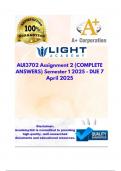
,AUI3702 Assignment 2 (COMPLETE ANSWERS) Semester
1 2025 - DUE 7 April 2025; 100% TRUSTED Complete,
trusted solutions and explanations…
ALL QUESTIONS ANSWERED CORRECTLY
QUESTION 1 15 MARKS
The chief audit executive (CAE) decided that, while you are
busy assisting the procurement department, you may as well
perform the assurance audit of the procurement function
originally scheduled for later in the year.
After identifying the risks, you have compiled the following
audit objectives to include in your audit programme.
I .Validity: To determine that only valid purchases are recorded.
II. Completeness: To determine that all the goods received from
suppliers are recorded as purchases in the purchase journal.
III..Valuation: To determine that the liability in respect of credit
purchases is recorded at the correct value.
IV Cut-off: To determine that purchases accounted for in the
current period relate only to goods received in the current
period.
REQUIRED MARKS
1.1 List six (6) planning steps you would need to undertake to
properly plan the internal audit of the procurement cycle.(3)
1. Understand the Procurement Process:
, Objective: Gain a comprehensive understanding of the
procurement cycle, including the policies, procedures, and
controls in place.
Actions: Review procurement documents, such as purchase
orders, contracts, goods receipt notes, supplier invoices,
and payment records. Interview key personnel involved in
procurement and purchasing to identify the key controls
and risk areas.
2. Identify and Assess Risks:
Objective: Identify and assess the risks associated with the
procurement cycle to focus on areas that are vulnerable to
fraud, errors, or inefficiencies.
Actions: Perform a risk assessment to identify risks in
areas such as supplier selection, purchase order accuracy,
receiving goods, and invoice matching. Consider both
financial and operational risks. Evaluate the likelihood and
impact of these risks.
3. Set Clear Audit Objectives:
Objective: Define the specific audit objectives to be
achieved in the audit process. This ensures the audit is
focused and aligned with the overall organizational goals.
Actions: Based on your understanding of the procurement
process and the identified risks, draft clear audit objectives
(e.g., validity, completeness, valuation, and cut-off, as
listed in the question). These objectives will guide your
audit tests.
4. Define the Scope of the Audit:
1 2025 - DUE 7 April 2025; 100% TRUSTED Complete,
trusted solutions and explanations…
ALL QUESTIONS ANSWERED CORRECTLY
QUESTION 1 15 MARKS
The chief audit executive (CAE) decided that, while you are
busy assisting the procurement department, you may as well
perform the assurance audit of the procurement function
originally scheduled for later in the year.
After identifying the risks, you have compiled the following
audit objectives to include in your audit programme.
I .Validity: To determine that only valid purchases are recorded.
II. Completeness: To determine that all the goods received from
suppliers are recorded as purchases in the purchase journal.
III..Valuation: To determine that the liability in respect of credit
purchases is recorded at the correct value.
IV Cut-off: To determine that purchases accounted for in the
current period relate only to goods received in the current
period.
REQUIRED MARKS
1.1 List six (6) planning steps you would need to undertake to
properly plan the internal audit of the procurement cycle.(3)
1. Understand the Procurement Process:
, Objective: Gain a comprehensive understanding of the
procurement cycle, including the policies, procedures, and
controls in place.
Actions: Review procurement documents, such as purchase
orders, contracts, goods receipt notes, supplier invoices,
and payment records. Interview key personnel involved in
procurement and purchasing to identify the key controls
and risk areas.
2. Identify and Assess Risks:
Objective: Identify and assess the risks associated with the
procurement cycle to focus on areas that are vulnerable to
fraud, errors, or inefficiencies.
Actions: Perform a risk assessment to identify risks in
areas such as supplier selection, purchase order accuracy,
receiving goods, and invoice matching. Consider both
financial and operational risks. Evaluate the likelihood and
impact of these risks.
3. Set Clear Audit Objectives:
Objective: Define the specific audit objectives to be
achieved in the audit process. This ensures the audit is
focused and aligned with the overall organizational goals.
Actions: Based on your understanding of the procurement
process and the identified risks, draft clear audit objectives
(e.g., validity, completeness, valuation, and cut-off, as
listed in the question). These objectives will guide your
audit tests.
4. Define the Scope of the Audit: