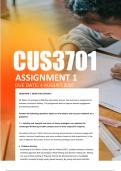
CUS3701
ASSIGNMENT 1
DUE DATE: 4 AUGUST 2025
,QUESTION 1: READ THE EXTRACT
Mr Metsi, the principal of Mabotse Secondary School, has launched a programme to
enhance curriculum delivery. The programme aims to improve learner engagement
and learning outcomes.
Mr Moeng, the physical science teacher, noticed that his learners struggled to engage
during practical experiments. He welcomed the initiative hoping that integrating new
teaching strategies could make physical science more accessible and comprehendible.
This was supported by Mrs Lebepe, the English teacher who cited that learners
struggle to analyse literature, affecting their comprehension and performance.
After attending the professional development workshop, all teachers at the school
were encouraged to implement the teaching methods that are fit for their respective
subjects to improve curriculum delivery.
Mr Moeng and Mrs Lebepe decided on the following methods:
• Problem Solving.
• Flipped classroom.
• Simulation.
Answer the following questions based on the extract and use your textbook as a
guideline:
1.1. Identify and analyse how each of these strategies can address the
challenges Mr Moeng and Mrs Lebepe faced in their respective subjects.
According to Bruner (1962), discovery learning allows learners to actively engage with
content, construct hypotheses, and solve problems based on their experiences. In the
case of Mabotse Secondary School, the following strategies were selected:
Problem-Solving
According to Du Plessis, Conley, and Du Plessis (2007), problem-solving is a learner-
centered approach that encourages critical thinking and decision-making. Mr. Moeng
can use problem-solving in Physical Science by allowing learners to investigate
scientific concepts through inquiry-based learning. By posing real-world scientific
, problems, learners develop analytical skills, which can improve their engagement
during practical experiments.
In English, problem-solving can help learners analyze literature more effectively.
According to Bruner (1966), learning is most effective when learners discover
knowledge on their own. Mrs. Lebepe can encourage learners to analyze literary
texts by guiding them through structured questioning and inference-making
exercises.
Flipped Classroom
According to Pouezevara (2010), flipped classrooms use digital tools to shift direct
instruction outside the classroom, allowing for more interactive learning during class
time. Mr. Moeng can provide video tutorials on scientific experiments before
lessons, ensuring that class time is dedicated to hands-on practical work. This
approach enables learners to revisit the material at their own pace, enhancing
comprehension.
In English, Mrs. Lebepe can provide learners with recorded explanations of literary
texts, summaries, and analytical frameworks before the lesson. This will allow
classroom discussions to focus on deeper textual analysis rather than basic
comprehension, improving learners' performance in literature.
Simulation
According to Maley (1997), simulations create a structured, problem-based
environment where learners apply their knowledge to real-world situations. Mr.
Moeng can use virtual lab simulations to replicate complex scientific experiments
that may not be feasible in a physical classroom. This approach allows learners to
manipulate variables and observe outcomes, making concepts more tangible.
ASSIGNMENT 1
DUE DATE: 4 AUGUST 2025
,QUESTION 1: READ THE EXTRACT
Mr Metsi, the principal of Mabotse Secondary School, has launched a programme to
enhance curriculum delivery. The programme aims to improve learner engagement
and learning outcomes.
Mr Moeng, the physical science teacher, noticed that his learners struggled to engage
during practical experiments. He welcomed the initiative hoping that integrating new
teaching strategies could make physical science more accessible and comprehendible.
This was supported by Mrs Lebepe, the English teacher who cited that learners
struggle to analyse literature, affecting their comprehension and performance.
After attending the professional development workshop, all teachers at the school
were encouraged to implement the teaching methods that are fit for their respective
subjects to improve curriculum delivery.
Mr Moeng and Mrs Lebepe decided on the following methods:
• Problem Solving.
• Flipped classroom.
• Simulation.
Answer the following questions based on the extract and use your textbook as a
guideline:
1.1. Identify and analyse how each of these strategies can address the
challenges Mr Moeng and Mrs Lebepe faced in their respective subjects.
According to Bruner (1962), discovery learning allows learners to actively engage with
content, construct hypotheses, and solve problems based on their experiences. In the
case of Mabotse Secondary School, the following strategies were selected:
Problem-Solving
According to Du Plessis, Conley, and Du Plessis (2007), problem-solving is a learner-
centered approach that encourages critical thinking and decision-making. Mr. Moeng
can use problem-solving in Physical Science by allowing learners to investigate
scientific concepts through inquiry-based learning. By posing real-world scientific
, problems, learners develop analytical skills, which can improve their engagement
during practical experiments.
In English, problem-solving can help learners analyze literature more effectively.
According to Bruner (1966), learning is most effective when learners discover
knowledge on their own. Mrs. Lebepe can encourage learners to analyze literary
texts by guiding them through structured questioning and inference-making
exercises.
Flipped Classroom
According to Pouezevara (2010), flipped classrooms use digital tools to shift direct
instruction outside the classroom, allowing for more interactive learning during class
time. Mr. Moeng can provide video tutorials on scientific experiments before
lessons, ensuring that class time is dedicated to hands-on practical work. This
approach enables learners to revisit the material at their own pace, enhancing
comprehension.
In English, Mrs. Lebepe can provide learners with recorded explanations of literary
texts, summaries, and analytical frameworks before the lesson. This will allow
classroom discussions to focus on deeper textual analysis rather than basic
comprehension, improving learners' performance in literature.
Simulation
According to Maley (1997), simulations create a structured, problem-based
environment where learners apply their knowledge to real-world situations. Mr.
Moeng can use virtual lab simulations to replicate complex scientific experiments
that may not be feasible in a physical classroom. This approach allows learners to
manipulate variables and observe outcomes, making concepts more tangible.