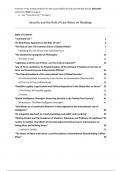
Summary of the reading materials for the course (2025) Security and the Rule of Law. INCLUDES
notes from (Total: 61 pages):
● See * Summary List * on page 1.
Security and the Rule of Law Notes on Readings
Table of Contents
* Summary List * 1
“An Elementary Approach to the Rule of Law” 2
“The Rule of Law: The Common Sense of Global Politics” 7
4 Building the rule of law with a political focus 7
“The Stanford Encyclopedia of Philosophy” 11
The Rule of Law 11
“Legitimacy and the use of force: can the circle be squared?” 15
“Use of Force: Guidelines for Implementation of the UN Basic Principles on the Use of
Force and Firearms by Law Enforcement Officials” 21
“The Oxford Handbook of the International Law of Global Security” 25
22 Institutionalized Inhumanity: From Torture to Assassination (Mavronicola) 25
45 The Use of Force (Wilmshurst) 28
“Plausible Legality: Legal Culture and Political Imperative in the Global War on Terror” 32
1 The Politics of Plausible Legality 32
3 Torture 36
“Global Intelligence Oversight: Governing Security in the Twenty-First Century” 41
Introduction: The New Intelligence Oversight 41
“SolarWinds as a Constitutive Moment: A New Agenda for the International Law of
Intelligence” 44
“An integrated approach to crowd psychology and public order policing” 47
“Policing Protest and the Avoidance of Violence: Dilemmas and Problems of Legitimacy”52
“Justice in Conflict: The Effects of the International Criminal Court’s Interventions on
Ending Wars and Building Peace” 56
1 Justice in Conflict 56
“The Dance of Peace and Justice: Local Perceptions of International Peacebuilding in West
Africa” 59
, 1
* Summary List *
These notes include a summary of each of the following readings:
● Adriaan Bedner’s article (2010) “An Elementary Approach to the Rule of Law”.
● Christopher May’s chapter (2014) “4 Building the rule of law with a political focus” in the
book “The Rule of Law: The Common Sense of Global Politics”.
● Jeremy Waldron’s website article (2016) “The Rule of Law” in the “The Stanford Encyclopedia
of Philosophy”.
● Andrew Hurrell’s article (2005) “Legitimacy and the use of force: can the circle be squared?”.
● Amnesty International’s (2016) guidelines “Use of Force: Guidelines for Implementation of
the UN Basic Principles on the Use of Force and Firearms by Law Enforcement Officials”.
● Robin Geiß & Nils Melzer’s (eds.) (2021) “The Oxford Handbook of the International Law of
Global Security”, chapters 22 (Natasa Mavronicola) & 45 (Elizabeth Wilmshurst).
● Rebecca Sanders’ book (2018) “Plausible Legality: Legal Culture and Political Imperative in
the Global War on Terror”, chapters 1 & 3.
● Zachary K. Goldman & Samuel J. Rascoff’s book (2016) “Global Intelligence Oversight:
Governing Security in the Twenty-First Century”, introduction.
● Lubin’s website article (2020) “SolarWinds as a Constitutive Moment: A New Agenda for the
International Law of Intelligence”.
● Stephen Reicherm Clifford Stott, Patrick Cronin & Otto Adang’s article (2004) “An integrated
approach to crowd psychology and public order policing”.
● Jan Terpstra’s article (2006) “Policing Protest and the Avoidance of Violence: Dilemmas and
Problems of Legitimacy”.
● Mark Kersten’s book (2016) “Justice in Conflict: The Effects of the International Criminal
Court’s Interventions on Ending Wars and Building Peace”, chapter 1.
● Julia Leib & Samantha Ruppel’s article (2021) “The Dance of Peace and Justice: Local
Perceptions of International Peacebuilding in West Africa”.
, 2
“An Elementary Approach to the Rule of Law”
Dissecting Rule of Law Definitions
Rule of Law (RoL) (rechtsstaat, état de droit): Contested concept depending on the resolution of
contestable normative issues. Need for an analytically sound approach.
➔ 2 main functions = tend to conflict (i.e. states often feel that they need more unfettered
power than is actually good for them to ‘protect citizens from one another’):
1. Curb arbitrary & inequitable use of state power (i.e. protect citizens against the
state). The sovereign is bound by law (Plato & Aristotle)
2. Protect citizens’ property & lives from infringements or assaults by fellow citizens
(Enlightenment). Reasons to leave it in:
a. It is central to many of the current discussions concerning the RoL &
development.
b. Human rights have increasingly been used as a defining standard for
relations between citizens & their fellow-citizens (e.g. violence against
women).
➔ Competing definitions vary according to which instruments are best suited to attain an
optimum balance between limitations on state power & protecting citizens’ property & lives:
1. Which instruments offer the best guarantees to protect citizens against the state &
fellow citizens? Which connections exist between them?
2. Which of the 2 functions the RoL is supposed to serve should be prioritised if they
come into conflict? (e.g. protecting citizens vs. protecting privacy).
➔ Issues:
◆ Many donor agencies promoting RoL development pretend to promote something
that is ‘beyond politics’ (i.e. their version of the RoL is presented as a ‘universal
good’), while much of it actually is NOT.
◆ Some authoritarian regimes stretch the definition so far (i.e. dismiss central RoL
components, BUT claim that they adhere to the RoL doctrine in its entirety).
➔ Dissecting RoL into elements = approaches to achieve a more systematic classification:
1. Formal vs. substantive versions of the RoL.
● Formal: Concerned with law as an instrument & a basis of government
(Greek tradition), BUT are silent on what the law should regulate.
● Substantive: Set standards to the contents of a norm, which should be
morally justified (Lockean fundamental rights approach).
2. RoL definitions range from restricted (thin) to elaborate, adding onto thin definitions
(thick).
3. Distinguishing between means & ends of the RoL (Kleinfeld).
● Take the ends as the distinguishing feature.
● There are 5 ends = government bound by law, equality before the law, law &
order, predictable & effi-cient justice, & lack of state violation of human
rights.
4. Bedner’s model = ‘elementary RoL model’ building on the ‘formal-substantive’
distinction & the ‘thin-thick’ continuum. Consist of 3 steps:
a. Heuristic determining which elements are part of it (according to literature).
, 3
b. Classify the elements into 3 well-known categories (formal & substantive
elements, & controlling mechanisms).
c. Adding questions to each element (partly of a legal nature & partly
empirical) & distinguishing between a norm & fact.
i. A state NOT following its own rules ≠ RoL law state.
ii. Citizens generally obey the law for the RoL to be in place.
Categories
1. Procedural Elements
I. Rule by Law: Concerned with the mode of governing & its legality (i.e. the rule of laws). The
ultimate foundation of any attempt at curbing the exercise of state power & the first step
towards legitimacy based on rational legal government.
➔ Law(s) should be:
a. Understood as general rules (NOT as individual, arbitrary decrees). A state
subverts this element if it acts without any legal basis (i.e. undermining its
own general rules by deploying individual decrees).
b. General in its content (critiques regimes that use ‘rule by exception’), which
is indispensable for governing over larger numbers of people (i.e. create
clarity & stability where self-regulation is NOT wanted or overruled).
c. Known.
➔ Demands a minimum degree of equality before the law, unlike:
◆ Rule by Men: Carries the connotation of arbitrariness.
◆ Rule of Law: Conveying a rather negative meaning on rule by law, suggesting
that the state has law at its disposal as a powerful weapon without being
subject to any restraint it inherently imposes.
➔ Any form of centralised authority will know a certain degree of rule by law.
II. State Actions are Subject to Law: Common core requiring legality & demands that the
government obey its own rules (Rechtsstaat).
➔ Legality: A legal basis for every government to act. Can be rendered meaningless if
this legal basis lacks specificity. Dangers include:
a. Freies Ermessen: Attributes the government scope to freely determine its
policies without having to account for them in any legal manner. Creates the
danger that the government will act in an arbitrary manner.
a. Open Concepts: Can be filled by the government according to its own wishes
& preferences (e.g. ‘common good’).
b. Retroactive Laws: Legality can also be subverted by the state by introducing
laws retroactively. Resembles the ‘rule by exception’ in that it provides a
legal justification of state behaviour where the state acted without a basis in
law.
c. Vigilantism: Involves the situations where state officials themselves act
without a legal basis or where the state uses ‘ordinary citizens’ for this
purpose.
III. Formal legality: Law must be clear & certain in its content, accessible & predictable for the
subject, & general in its application. Provides the first direct link between the state-centred
RoL concept with the citizen-centred access to justice approach.
notes from (Total: 61 pages):
● See * Summary List * on page 1.
Security and the Rule of Law Notes on Readings
Table of Contents
* Summary List * 1
“An Elementary Approach to the Rule of Law” 2
“The Rule of Law: The Common Sense of Global Politics” 7
4 Building the rule of law with a political focus 7
“The Stanford Encyclopedia of Philosophy” 11
The Rule of Law 11
“Legitimacy and the use of force: can the circle be squared?” 15
“Use of Force: Guidelines for Implementation of the UN Basic Principles on the Use of
Force and Firearms by Law Enforcement Officials” 21
“The Oxford Handbook of the International Law of Global Security” 25
22 Institutionalized Inhumanity: From Torture to Assassination (Mavronicola) 25
45 The Use of Force (Wilmshurst) 28
“Plausible Legality: Legal Culture and Political Imperative in the Global War on Terror” 32
1 The Politics of Plausible Legality 32
3 Torture 36
“Global Intelligence Oversight: Governing Security in the Twenty-First Century” 41
Introduction: The New Intelligence Oversight 41
“SolarWinds as a Constitutive Moment: A New Agenda for the International Law of
Intelligence” 44
“An integrated approach to crowd psychology and public order policing” 47
“Policing Protest and the Avoidance of Violence: Dilemmas and Problems of Legitimacy”52
“Justice in Conflict: The Effects of the International Criminal Court’s Interventions on
Ending Wars and Building Peace” 56
1 Justice in Conflict 56
“The Dance of Peace and Justice: Local Perceptions of International Peacebuilding in West
Africa” 59
, 1
* Summary List *
These notes include a summary of each of the following readings:
● Adriaan Bedner’s article (2010) “An Elementary Approach to the Rule of Law”.
● Christopher May’s chapter (2014) “4 Building the rule of law with a political focus” in the
book “The Rule of Law: The Common Sense of Global Politics”.
● Jeremy Waldron’s website article (2016) “The Rule of Law” in the “The Stanford Encyclopedia
of Philosophy”.
● Andrew Hurrell’s article (2005) “Legitimacy and the use of force: can the circle be squared?”.
● Amnesty International’s (2016) guidelines “Use of Force: Guidelines for Implementation of
the UN Basic Principles on the Use of Force and Firearms by Law Enforcement Officials”.
● Robin Geiß & Nils Melzer’s (eds.) (2021) “The Oxford Handbook of the International Law of
Global Security”, chapters 22 (Natasa Mavronicola) & 45 (Elizabeth Wilmshurst).
● Rebecca Sanders’ book (2018) “Plausible Legality: Legal Culture and Political Imperative in
the Global War on Terror”, chapters 1 & 3.
● Zachary K. Goldman & Samuel J. Rascoff’s book (2016) “Global Intelligence Oversight:
Governing Security in the Twenty-First Century”, introduction.
● Lubin’s website article (2020) “SolarWinds as a Constitutive Moment: A New Agenda for the
International Law of Intelligence”.
● Stephen Reicherm Clifford Stott, Patrick Cronin & Otto Adang’s article (2004) “An integrated
approach to crowd psychology and public order policing”.
● Jan Terpstra’s article (2006) “Policing Protest and the Avoidance of Violence: Dilemmas and
Problems of Legitimacy”.
● Mark Kersten’s book (2016) “Justice in Conflict: The Effects of the International Criminal
Court’s Interventions on Ending Wars and Building Peace”, chapter 1.
● Julia Leib & Samantha Ruppel’s article (2021) “The Dance of Peace and Justice: Local
Perceptions of International Peacebuilding in West Africa”.
, 2
“An Elementary Approach to the Rule of Law”
Dissecting Rule of Law Definitions
Rule of Law (RoL) (rechtsstaat, état de droit): Contested concept depending on the resolution of
contestable normative issues. Need for an analytically sound approach.
➔ 2 main functions = tend to conflict (i.e. states often feel that they need more unfettered
power than is actually good for them to ‘protect citizens from one another’):
1. Curb arbitrary & inequitable use of state power (i.e. protect citizens against the
state). The sovereign is bound by law (Plato & Aristotle)
2. Protect citizens’ property & lives from infringements or assaults by fellow citizens
(Enlightenment). Reasons to leave it in:
a. It is central to many of the current discussions concerning the RoL &
development.
b. Human rights have increasingly been used as a defining standard for
relations between citizens & their fellow-citizens (e.g. violence against
women).
➔ Competing definitions vary according to which instruments are best suited to attain an
optimum balance between limitations on state power & protecting citizens’ property & lives:
1. Which instruments offer the best guarantees to protect citizens against the state &
fellow citizens? Which connections exist between them?
2. Which of the 2 functions the RoL is supposed to serve should be prioritised if they
come into conflict? (e.g. protecting citizens vs. protecting privacy).
➔ Issues:
◆ Many donor agencies promoting RoL development pretend to promote something
that is ‘beyond politics’ (i.e. their version of the RoL is presented as a ‘universal
good’), while much of it actually is NOT.
◆ Some authoritarian regimes stretch the definition so far (i.e. dismiss central RoL
components, BUT claim that they adhere to the RoL doctrine in its entirety).
➔ Dissecting RoL into elements = approaches to achieve a more systematic classification:
1. Formal vs. substantive versions of the RoL.
● Formal: Concerned with law as an instrument & a basis of government
(Greek tradition), BUT are silent on what the law should regulate.
● Substantive: Set standards to the contents of a norm, which should be
morally justified (Lockean fundamental rights approach).
2. RoL definitions range from restricted (thin) to elaborate, adding onto thin definitions
(thick).
3. Distinguishing between means & ends of the RoL (Kleinfeld).
● Take the ends as the distinguishing feature.
● There are 5 ends = government bound by law, equality before the law, law &
order, predictable & effi-cient justice, & lack of state violation of human
rights.
4. Bedner’s model = ‘elementary RoL model’ building on the ‘formal-substantive’
distinction & the ‘thin-thick’ continuum. Consist of 3 steps:
a. Heuristic determining which elements are part of it (according to literature).
, 3
b. Classify the elements into 3 well-known categories (formal & substantive
elements, & controlling mechanisms).
c. Adding questions to each element (partly of a legal nature & partly
empirical) & distinguishing between a norm & fact.
i. A state NOT following its own rules ≠ RoL law state.
ii. Citizens generally obey the law for the RoL to be in place.
Categories
1. Procedural Elements
I. Rule by Law: Concerned with the mode of governing & its legality (i.e. the rule of laws). The
ultimate foundation of any attempt at curbing the exercise of state power & the first step
towards legitimacy based on rational legal government.
➔ Law(s) should be:
a. Understood as general rules (NOT as individual, arbitrary decrees). A state
subverts this element if it acts without any legal basis (i.e. undermining its
own general rules by deploying individual decrees).
b. General in its content (critiques regimes that use ‘rule by exception’), which
is indispensable for governing over larger numbers of people (i.e. create
clarity & stability where self-regulation is NOT wanted or overruled).
c. Known.
➔ Demands a minimum degree of equality before the law, unlike:
◆ Rule by Men: Carries the connotation of arbitrariness.
◆ Rule of Law: Conveying a rather negative meaning on rule by law, suggesting
that the state has law at its disposal as a powerful weapon without being
subject to any restraint it inherently imposes.
➔ Any form of centralised authority will know a certain degree of rule by law.
II. State Actions are Subject to Law: Common core requiring legality & demands that the
government obey its own rules (Rechtsstaat).
➔ Legality: A legal basis for every government to act. Can be rendered meaningless if
this legal basis lacks specificity. Dangers include:
a. Freies Ermessen: Attributes the government scope to freely determine its
policies without having to account for them in any legal manner. Creates the
danger that the government will act in an arbitrary manner.
a. Open Concepts: Can be filled by the government according to its own wishes
& preferences (e.g. ‘common good’).
b. Retroactive Laws: Legality can also be subverted by the state by introducing
laws retroactively. Resembles the ‘rule by exception’ in that it provides a
legal justification of state behaviour where the state acted without a basis in
law.
c. Vigilantism: Involves the situations where state officials themselves act
without a legal basis or where the state uses ‘ordinary citizens’ for this
purpose.
III. Formal legality: Law must be clear & certain in its content, accessible & predictable for the
subject, & general in its application. Provides the first direct link between the state-centred
RoL concept with the citizen-centred access to justice approach.