©BRIGHTSTARS 2025 ALL RIGHTS RESERVED 11:22 AM A+
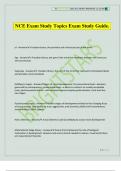
NCE Exam Prep Study Guide 100%
Verified.
Freud's Stages of Psychosexual Development - Answer✔Oral Anal Phallic Latency, Genital
Erikson's First Stage (Birth to 18 Months) - Answer✔Trust vs Mistrust (Hope)
Erikson's Second Stage (1-3) - Answer✔Autonomy vs Shame/Doubt (Will)
Erikson's Third Stage (3-6) - Answer✔Initiative vs Guilt (Purpose)
Erikson's Fourth Stage (7-11) - Answer✔Industry vs Inferiority (Competence)
Erikson's Fifth Stage (12-18) - Answer✔Identity vs Role Confusion (Fidelity)
Erikson's Sixth Stage (19-29) - Answer✔Intimacy vs Isolation (Love)
Erikson's Seventh Stage (30-64) - Answer✔Generativity vs Stagnation (Care)
Erikson's Eighth Stage (65-Death) - Answer✔Integrity vs Despair (Wisdom)
1|P a g e
, ©BRIGHTSTARS 2025 ALL RIGHTS RESERVED 11:22 AM A+
Ego Psychology - Answer✔Believes in man's power to reason and control behavior
Behaviorism - Answer✔the science of behavior that focuses on observable behavior only; man
is slave to his impulses
Erik Erikson - Answer✔The most influential developmental theorist of all time and a student of
Freud. Only theorist to create a developmental theory that covers the entire lifespan (Freud's
ended at 12)
Epigenesis - Answer✔The theory that physical and behavioral characteristics arise from an
interaction between genetic and environmental influences, rather than one over the other. The
middle ground of the nature vs nurture debate.
Jay Haley - Answer✔His work includes strategic and problem solving therapy; often uses
paradox.
Arnold Lazarus - Answer✔Pioneer in behavior therapy movement, especially in systematic
desensitization. Associated with multimodal therapy.
William G. Perry - Answer✔Known for his ideas related to adult cognitive development;
especially regarding college students and stresses the concept of dualistic thinking (black and
white thinking)
Robert Kegan - Answer✔Developed constructive developmental theory (CDT) and defined five
stages of mental complexity (orders of mind): Impulsive Mind, Instrumental Mind, Socialized
Mind, Self-Authoring Mind, and Self-Transforming Mind. Uses an underlying structure of
meaning-making based on objects and what we are subject to.
Piaget's Stages of Development - Answer✔Sensorimotor, Preoperational, Concrete Operational,
Formal Operational
2|P a g e
, ©BRIGHTSTARS 2025 ALL RIGHTS RESERVED 11:22 AM A+
Idiographic Approach vs Nomothetic Approach - Answer✔IA examines individuals in depth
while NA examines large groups of people to generalize to the population
Criticism of Piaget's Theory - Answer✔His findings were often built on observations of only his
own children
Alfred Binet - Answer✔Created first intelligence test for Parisian school children
Conservation (according to Piaget) - Answer✔A substance's characteristics can stay the same
even if the shape changes. Mastered around 7-11, during concrete ops
Symbolic Schema - Answer✔A schema is a system where the child tests out things in the
physical world. An example of a symbolic schema is when a child uses a pie plate as a steering
wheel (because it fits into the schema they have created for "Steering Wheel") This occurs in
the Preoperational Stage.
Lawrence Kohlberg - Answer✔Expanded on Piaget's concept of moral development. Used
stories to determine a child's level of moral development.
Lev Vygotsky - Answer✔child development; investigated how culture & interpersonal
communication guide development; zone of proximal development; play research
John B. Watson - Answer✔Father of behaviorism and coined the term in 1912
Reversibility (according to Piaget) - Answer✔The principle that actions, once done, can be
undone. For example, a glass of water poured into a differently shaped glass can regain its
shape. Mastered in concrete ops.
Egocentrism (Piaget's Theory) - Answer✔A child's inability to see the world from any viewpoint
other than his own. Present in the preoperational stage.
3|P a g e
, ©BRIGHTSTARS 2025 ALL RIGHTS RESERVED 11:22 AM A+
Kohlberg's Stages of Moral Development - Answer✔Pre-conventional, conventional, post-
conventional
The Heinz Dilemma - Answer✔A woman is dying and needs an expensive medication. Husband
cannot afford the medication, should he steal it or should she die? Used by Kohlberg to
evaluate one's level of moral development
Identity Crisis (Erikson) - Answer✔state of emotional turmoil that arises when and adolescent's
sense of self becomes 'unglued' to achieve a new, more mature sense of self; the stage also
involves more identification with peers
RS Involvement - Answer✔'Religious and spiritual'
Positive Psychology - Answer✔the scientific study of optimal human functioning; aims to
discover and promote strengths and virtues that enable individuals and communities to thrive.
Coined by Abraham Maslow and popularized by Martin Seligman.
Preconventional Morality - Answer✔first level of Kohlberg's stages of moral development in
which the child's behavior is governed by the consequences of the behavior. Ages 3-7. (1)
Reward/Punishment Motivated and (2) Self-Interest
Conventional Morality - Answer✔second level of Kohlberg's stages of moral development in
which the child's behavior is governed by conforming to the society's norms of behavior. Ages
8-13. (1) Pleasing Others and (2) Law and Order
Postconventional Morality - Answer✔third level of Kohlberg's stages of moral development in
which the person's behavior is governed by moral principles that have been decided on by the
individual and that may be in disagreement with accepted social norms. Adulthood. (1) Social
Contract and (2) Principle.
4|P a g e
NCE Exam Prep Study Guide 100%
Verified.
Freud's Stages of Psychosexual Development - Answer✔Oral Anal Phallic Latency, Genital
Erikson's First Stage (Birth to 18 Months) - Answer✔Trust vs Mistrust (Hope)
Erikson's Second Stage (1-3) - Answer✔Autonomy vs Shame/Doubt (Will)
Erikson's Third Stage (3-6) - Answer✔Initiative vs Guilt (Purpose)
Erikson's Fourth Stage (7-11) - Answer✔Industry vs Inferiority (Competence)
Erikson's Fifth Stage (12-18) - Answer✔Identity vs Role Confusion (Fidelity)
Erikson's Sixth Stage (19-29) - Answer✔Intimacy vs Isolation (Love)
Erikson's Seventh Stage (30-64) - Answer✔Generativity vs Stagnation (Care)
Erikson's Eighth Stage (65-Death) - Answer✔Integrity vs Despair (Wisdom)
1|P a g e
, ©BRIGHTSTARS 2025 ALL RIGHTS RESERVED 11:22 AM A+
Ego Psychology - Answer✔Believes in man's power to reason and control behavior
Behaviorism - Answer✔the science of behavior that focuses on observable behavior only; man
is slave to his impulses
Erik Erikson - Answer✔The most influential developmental theorist of all time and a student of
Freud. Only theorist to create a developmental theory that covers the entire lifespan (Freud's
ended at 12)
Epigenesis - Answer✔The theory that physical and behavioral characteristics arise from an
interaction between genetic and environmental influences, rather than one over the other. The
middle ground of the nature vs nurture debate.
Jay Haley - Answer✔His work includes strategic and problem solving therapy; often uses
paradox.
Arnold Lazarus - Answer✔Pioneer in behavior therapy movement, especially in systematic
desensitization. Associated with multimodal therapy.
William G. Perry - Answer✔Known for his ideas related to adult cognitive development;
especially regarding college students and stresses the concept of dualistic thinking (black and
white thinking)
Robert Kegan - Answer✔Developed constructive developmental theory (CDT) and defined five
stages of mental complexity (orders of mind): Impulsive Mind, Instrumental Mind, Socialized
Mind, Self-Authoring Mind, and Self-Transforming Mind. Uses an underlying structure of
meaning-making based on objects and what we are subject to.
Piaget's Stages of Development - Answer✔Sensorimotor, Preoperational, Concrete Operational,
Formal Operational
2|P a g e
, ©BRIGHTSTARS 2025 ALL RIGHTS RESERVED 11:22 AM A+
Idiographic Approach vs Nomothetic Approach - Answer✔IA examines individuals in depth
while NA examines large groups of people to generalize to the population
Criticism of Piaget's Theory - Answer✔His findings were often built on observations of only his
own children
Alfred Binet - Answer✔Created first intelligence test for Parisian school children
Conservation (according to Piaget) - Answer✔A substance's characteristics can stay the same
even if the shape changes. Mastered around 7-11, during concrete ops
Symbolic Schema - Answer✔A schema is a system where the child tests out things in the
physical world. An example of a symbolic schema is when a child uses a pie plate as a steering
wheel (because it fits into the schema they have created for "Steering Wheel") This occurs in
the Preoperational Stage.
Lawrence Kohlberg - Answer✔Expanded on Piaget's concept of moral development. Used
stories to determine a child's level of moral development.
Lev Vygotsky - Answer✔child development; investigated how culture & interpersonal
communication guide development; zone of proximal development; play research
John B. Watson - Answer✔Father of behaviorism and coined the term in 1912
Reversibility (according to Piaget) - Answer✔The principle that actions, once done, can be
undone. For example, a glass of water poured into a differently shaped glass can regain its
shape. Mastered in concrete ops.
Egocentrism (Piaget's Theory) - Answer✔A child's inability to see the world from any viewpoint
other than his own. Present in the preoperational stage.
3|P a g e
, ©BRIGHTSTARS 2025 ALL RIGHTS RESERVED 11:22 AM A+
Kohlberg's Stages of Moral Development - Answer✔Pre-conventional, conventional, post-
conventional
The Heinz Dilemma - Answer✔A woman is dying and needs an expensive medication. Husband
cannot afford the medication, should he steal it or should she die? Used by Kohlberg to
evaluate one's level of moral development
Identity Crisis (Erikson) - Answer✔state of emotional turmoil that arises when and adolescent's
sense of self becomes 'unglued' to achieve a new, more mature sense of self; the stage also
involves more identification with peers
RS Involvement - Answer✔'Religious and spiritual'
Positive Psychology - Answer✔the scientific study of optimal human functioning; aims to
discover and promote strengths and virtues that enable individuals and communities to thrive.
Coined by Abraham Maslow and popularized by Martin Seligman.
Preconventional Morality - Answer✔first level of Kohlberg's stages of moral development in
which the child's behavior is governed by the consequences of the behavior. Ages 3-7. (1)
Reward/Punishment Motivated and (2) Self-Interest
Conventional Morality - Answer✔second level of Kohlberg's stages of moral development in
which the child's behavior is governed by conforming to the society's norms of behavior. Ages
8-13. (1) Pleasing Others and (2) Law and Order
Postconventional Morality - Answer✔third level of Kohlberg's stages of moral development in
which the person's behavior is governed by moral principles that have been decided on by the
individual and that may be in disagreement with accepted social norms. Adulthood. (1) Social
Contract and (2) Principle.
4|P a g e